Hazard communication training and SDS access
CHST video lesson, 6:17. CHST Domain 4: Leadership, Communication, and Training
What HazCom training must cover, when it is due, and how SDSs must be kept accessible: the 16 sections, update timing, remote workers, and the traps CHST questions use.
Included with every pass, and free to watch with captions. Every rule and number is cited on screen to its primary source.
Transcript
0:00 Intro
Hazard communication training and SDS access, for the CHST exam. Every rule and number here is cited to its primary source, on screen.
0:10 Learning objectives
In this lesson, you'll learn to: state when hazard communication training is required, list what that training must include, recall the 16 SDS sections and the update timing rules, and apply the SDS access rules to real workplaces.
0:28 When training is required
The employer must provide effective information and training on hazardous chemicals in the employee's work area. First trigger: initial assignment. Second trigger: a new chemical hazard the employees haven't been trained about is introduced into the work area. Training may cover categories of hazards or specific chemicals, but chemical-specific information must always be available through labels and SDSs.
0:52 Information
Separate from training content, employees must be informed of three items. One: the requirements of the HazCom standard. Two: any operations in their work area where hazardous chemicals are present.
1:14 Training content
Three: the location and availability of the written program, the chemical list or lists, and the SDSs. Training must include at least four elements. Detection: methods and observations such as employer monitoring, continuous monitoring devices, or the look and odor of a release. Hazards: physical, health, simple asphyxiation, combustible dust, pyrophoric gas, and hazards not otherwise classified. Protection: work practices, emergency procedures, and PPE. Program: label explanation, workplace labeling, and the SDS, including its order of information and how to obtain and use the hazard information.
1:53 SDS format
The SDS must be in English, with 16 headings in a set order. Sections 1 through 4: identification, hazards, composition, first-aid. Sections 5 through 8: fire-fighting, release, handling, and exposure controls and PPE. Sections 9 through 11 are properties, stability, toxicology. Headings 12 through 15 must still appear, but OSHA doesn't enforce their information requirements.
2:26 Keeping the SDS current
Section 16 is other information. Whoever prepares the SDS must keep it accurate. Newly known significant hazard or protection information must be added within three months. If the chemical isn't currently produced or imported, add it before the chemical re-enters the workplace.
2:46 Who supplies SDSs
Mark empty sub-headings as having no information. Manufacturers and importers obtain or develop an SDS for each hazardous chemical. Employers need one in the workplace for each hazardous chemical they use. One goes with the initial shipment, and with the first shipment after an update.
3:11 Access
It travels with the containers, or arrives before or at shipment. If a labeled hazardous shipment arrives without one, obtain it as soon as possible. The employer keeps SDS copies in the workplace, readily accessible during each work shift to employees when they are in their work areas.
3:36 On the job
Electronic access is permitted if it creates no barriers to immediate access. For employees traveling between workplaces during a shift, SDSs may stay at the primary facility, but employees must be able to get them immediately in an emergency. You're the safety manager at a metal fabrication shop. A new solvent with a hazard your crew hasn't been trained on is headed for the paint area.
4:01 Common exam traps
First, confirm its SDS is in the workplace and readily accessible every shift, with no barriers. Next, train employees on the new hazard, including label and SDS use. Then make sure they know where the program, chemical list and SDSs are. Now, five traps that catch people on exam day. One: training is tied to initial assignment and new hazards, not an annual interval. Two: paper is not required. Electronic works if there are no barriers to immediate access.
4:39 Recap quiz
Three: SDSs may stay at the primary facility, but employees must be able to get them immediately in an emergency. Four: significant new information goes on the SDS within three months. Five: headings 12 through 15 must still appear, but OSHA doesn't enforce their information requirements. Question 1. When must HazCom training be provided to an employee? A: Only once a year. B: At initial assignment and when a new hazard is introduced. C: Only after an exposure incident. D: Only when OSHA requests it. B. Training is due at initial assignment and when a new chemical hazard is introduced. Question 2. A manufacturer learns significant new hazard information. By when must it be added to the SDS? A: 24 hours. B: 30 days. C: 6 months. D: Three months. D. Within three months of becoming newly aware. Question 3. Crews drive between sites each shift. The SDSs are at the main facility. What must the employer ensure? A: Employees can immediately get the information in an emergency. B: SDSs are mailed monthly. C: Each truck carries paper copies. D: Training replaces SDS access. A. SDSs may stay at the primary facility if employees can immediately get the information in an emergency. Want to see where you stand on every CHST domain? com.
More CHST lessons
 Confined space, steel erection and HAZWOPER trainingCHST lesson, 6:28CHST exam review of required training under 1926 Subpart AA, Subpart R and HAZWOPER: who trains, when retraining is required, the 40, 24 and 8 hour thresholds, and the records and certificates you must keep.
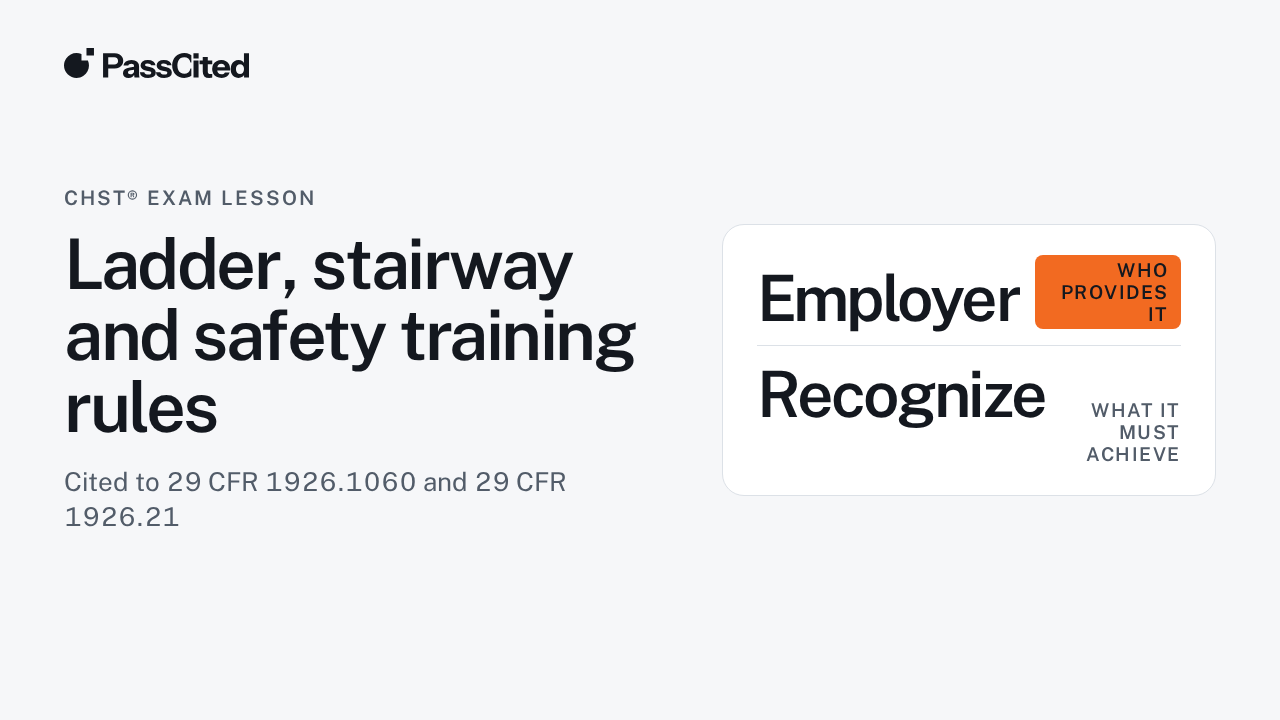 Ladder, stairway and safety training rulesCHST lesson, 6:09What 1926.1060 and 1926.21(b) require for ladder and stairway training: who trains, what the training covers, retraining, and the broader duty to instruct employees on hazards.
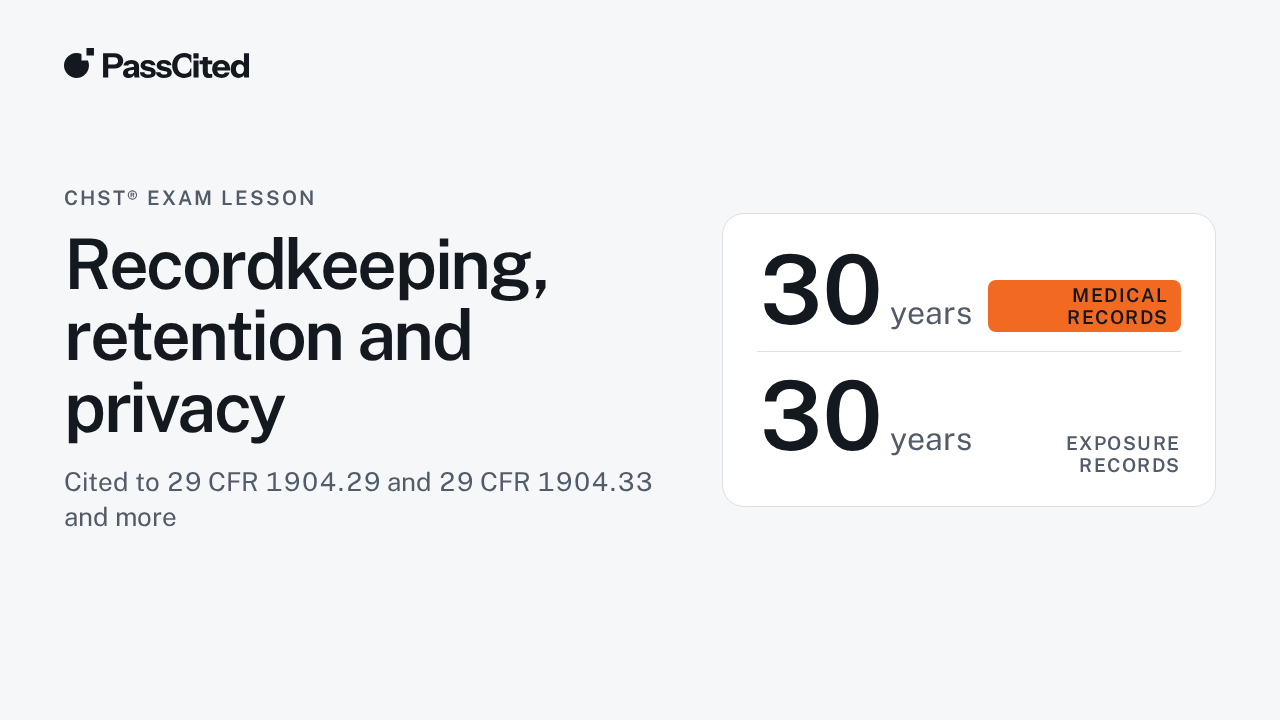 Recordkeeping, retention and privacyCHST lesson, 5:53OSHA 300, 300-A and 301 forms, five-year retention, privacy concern cases, and 1910.1020 exposure and medical record retention and access: the numbers and rules tested on the CHST exam.
See where you stand on the CHST
25 questions, free, no card. You get a readiness score for each CHST domain.
ASP®, CSP® and CHST® are registered marks of BCSP. PassCited is not affiliated with or endorsed by BCSP.