Heavy equipment and struck-by hazards
CHST video lesson, 7:02. CHST Domain 1: Hazard and Risk Identification and Control
CHST exam review of OSHA 1926.600-602: power line clearances, vehicle brakes, backup alarms, daily checks, blocking and chocking, seat belts and industrial truck rules, with the numbers cited.
Included with every pass, and free to watch with captions. Every rule and number is cited on screen to its primary source.
Transcript
0:00 Intro
Heavy equipment and struck-by hazards, for the CHST exam. Every rule and number here is cited to its primary source, on screen. In this lesson, you'll learn to: state the power line clearances for equipment, apply the backup alarm and observer rules, know the start-of-shift vehicle check and the parking and blocking rules, and apply the seat belt and industrial truck rules.
0:30 Power line clearance
600, equipment working near power lines has minimum clearances. For lines rated 50 kV or below, any part of the crane or load stays at least 10 feet away. 4 inch per kV over 50, or twice the insulator length, never under 10 feet. None of these clearance rules apply if the lines are deenergized and visibly grounded at point of work, or if insulating barriers not attached to the equipment are erected.
1:08 In transit
In transit with no load and the boom lowered, the minimums change. Under 50 kV: 4 feet. Over 50 kV up to 345 kV: 10 feet. Up to 750 kV: 16 feet. Any overhead wire is energized until the owner or utility says otherwise and it is visibly grounded. Where the operator can't easily keep clearance by sight, designate a person to watch and warn.
1:39 Backing up
Obstructed view to the rear triggers a requirement. Motor vehicles with an obstructed rear view need a reverse alarm audible above surrounding noise, or backing only when an observer signals it is safe.
2:03 Inspection
Earthmoving or compacting equipment: alarm distinguishable from surrounding noise, or an employee's signal. All vehicles in use are checked at the beginning of each shift. Brakes: service, parking, and emergency, including trailer brake connections. Tires, horn, steering, and coupling devices.
2:31 Parked and repaired
Seat belts, controls, safety devices, plus lights, wipers and extinguishers where necessary. Correct defects before service. Three rules cover equipment that is parked, left unattended, or being repaired. Whenever parked, set the parking brake. On inclines, chock the wheels and set the brake. Held aloft, equipment is blocked or cribbed before anyone works under or between it. Blades, buckets, dump bodies: fully lowered or blocked when repaired or not in use.
3:14 Operator protection
Controls neutral, motors stopped, brakes set, unless the work requires otherwise. Unattended at night near a highway in use or active work: lights, reflectors, or barricades with them. Earthmoving equipment needs seat belts, with two exceptions. Exceptions: stand-up-only equipment, or equipment without ROPS or adequate canopy. Motor vehicles need them always.
3:46 Industrial trucks
Haulers loaded by cranes, shovels, or loaders need a cab shield or canopy for the operator. Dump bodies need a permanently attached, lockable support during maintenance or inspection. Hoisting or dumping levers need a latch or other device. 602(c). Rated capacity must be clearly posted, visible to the operator, and not exceeded. No modifications affecting capacity or safe operation without the manufacturer's written approval.
4:29 Common exam traps
Unauthorized personnel may not ride. Trucks with elevatable controls for lifting personnel need a secured platform, a power shutoff for personnel, and falling-object protection as conditions require. 178(l). Now, six traps that catch people on exam day. One: a backup alarm is required only when the rear view is obstructed, and an observer's signal can substitute. Two: 10 feet is the working floor and grows over 50 kV. Only in transit, no load, boom lowered, is it 4 feet under 50 kV. Three: any overhead wire is energized until the owner or utility says it isn't and it is visibly grounded.
5:25 Recap quiz
Four: earthmoving belts aren't needed if stand-up-only or without ROPS or adequate canopy. Motor vehicles always need them. Five: on an incline, chock the wheels and set the parking brake. Six: unauthorized personnel may not ride powered industrial trucks. Question 1. A crane works near a 50 kV line. Minimum clearance for crane or load? A: 4 feet. B: 10 feet. C: 16 feet. D: 12 feet. B. Lines of 50 kV or below require 10 feet. Four feet applies only in transit, no load, boom lowered. Question 2. A dump truck has an obstructed rear view and no reverse alarm. What allows backing? A: Mirror. B: Observer's safe signal. C: Horn tap. D: Nothing. B. Backing is permitted only when an observer signals it is safe. Question 3. A loader is parked on an incline. What must be done? A: Lower the bucket only. B: Brake only. C: Chock wheels and set brake. D: Leave it in gear. C. On inclines, chock the wheels and set the parking brake. The bucket must also be fully lowered or blocked. Want to see where you stand on every CHST domain? com.
More CHST lessons
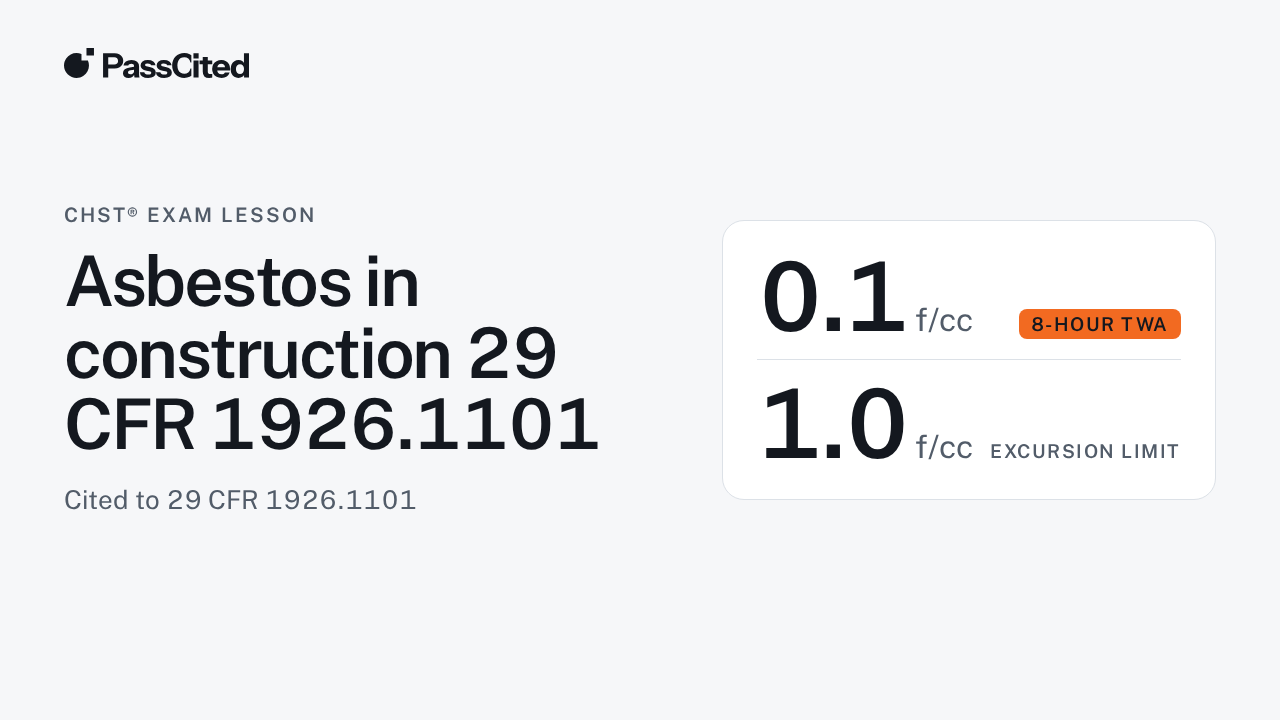 Asbestos in construction 29 CFR 1926.1101CHST lesson, 7:27Asbestos in construction under 29 CFR 1926.1101 for the CHST exam: PELs, work classes, competent person duties, regulated areas, monitoring, training hours and notification deadlines.
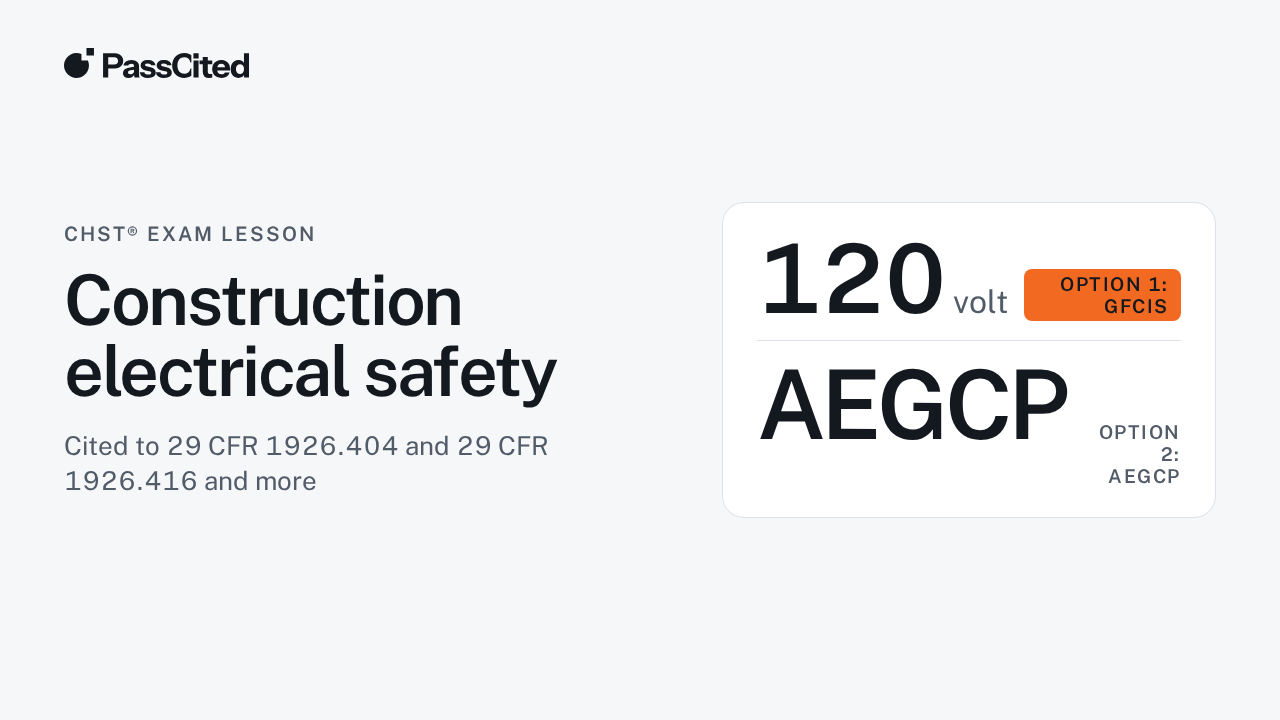 Construction electrical safetyCHST lesson, 7:05Construction electrical safety for the CHST exam: GFCI versus the assured grounding program, test intervals, overhead clearances, grounding distances, and lockout tagging under 1926 Subpart K.
 Cranes, hoisting and riggingCHST lesson, 7:22CHST review of crane power line clearances, operator duties, rated capacity checks, sling inspection and removal criteria, plus a worked sling tension example, cited to 29 CFR 1926.
See where you stand on the CHST
25 questions, free, no card. You get a readiness score for each CHST domain.
ASP®, CSP® and CHST® are registered marks of BCSP. PassCited is not affiliated with or endorsed by BCSP.