Rigging and sling angle calculations
CHST video lesson, 6:21. CHST Domain 1: Hazard and Risk Identification and Control
Calculate load angle factor and leg tension for a two-leg bridle at 60, 45 and 30 degrees, and see why only two legs count, why 30 degrees is the floor, and how choke angle cuts capacity.
Included with every CHST pass, with captions, chapters and the full transcript. Every rule and number is cited on screen to its primary source.
What this lesson covers
In this lesson, you'll learn to: calculate the load angle factor from sling length and height, find the tension in each leg of a two-leg bridle, explain why only two legs are assumed to carry the load, and state the 30 degree minimum and the choker capacity reductions. Sling angles multiply the stress on each leg. The tool is the load angle factor, or LAF. Start with the load at the pick point and the sling length.
- Intro
- Learning objectives
- The core idea
- Worked example
- Angle changes everything
- Worked example
- How many legs carry the load?
- Choker hitches
- Worked example
- On the job
- Common exam traps
- Recap quiz
The video, captions and full transcript are included with every CHST pass. See passes
More CHST lessons
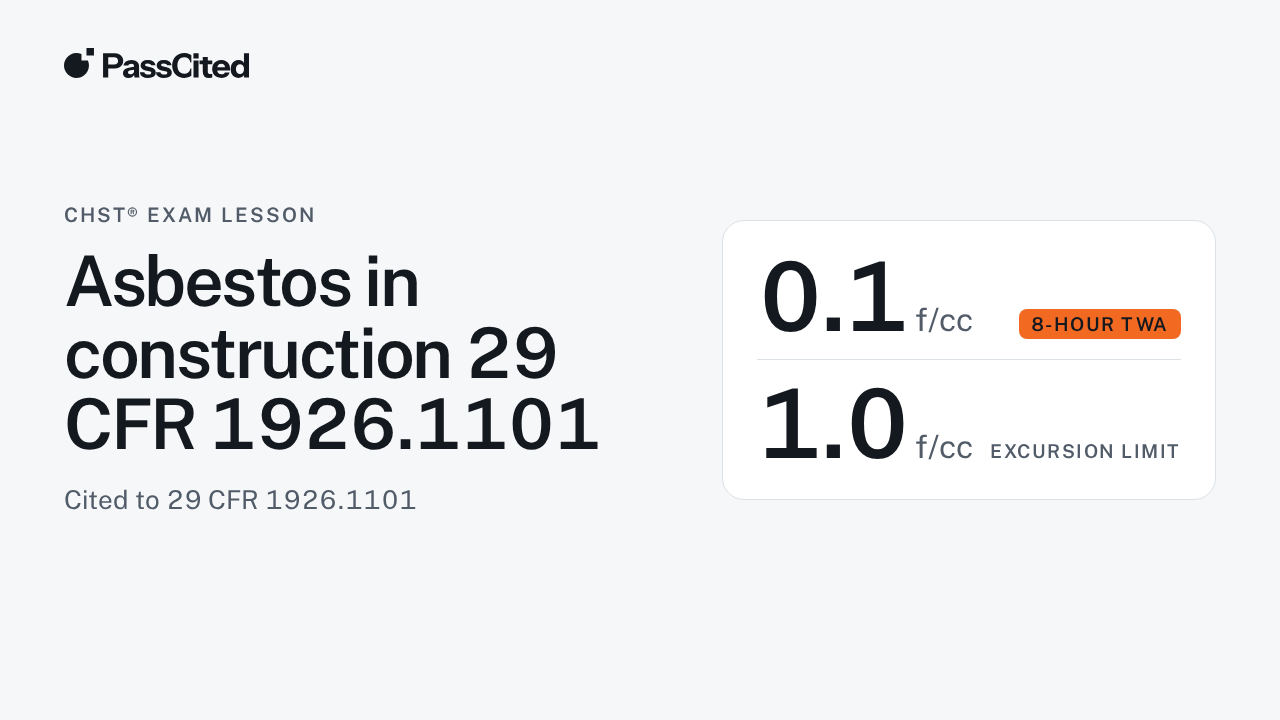 Asbestos in construction 29 CFR 1926.1101CHST lesson, 7:12Asbestos in construction under 29 CFR 1926.1101 for the CHST exam: PELs, work classes, competent person duties, regulated areas, monitoring, training hours and notification deadlines.
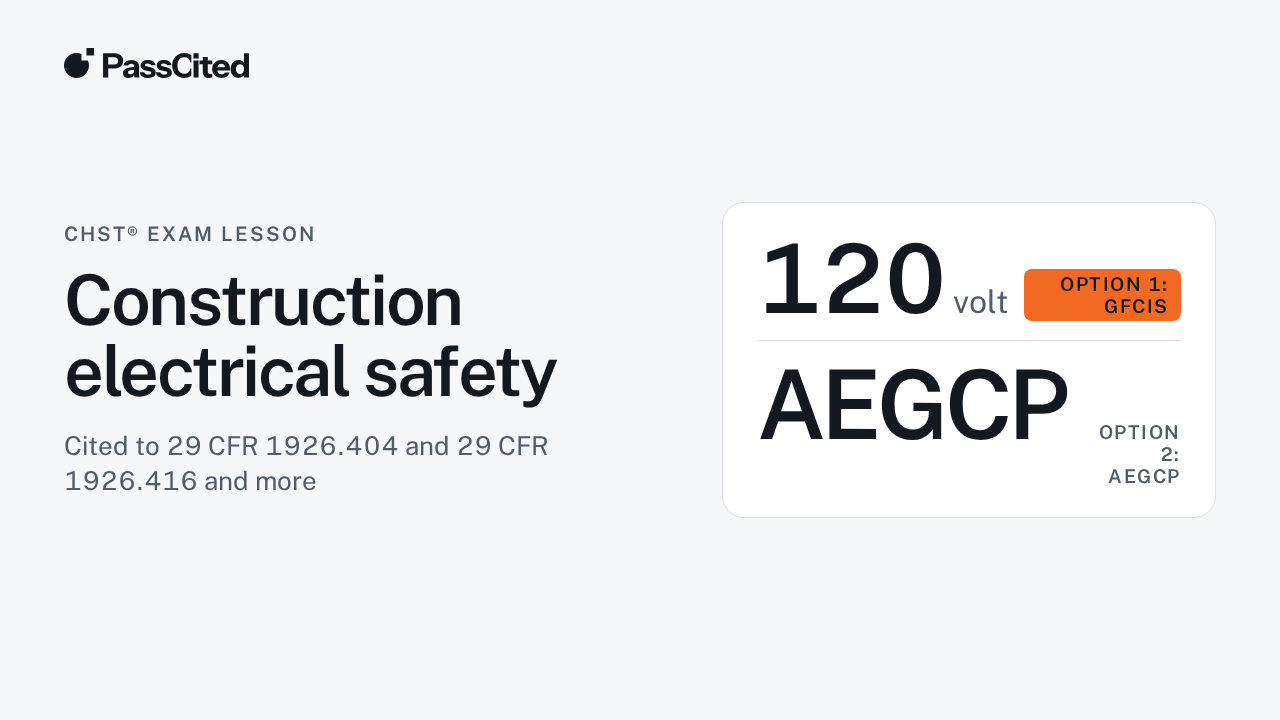 Construction electrical safetyCHST lesson, 6:54Construction electrical safety for the CHST exam: GFCI versus the assured grounding program, test intervals, overhead clearances, grounding distances, and lockout tagging under 1926 Subpart K.
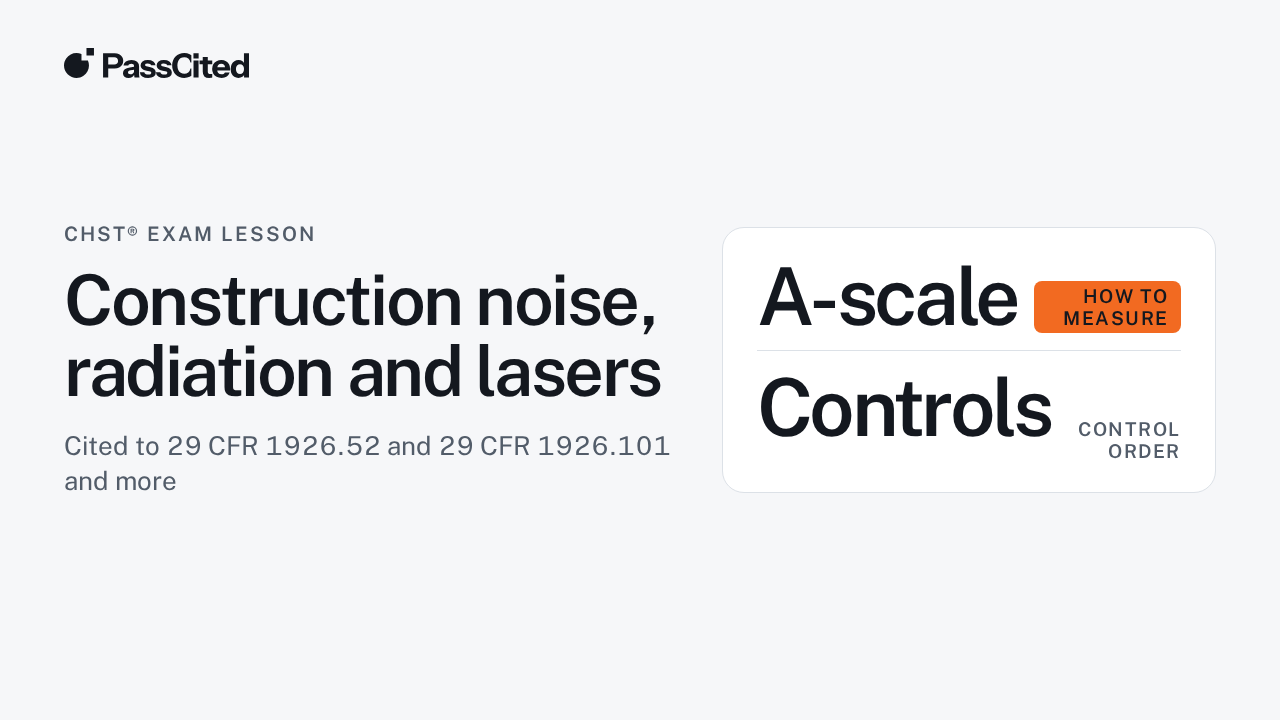 Construction noise, radiation and lasersCHST lesson, 6:57CHST exam lesson on construction noise (Table D-2, the Fe formula, hearing protection), ionizing radiation, and laser and microwave limits under 29 CFR 1926.52, .53, .54 and .101.
See where you stand on the CHST
25 questions, free, no card. You get a readiness score for each CHST domain.
ASP®, CSP® and CHST® are registered marks of BCSP. PassCited is not affiliated with or endorsed by BCSP.