Compressed gas cylinders
ASP video lesson, 6:17. ASP Domain 2: Safety Programs and Concepts
The testable rules for compressed gas cylinders: handling, storage distances, fuel gas use, leaks, hose and manifolds, under 29 CFR 1910.101 and 1926.350, for the ASP exam.
Watch the first 1:21 free. The full lesson, with captions and the full transcript, is included with every ASP pass. Every rule and number is cited on screen to its primary source.
Transcript of the preview
0:00 Intro
Compressed gas cylinders, for the ASP exam. Every rule and number here is cited to its primary source, on screen.
0:09 Learning objectives
In this lesson, you'll learn to: apply the moving and hoisting rules, state the oxygen and fuel-gas storage distances, describe fuel gas use and leak response, and recall the hose and manifold requirements.
0:25 General industry: 1910.101
101 sets three duties: inspection, handling and storage, and relief devices. Inspection first: the employer must determine cylinders are in a safe condition, as far as visual inspection can tell. Inspections follow DOT regulations. Where those are not applicable, CGA pamphlets C-6 and C-8 apply. Handling and storage: in-plant handling, storage and use of all compressed gases follow CGA pamphlet P-1. 2. 350 governs how cylinders move. Valve protection caps must be in place and secured, and never used for lifting.
1:10 Construction: 1926.350(a)
Hoist on a cradle, slingboard or pallet, never with magnets or choker slings. Move cylinders by tilting and rolling them on their bottom edges. Powered vehicles carry them vertical, and the valve is closed whenever they move. Stored oxygen must be separated from fuel-gas cylinders or combustible materials, especially oil or grease.
Also in the full lesson
- Storage separation
- Storage and placement
- Use of fuel gas
- Leak response
- Hose and manifolds
- On the job
- Common exam traps
- Recap quiz
The full transcript is included with every ASP pass. See passes
More ASP lessons
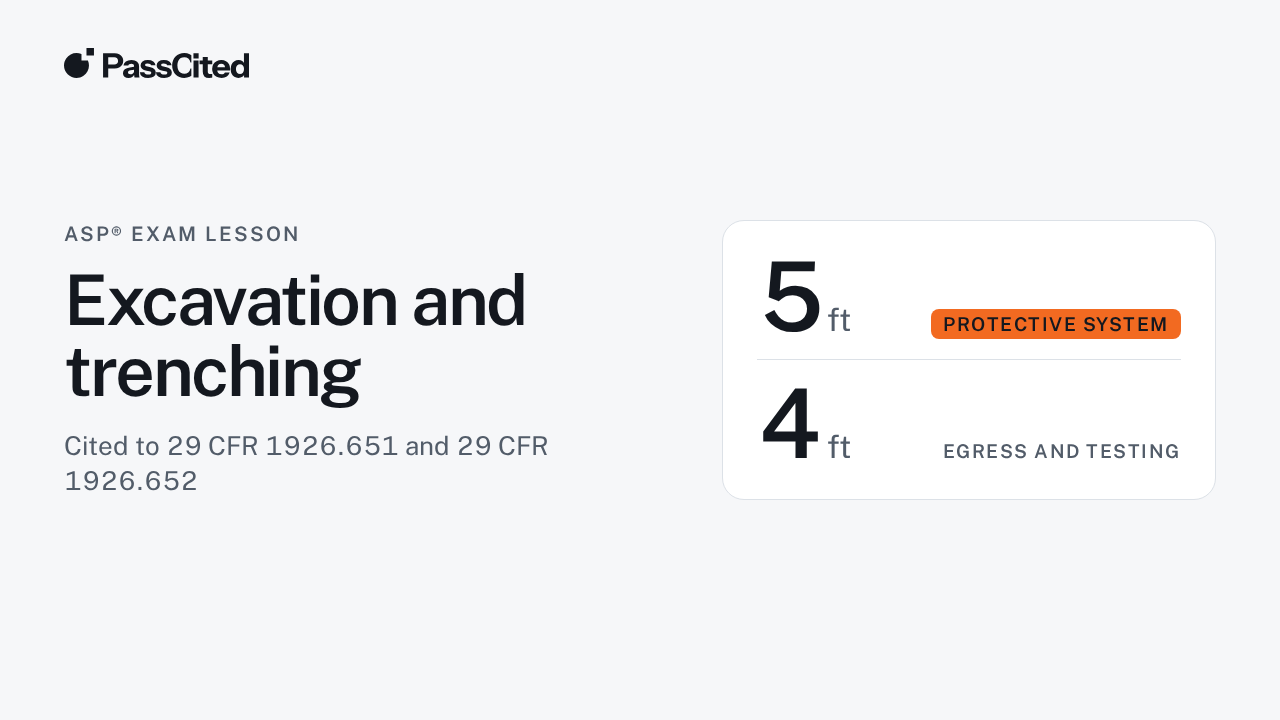 Excavation and trenchingASP lesson, 6:52ASP exam review of 29 CFR 1926 Subpart P: the 5-foot and 4-foot thresholds, utility locates, daily inspections, soil types, maximum allowable slopes, and who does what.
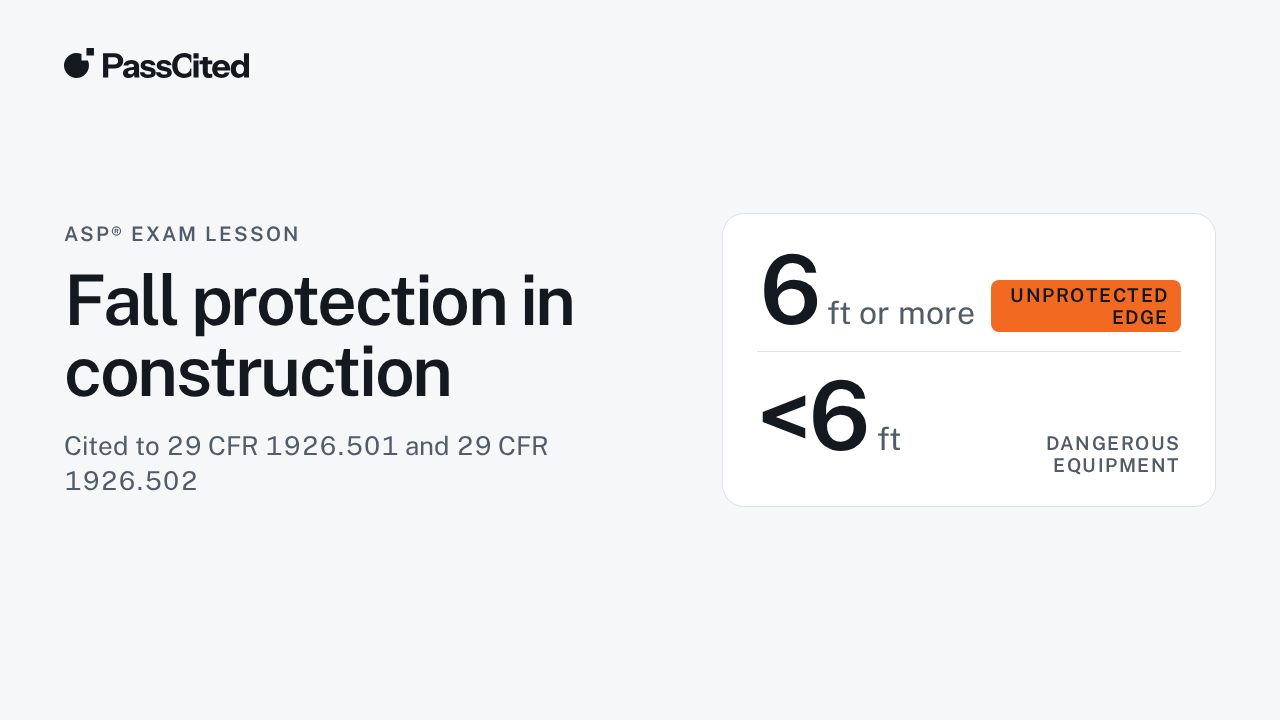 Fall protection in constructionASP lesson, 6:49Construction fall protection under 1926.501 and 1926.502: the 6-foot trigger, system criteria, guardrail, net, arrest and warning line numbers, and who must prepare and supervise.
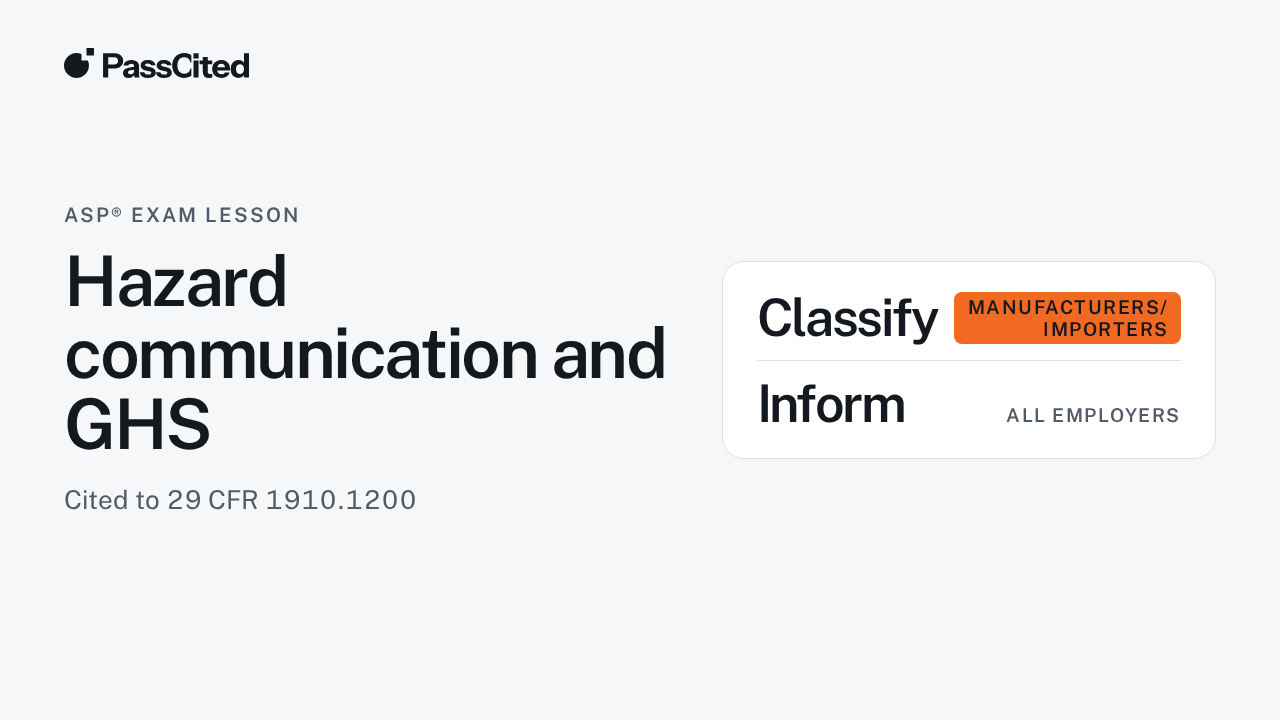 Hazard communication and GHSASP lesson, 7:21ASP exam review of OSHA 1910.1200: who classifies chemicals, the six label elements, SDS timing and 16 sections, the written program, training, trade secrets and 2026-2028 dates.
See where you stand on the ASP
25 questions, free, no card. You get a readiness score for each ASP domain.
ASP®, CSP® and CHST® are registered marks of BCSP. PassCited is not affiliated with or endorsed by BCSP.