Fall protection in construction
ASP video lesson, 7:07. ASP Domain 2: Safety Programs and Concepts
Construction fall protection under 1926.501 and 1926.502: the 6-foot trigger, system criteria, guardrail, net, arrest and warning line numbers, and who must prepare and supervise.
Included with every pass, and free to watch with captions. Every rule and number is cited on screen to its primary source.
Transcript
0:00 Intro
Fall protection in construction, for the ASP exam. Every rule and number here is cited to its primary source, on screen.
0:10 Learning objectives
In this lesson, you'll learn to: state the six-foot trigger and its main variations, give guardrail and safety net criteria, apply personal fall arrest limits, and assign fall protection plan and monitoring duties to the right person.
0:30 The trigger
The general rule: an unprotected side or edge 6 feet or more above a lower level needs protection. Choose guardrail systems, safety net systems, or personal fall arrest systems. Dangerous equipment is different. Below 6 feet, guardrails or equipment guards. At 6 feet or more, guardrail, arrest, or net.
0:57 Specific hazards
Many hazards use a 6-foot trigger but limit your options. Ramps, runways and walkways: guardrail systems only. Steep roofs: guardrails with toeboards, nets, or arrest. Formwork and rebar faces may use positioning device systems. Holes more than 6 feet up get covers, arrest, or guardrails; covers also guard against tripping or stepping into holes. Wall openings: outside edge 6 feet or more up, inside edge under 39 inches.
1:35 Guardrail criteria
Top rail height is 42 inches, plus or minus 3. When conditions warrant, it may exceed 45 inches if all other criteria are met; with stilts, add the stilt height. The top edge must withstand 200 pounds, outward or downward. Under that load, it must not deflect below 39 inches. Midrails and similar members must withstand 150 pounds. Balusters can be no more than 19 inches apart.
2:11 Safety nets
Install nets as close as practicable under the work, never more than 30 feet below. Outward extension grows with the drop. Up to 5 feet needs 8 feet; over 5 up to 10 needs 10 feet; over 10 feet needs 13 feet. Drop-test with a 400 pound sand bag after installation, relocation or major repair, and at 6-month intervals if left in place. If testing is unreasonable, a certification record substitutes. Inspection is separate from drop testing: at least once a week.
2:51 Personal fall arrest
Anchorages must be independent of platform supports and hold 5,000 pounds per employee, or be part of a complete system with a safety factor of at least two, under a qualified person. Maximum arresting force with a harness is 1,800 pounds. Free fall can be no more than 6 feet, with no contact with a lower level. 5 feet. Impact-loaded gear comes out of service until a competent person inspects it and finds it undamaged and suitable for reuse.
3:27 Roofs and zones
Two systems that look alike. Warning lines serve low-slope roofing; control lines mark controlled access zones. With no mechanical equipment, the warning line stands at least 6 feet from the roof edge, flagged at no more than 6-foot intervals. Its height is 34 inches minimum at the lowest point, 39 inches maximum at the highest. Control lines sit 6 to 25 feet from the unprotected or leading edge. Precast erection: 6 feet to 60 feet or half the member length, whichever is less.
4:16 Who does what
Bricklaying lines sit 10 to 15 feet from the working edge. Lowest point: at least 39 inches. A fall protection plan is only for leading edge, precast concrete, or residential work where conventional systems are infeasible or create a greater hazard. A qualified person prepares it, specific to the site, and approves changes.
4:47 Common exam traps
A competent person supervises its implementation. Separately, the employer designates a competent person as safety monitor, who cannot have other duties that distract from monitoring. Now, five traps that catch people on exam day. A fall plan is not for any job. It is limited to leading edge, precast, or residential work, and only where conventional systems are infeasible or create a greater hazard. Positioning devices limit free fall to 2 feet. Personal fall arrest systems allow 6.
5:33 Recap quiz
Never attach a personal fall arrest system to a guardrail system. Body belts are not acceptable for fall arrest. They may be used in positioning device systems. Warning lines and control lines are different. Check minimum distances and purpose, plus the equipment and precast variations. Question 1. What is the maximum free fall distance for a personal fall arrest system? A: 2 feet. 5 feet. C: 6 feet. D: 10 feet. C. 6 feet, with no contact with a lower level. Two feet is the positioning device limit. Question 2. A safety net is left in one place. How often is it drop-tested? A: Weekly. B: Every month. C: At 6-month intervals. D: Every 30 days. C. Six-month intervals. Weekly is the inspection frequency, not the drop test. Question 3. Who prepares a site-specific fall protection plan? A: A qualified person. B: Any authorized employee. C: The safety monitor. D: The first-line supervisor. A. A qualified person prepares it. A competent person supervises implementation. Want to see where you stand on every ASP domain? com.
More ASP lessons
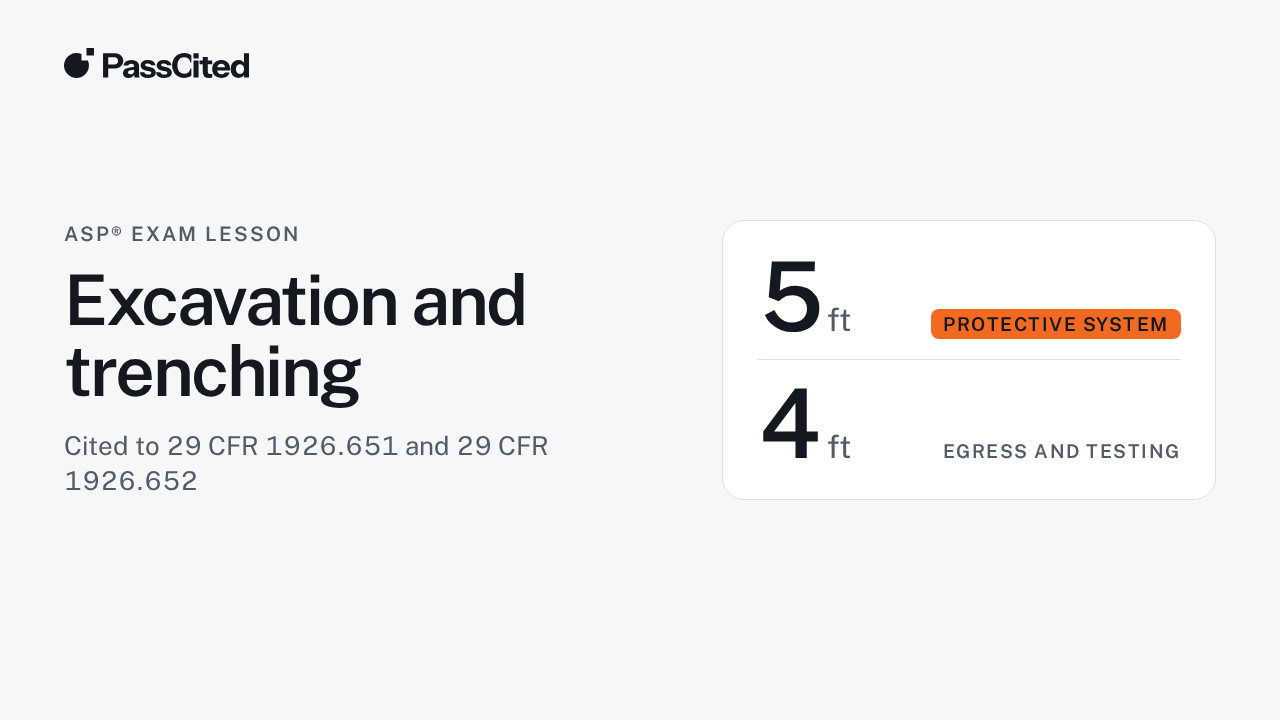 Excavation and trenchingASP lesson, 7:06ASP exam review of 29 CFR 1926 Subpart P: the 5-foot and 4-foot thresholds, utility locates, daily inspections, soil types, maximum allowable slopes, and who does what.
 Hazard communication and GHSASP lesson, 7:29ASP exam review of OSHA 1910.1200: who classifies chemicals, the six label elements, SDS timing and 16 sections, the written program, training, trade secrets and 2026-2028 dates.
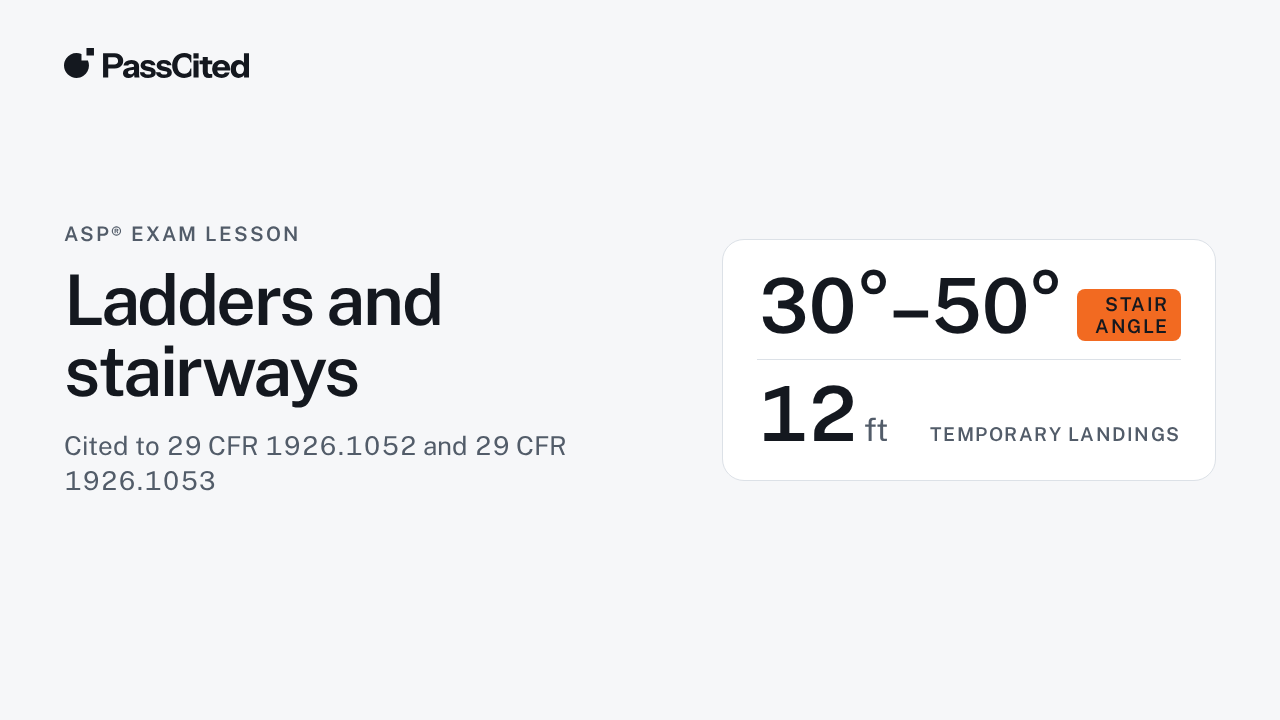 Ladders and stairwaysASP lesson, 6:15ASP review of 29 CFR 1926.1052 and 1926.1053: stairway angles and rails, portable ladder extension and angle, fixed ladder cages, wells and climb thresholds, and who inspects.
See where you stand on the ASP
25 questions, free, no card. You get a readiness score for each ASP domain.
ASP®, CSP® and CHST® are registered marks of BCSP. PassCited is not affiliated with or endorsed by BCSP.