Portable fire extinguishers
ASP video lesson, 7:46. ASP Domain 4: Fire Prevention and Protection
Portable fire extinguishers under 29 CFR 1910.157 for the ASP exam: travel distances by class, inspection and maintenance, hydrostatic test intervals, records, and annual employee education.
Included with every pass, and free to watch with captions. Every rule and number is cited on screen to its primary source.
Transcript
0:00 Intro
Portable fire extinguishers, for the ASP exam. Every rule and number here is cited to its primary source, on screen.
0:11 Learning objectives
In this lesson, you'll learn to: state the travel distances for Class A, B and D, separate monthly, annual and 6-year duties, recall hydrostatic test intervals and their exceptions, and explain how education differs from training.
0:31 Scope and exemptions
157 covers extinguishers for employee use. 39 exist, only (e) and (f) apply. Total evacuation, written plans, no extinguishers in the workplace: exempt from the whole section, unless another part 1910 standard requires one. 38 names the only authorized users and has all others in the fire area evacuate on the alarm, only (d) distribution is exempt. Mount, locate and identify extinguishers so they are readily accessible without risking injury.
1:14 General requirements
Only approved extinguishers count toward compliance. Carbon tetrachloride and chlorobromomethane agents may not be provided at all. Keep them fully charged and in place except during use. Soldered or riveted inverting types must go.
1:39 Selection and distribution
Select extinguishers by class of anticipated fire, and size and degree of hazard. Class A: 75 feet or less to any extinguisher. Class B: 50 feet or less, measured from the hazard area. Class C follows the Class A or B pattern. Class D is 75 feet or less. Two special cases show up on exams.
2:06 Special cases
Class D is required where combustible metal powders, flakes, shavings, or similar products are generated at least once every two weeks. 159, give total coverage, and employees are trained at least annually. The employer is responsible for inspecting, maintaining and testing every extinguisher.
2:34 Inspection and maintenance
Monthly: a visual inspection, including hose used in lieu of extinguishers. Annually: a maintenance check. Stored pressure units need no internal examination. Keep the record one year after the last entry or the shell's life, whichever is less. Every 6 years: 12-year stored pressure dry chemical units are emptied and maintained. Disposable containers are exempt. Recharging or testing restarts the clock. Provide alternate protection during service.
3:17 Hydrostatic testing
Hydrostatic testing must be done by trained persons with suitable equipment and facilities. Five years: water types, wetting agent, stainless steel soda acid and foam, AFFF, loaded stream, carbon dioxide, stainless steel dry chemical. Twelve years: stored pressure dry chemical in mild steel, brazed brass or aluminum; cartridge dry chemical and dry powder in mild steel; both Halons. Soft-soldered or riveted copper or brass shells are never tested; removal was due January 1, 1982.
3:58 Hydrostatic testing
A hydrostatic test is required whenever new evidence of corrosion or mechanical injury appears, except under the (f)(2) conditions. Table L-1 intervals do not apply after repair by soldering, welding, brazing or patching compounds, damaged threads, pitting, a fire, or calcium chloride in stainless steel. Examine internally and externally before any test. Never use air or gas pressure. Failed or unfit shells leave service and the workplace.
4:46 Training and education
Keep a certification record: test date, tester's signature, serial number or other identifier, until retest or removal from service, whichever comes first. Two different programs, both at least annual. Education: where extinguishers are provided for employee use, employees learn general principles and incipient stage fire fighting hazards.
5:16 Common exam traps
At hire, then annually. Training: employees designated to use fire fighting equipment under the emergency action plan learn the appropriate equipment. On assignment, then annually. Now, five traps that catch people on exam day. One: Class A and D are 75 feet. Class B is 50 feet, from the hazard area. Two: stored pressure units skip the internal examination at the annual check. Three: Table L-1 is 5 or 12 years by type.
6:01 Recap quiz
Qualifying nitrogen cylinders may go 10. New corrosion or injury forces a test. Four: air or gas pressure may never be used for hydrostatic testing. Five: education covers employees where extinguishers are provided; training covers designated users. Both annual. Question 1. What is the maximum travel distance to any extinguisher for Class A fires? A: 25 feet. B: 50 feet. C: 75 feet. D: 90 feet. C. Class A is 75 feet or less. Fifty feet is the Class B distance. Question 2. A stored pressure dry chemical extinguisher, mild steel shell: hydrostatic test interval? A: 5 years. B: 6 years. C: 7 years. D: 12 years. D. Table L-1 says 12 years. The 6-year duty is emptying and maintenance. Question 3. An extinguisher 2 years into a 5-year interval shows new corrosion, no other exception. A: test at interval end. B: hydrostatic test now. C: annual check. D: monthly inspection. B. New evidence of corrosion or mechanical injury requires a hydrostatic test now, unless an (f)(2) condition applies. Want to see where you stand on every ASP domain? com.
More ASP lessons
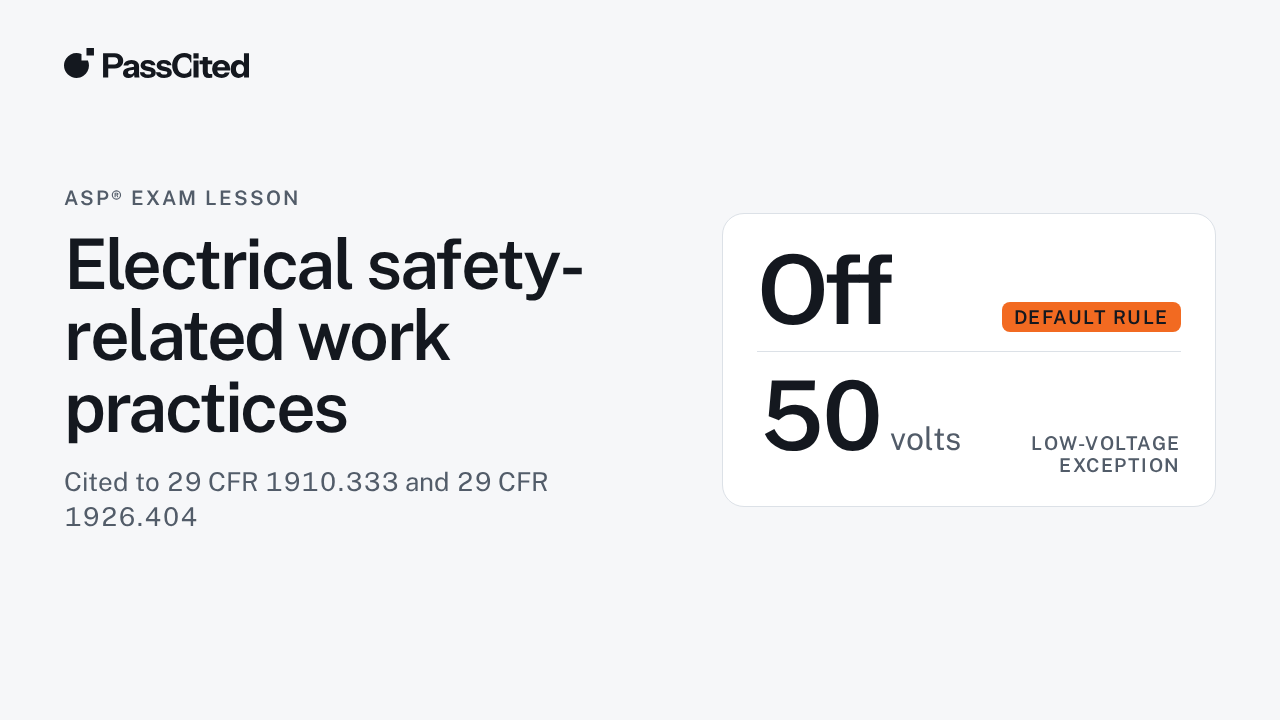 Electrical safety-related work practicesASP lesson, 7:14Deenergize first, lockout and tagging, qualified-person tests, overhead line distances, and construction GFCI and grounding rules from 1910.333 and 1926.404, for the ASP exam.
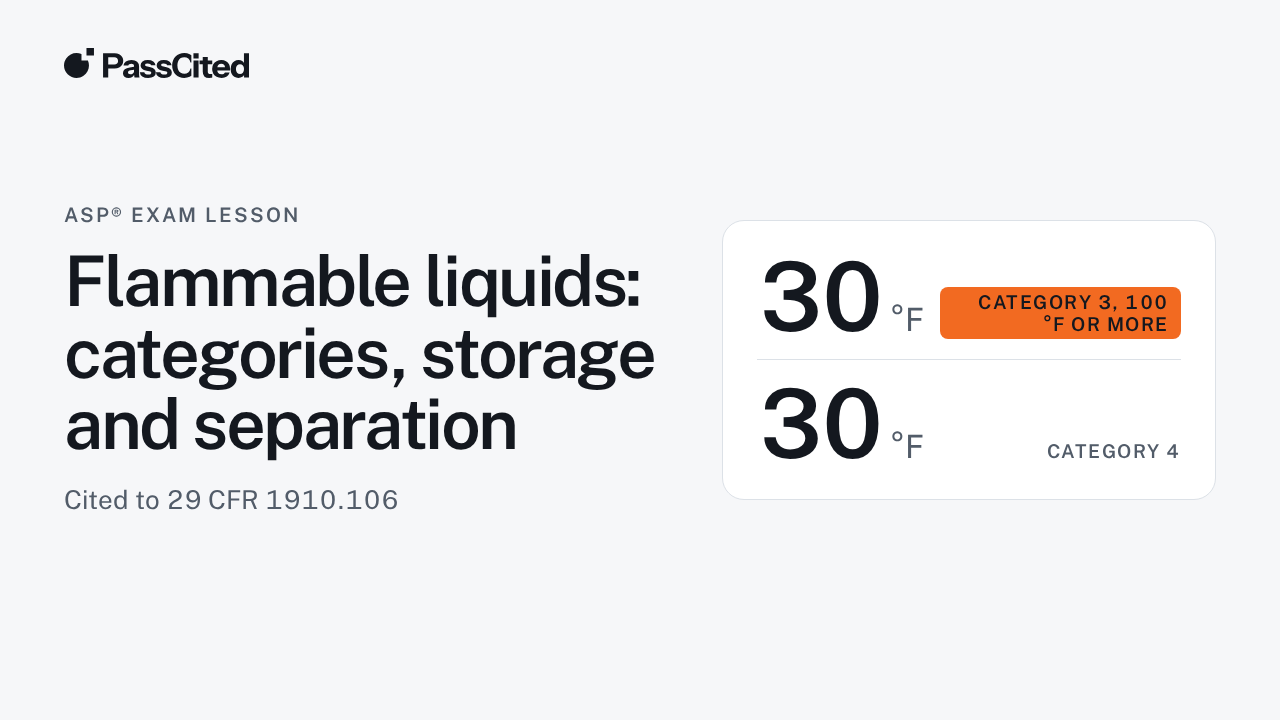 Flammable liquids: categories, storage and separationASP lesson, 7:421910.106 for the ASP exam: the four flammable liquid categories, safety cans, storage cabinets, inside rooms, outdoor distances and tank spacing, with cited numbers.
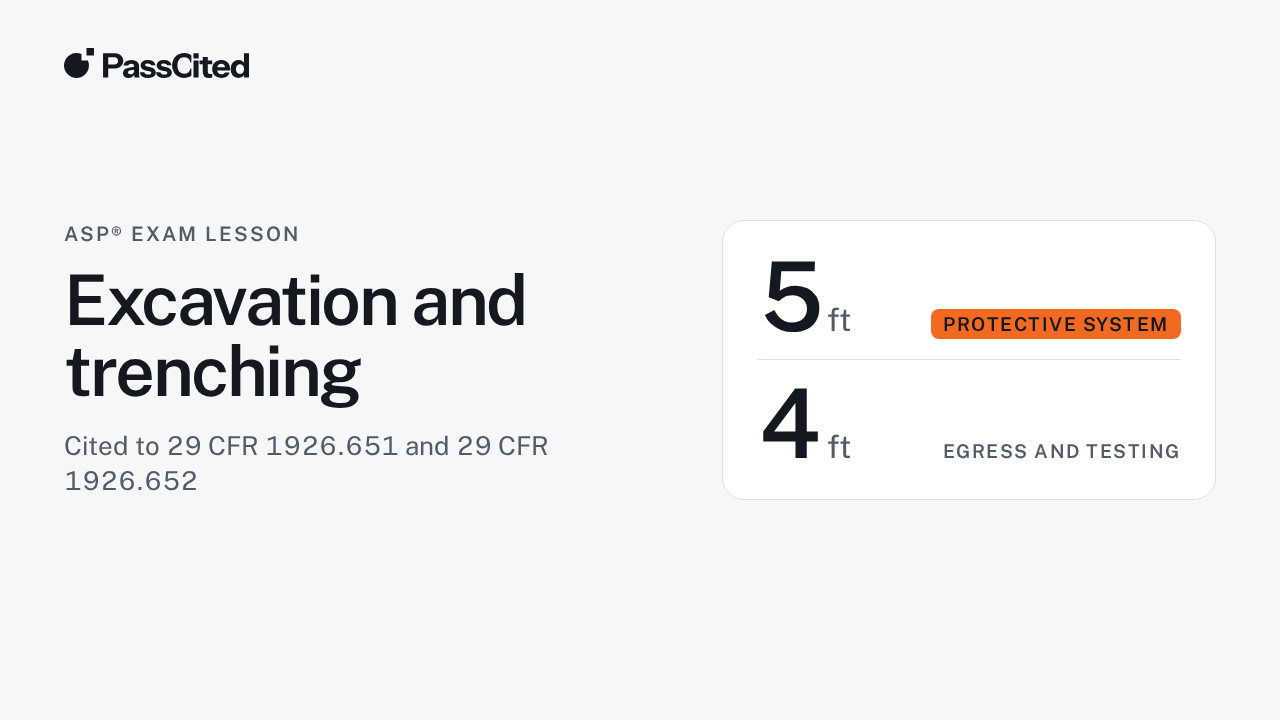 Excavation and trenchingASP lesson, 7:06ASP exam review of 29 CFR 1926 Subpart P: the 5-foot and 4-foot thresholds, utility locates, daily inspections, soil types, maximum allowable slopes, and who does what.
See where you stand on the ASP
25 questions, free, no card. You get a readiness score for each ASP domain.
ASP®, CSP® and CHST® are registered marks of BCSP. PassCited is not affiliated with or endorsed by BCSP.