Flammable liquids: categories, storage and separation
ASP video lesson, 7:42. ASP Domain 4: Fire Prevention and Protection
1910.106 for the ASP exam: the four flammable liquid categories, safety cans, storage cabinets, inside rooms, outdoor distances and tank spacing, with cited numbers.
Included with every pass, and free to watch with captions. Every rule and number is cited on screen to its primary source.
Transcript
0:00 Intro
106, for the ASP exam. Every rule and number here is cited to its primary source, on screen. In this lesson, you'll learn to: classify a liquid into Category 1 through 4 by flashpoint and boiling point, state the container, cabinet and inside storage room limits, apply outdoor storage and tank separation distances, and know the transfer, grounding and ventilation rules.
0:36 Definitions · 1910.106(a)(19)
4 °F. 4 °F, boiling point at or below 95 °F. Category 2: same flashpoint, boiling point above 95 °F. 4 to 140 °F. 4 °F. Heating changes handling. Category 3 at or above 100 °F, heated to within 30 °F of flashpoint, is handled as Category 3 below 100 °F.
1:10 Definitions · heated liquids
Category 4 heated to within 30 °F of flashpoint is handled as Category 3 at or above 100 °F. 4 °F flashpoint, heated within 30 °F: handle as Category 4. Table H-12 caps container size by type and category. Glass or approved plastic: 1 pint Category 1, 1 quart Category 2, 1 gallon for 3 and 4.
1:43 Containers · Table H-12
Metal (other than DOT drums): 1 gallon Category 1, 5 gallons for 2, 3 and 4. Safety cans: 2 gallons Category 1, 5 for the rest. DOT metal drums 60; portable tanks 660. Cabinets have a capacity cap and a fire test. At most 60 gallons of Category 1, 2 or 3, or 120 gallons of Category 4. In a 10-minute fire test, inside temperature stays at or below 325 °F; joints stay tight, door stays closed.
2:18 Storage cabinets · (d)(3)
” Deemed-compliant metal cabinets: three-point lock, sill at least 2 inches. Inside rooms have rating, size and quantity limits. A 2-hour room up to 500 square feet: 10 gallons per square foot with fire protection, 5 without.
2:50 Inside storage rooms · Table H-13
A 1-hour room up to 150 square feet: 4 with protection, 2 without. Openings need liquid-tight sills or ramps at least 4 inches high, a floor 4 inches lower, or a draining open-grated trench; self-closing fire doors. At least six air changes per hour; one clear aisle at least 3 feet wide. Outdoor storage has quantity, distance and curb rules.
3:29 Storage outside buildings · (d)(6), (d)(7)
Up to 1,100 gallons may sit adjacent to buildings on the same premises and management. Over 1,100 gallons, or conditions unmet: 10 feet from buildings to the nearest container. Grade away from buildings, or use a curb at least 6 inches high. A 12-B extinguisher: within 10 feet of a storage room door, or 10 to 25 feet from Category 1, 2 or 3 storage outside a room but inside a building.
4:06 Tank separation · (b)(2)
Aboveground tanks need a 3-foot floor plus a diameter formula. Generally one-sixth the sum of diameters, never under 3 feet. If one tank is under half the other's diameter: half the smaller diameter. Crude production tanks up to 126,000 gallons in noncongested areas: 3 feet. Unstable liquids: half the sum of diameters.
4:50 Industrial plants · 1910.106(e)
g. and for 125-gallon LPG beside 550-gallon fuel oil tanks. Paragraph (e) covers plants with incidental use or unit physical operations, not chemical plants, refineries or distilleries. Inside a building, transfer only by closed piping, safety cans, a top-drawing device, or gravity through an approved self-closing valve. Transfer by air pressure on the container or portable tank is prohibited. Category 1 or 2, or 3 below 100 °F: dispense into containers only if nozzle and container are electrically interconnected.
5:36 Common exam traps
Unit operations with those liquids: at least 1 cubic foot per minute per square foot of solid floor. Now, four traps that catch people on exam day.
6:06 Recap quiz
One: Categories 1 and 2 share a flashpoint range; boiling point separates them. Two: cabinets hold 60 gallons, or 120 for Category 4. Three: safety cans are 2 gallons for Category 1, 5 for others. Four: a 1-hour room is capped at 150 square feet, a 2-hour at 500. Question 1. Flashpoint 70 °F, boiling point 120 °F. Category? A: 1. B: 2. C: 3. D: 4. B. 4 °F flashpoint with a boiling point above 95 °F is Category 2. Question 2. Maximum cabinet capacity for Category 4? A: 60 gallons. B: 90 gallons. C: 120 gallons. D: 660 gallons. C. Category 4 cabinets may hold up to 120 gallons. Question 3. 1,500 gallons stored outdoors beside a building on the same premises. Minimum distance to nearest container? A: 5 feet. B: 10 feet. C: 25 feet. D: 50 feet. B. Over 1,100 gallons requires at least 10 feet. Want to see where you stand on every ASP domain? com.
More ASP lessons
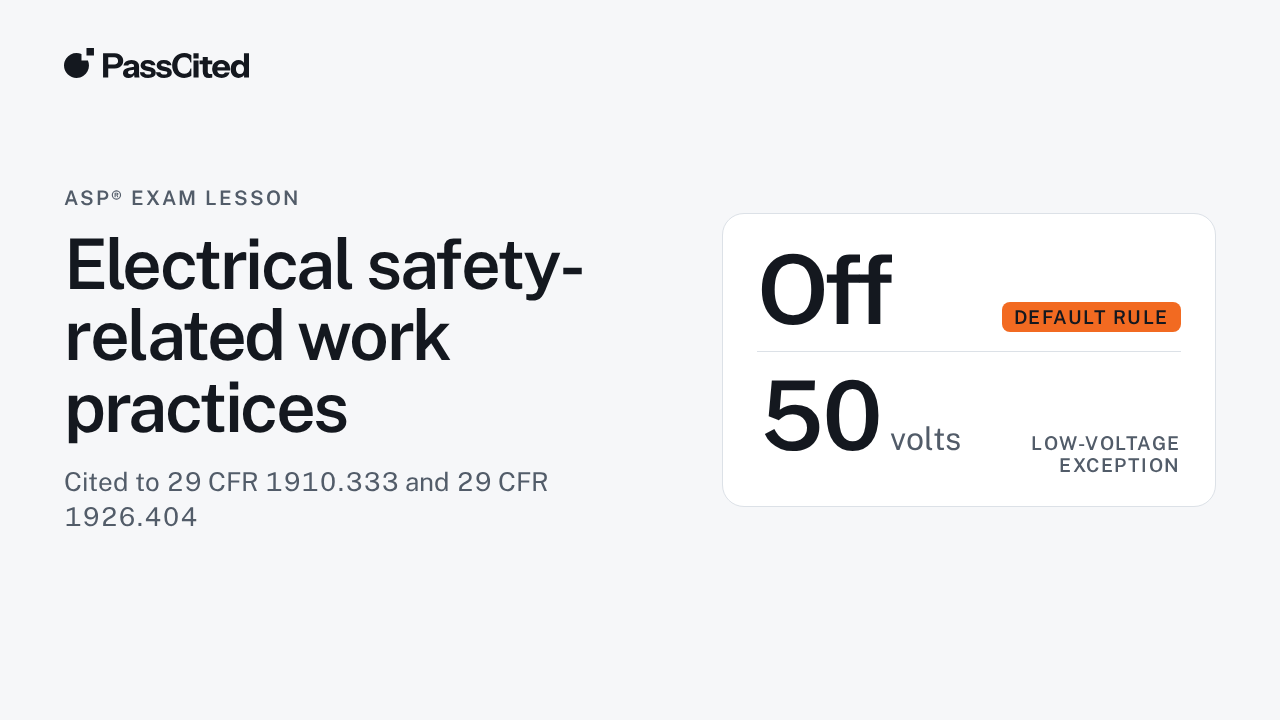 Electrical safety-related work practicesASP lesson, 7:14Deenergize first, lockout and tagging, qualified-person tests, overhead line distances, and construction GFCI and grounding rules from 1910.333 and 1926.404, for the ASP exam.
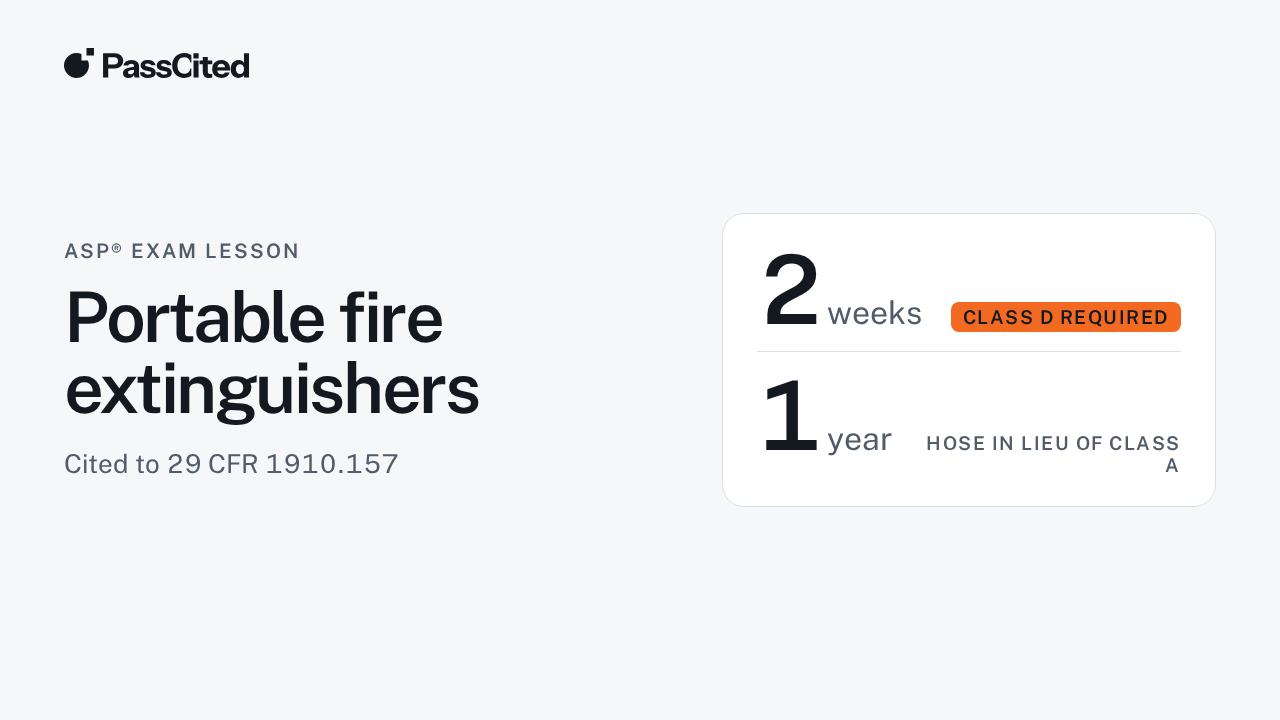 Portable fire extinguishersASP lesson, 7:46Portable fire extinguishers under 29 CFR 1910.157 for the ASP exam: travel distances by class, inspection and maintenance, hydrostatic test intervals, records, and annual employee education.
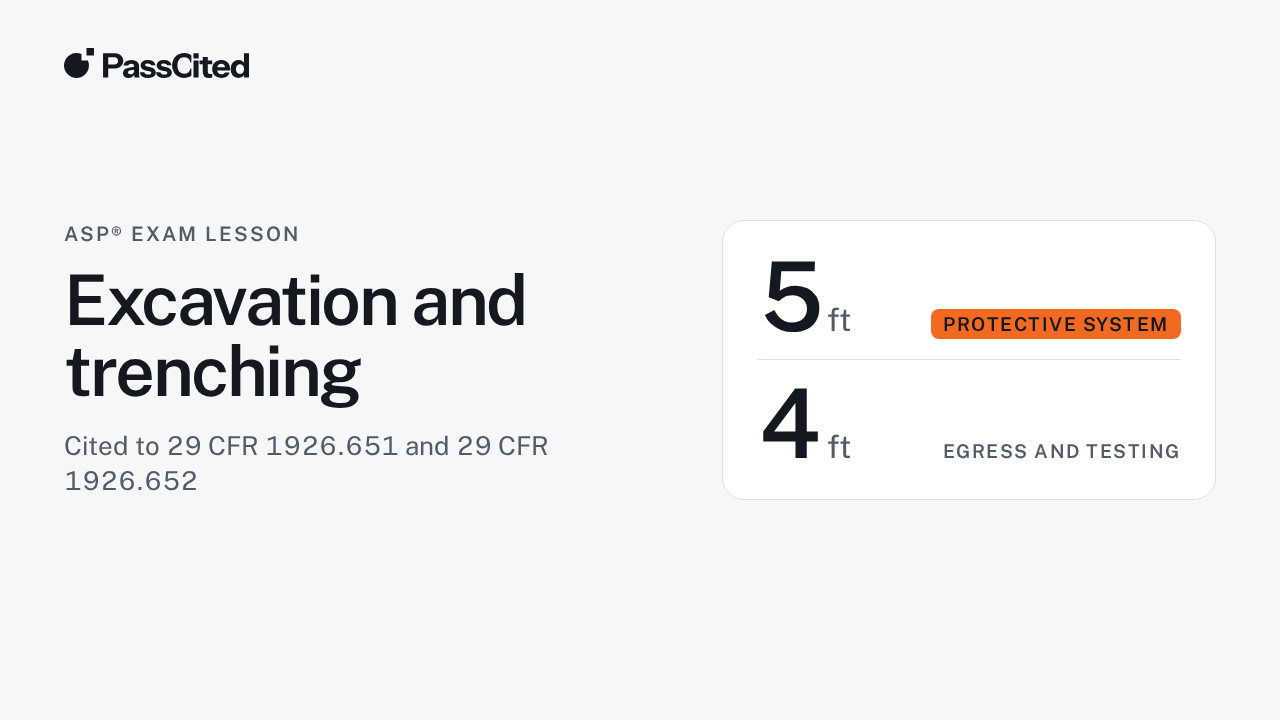 Excavation and trenchingASP lesson, 7:06ASP exam review of 29 CFR 1926 Subpart P: the 5-foot and 4-foot thresholds, utility locates, daily inspections, soil types, maximum allowable slopes, and who does what.
See where you stand on the ASP
25 questions, free, no card. You get a readiness score for each ASP domain.
ASP®, CSP® and CHST® are registered marks of BCSP. PassCited is not affiliated with or endorsed by BCSP.