Powered industrial trucks
ASP video lesson, 7:06. ASP Domain 2: Safety Programs and Concepts
ASP exam review of 29 CFR 1910.178: truck designations and hazardous locations, operator training and the three-year evaluation, the 25 ft unattended rule, travel rules and daily exams.
Included with every pass, and free to watch with captions. Every rule and number is cited on screen to its primary source.
Transcript
0:00 Intro
Powered industrial trucks, for the ASP exam. Every rule and number here is cited to its primary source, on screen.
0:10 Learning objectives
In this lesson, you'll learn to: match truck designations to hazardous locations, state the operator training and evaluation rules, apply the unattended truck rule and travel limits, and recall examination and maintenance requirements.
0:29 Truck designations
178 names eleven truck designations. The letters tell you fuel and safeguards. D is diesel, E is electric, G is gasoline, LP is liquefied petroleum gas. For DS, GS and LPS, an S adds exhaust, fuel and electrical safeguards. ES adds electrical safeguards against sparks and hot surfaces. DY has no electrical equipment, including ignition. EE fully encloses its electrical equipment. EX is built for certain flammable vapor or dust atmospheres. Which truck fits depends on the classified location.
1:13 Hazardous locations
Exams love EX, and the DY, EE, EX group. Where combustible dust is, or may be, in suspension under normal conditions, only EX trucks may be used. If dust is not normally suspended but deposits could be ignited by truck sparks, or the location is hazardous from easily ignitable fibers or flyings not likely in suspension, DY, EE or EX trucks are required.
1:47 Unclassified vs hazardous
Not every location is hazardous. Classification decides which trucks you may use. If not classified as hazardous, any approved truck of type D, E, G or LP, or a truck conforming to those types, may be used. If hazardous, only the types specified for that location. Separately, sealed-container storage allows approved DS, ES, GS or LPS trucks, and is not normally hazardous unless other hazards exist.
2:21 Operator training
The employer must ensure each operator is competent, shown by successful training and evaluation. Training combines formal instruction, practical training, and workplace evaluation. Trainers need the knowledge, training and experience to train and evaluate. The certification lists the operator's name, training date, evaluation date, and who performed the training or evaluation.
2:50 Evaluation and refresher
Initial training comes first. Then evaluation and refresher rules keep the operator current. For employees hired after December 1, 1999, initial training and evaluation must be completed before assignment to operate a truck. Refresher training follows unsafe operation, an accident or near-miss, a poor evaluation, a different truck type, or a workplace change that could affect safe operation.
3:28 Unattended trucks
Regardless of triggers, each operator's performance is evaluated at least once every three years. One distance is heavily tested: 25 feet. Unattended: operator 25 ft or more away with the truck in view, or out of view at any distance. Fully lower the forks, neutralize controls, shut off power, set brakes; block wheels on an incline.
3:59 Traveling
Dismounted but within 25 ft and in view: fully lower the forks, neutralize controls, set brakes. Travel rules supply most of the numbers on the exam. Keep a safe distance of approximately three truck lengths from the truck ahead. On grades over 10 percent, loaded trucks are driven with the load upgrade.
4:27 Maintenance and examination
Parking closer than 8 feet from the center of railroad tracks is prohibited. Where vision is obstructed, slow down and sound the horn. If the load blocks view, travel with the load trailing. Trucks stay in service only while safe, and only authorized personnel repair them. Examine trucks before placing them in service, at least daily.
5:00 Common exam traps
For round-the-clock use, examine after each shift. Any truck not in safe operating condition is removed from service. All repairs are by authorized personnel. No repairs in Class I, II and III locations. Disconnect the battery before electrical repairs. Now, five traps that catch people on exam day. One: evaluation is at least every three years, not five.
5:33 Recap quiz
Two: unattended is 25 feet or more in view, or out of view at any distance. Three: the railroad track limit is 8 feet from the center. Four: examinations are at least daily, not weekly. Five: capacity-affecting changes need the manufacturer's prior written approval. Question 1. An operator walks 10 feet from a truck, still in view. What must be done? A: nothing. B: fully lower forks, neutralize controls, set brakes. C: remove the key and tag it. D: block wheels and shut off power only. B. Within 25 feet and in view: fully lower the forks, neutralize controls, set brakes. Question 2. Combustible dust is suspended in ignitable quantities under normal operation. Which truck is permitted? A: DY. B: EE. C: EX. D: DS. C. Only approved EX trucks may be used there. Question 3. How often must each operator's performance be evaluated, at a minimum? A: once a year. B: every two years. C: every three years. D: only after an accident. C. At least once every three years. Want to see where you stand on every ASP domain? com.
More ASP lessons
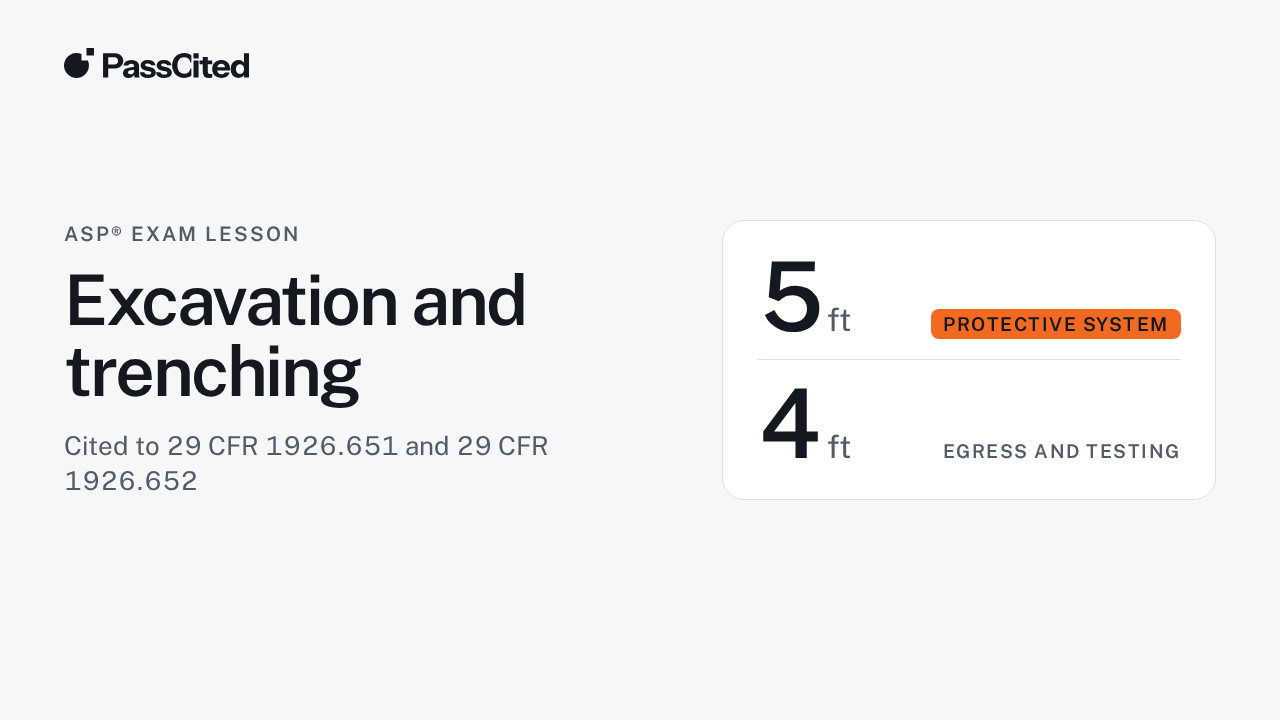 Excavation and trenchingASP lesson, 7:06ASP exam review of 29 CFR 1926 Subpart P: the 5-foot and 4-foot thresholds, utility locates, daily inspections, soil types, maximum allowable slopes, and who does what.
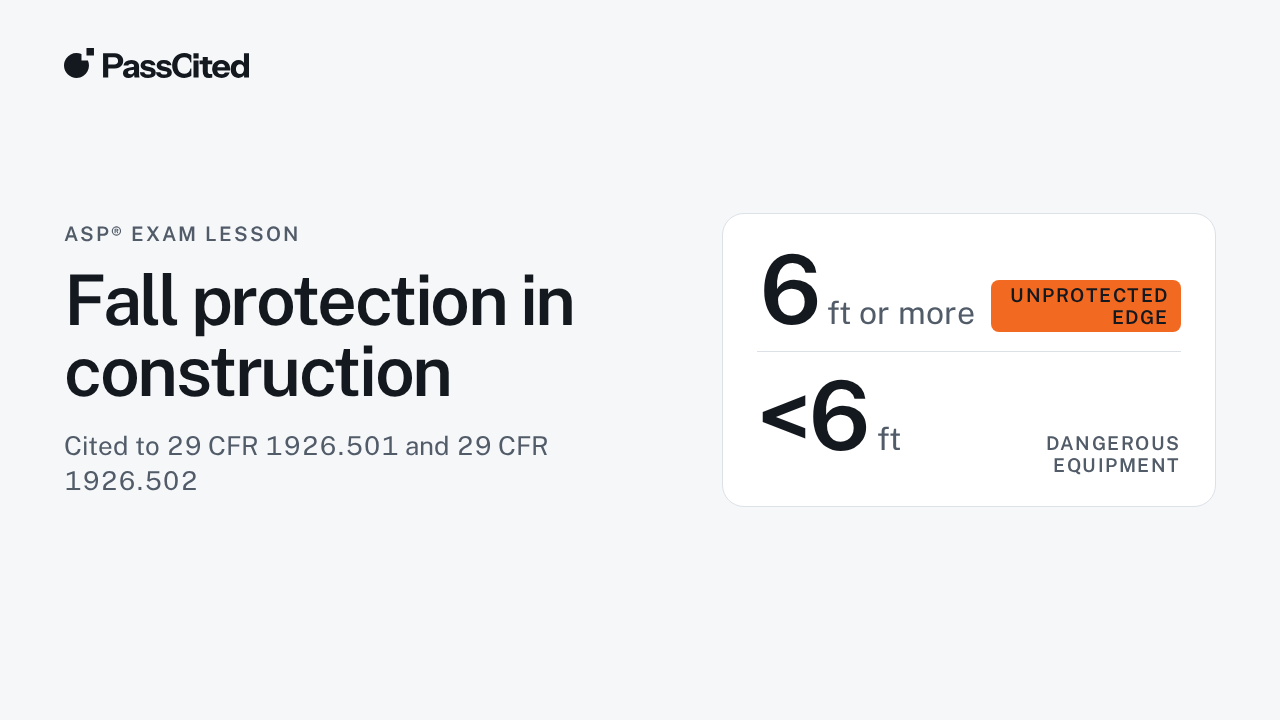 Fall protection in constructionASP lesson, 7:07Construction fall protection under 1926.501 and 1926.502: the 6-foot trigger, system criteria, guardrail, net, arrest and warning line numbers, and who must prepare and supervise.
 Hazard communication and GHSASP lesson, 7:29ASP exam review of OSHA 1910.1200: who classifies chemicals, the six label elements, SDS timing and 16 sections, the written program, training, trade secrets and 2026-2028 dates.
See where you stand on the ASP
25 questions, free, no card. You get a readiness score for each ASP domain.
ASP®, CSP® and CHST® are registered marks of BCSP. PassCited is not affiliated with or endorsed by BCSP.