Occupational noise and hearing conservation
ASP video lesson, 6:55. ASP Domain 6: Industrial Hygiene and Occupational Health
Action level vs PEL, the 5 dB exchange rate, audiometric testing and STS, noise dose and TWA math, decibel addition and NRR derating, cited to 29 CFR 1910.95.
Included with every pass, and free to watch with captions. Every rule and number is cited on screen to its primary source.
Transcript
0:00 Intro
Occupational noise and hearing conservation, for the ASP exam. Every rule and number here is cited to its primary source, on screen.
0:12 Learning objectives
In this lesson, you'll learn to: state the action level and the PEL, explain audiometric testing and the standard threshold shift, calculate a noise dose and an 8-hour TWA, and add decibels and derate an NRR the way OSHA does.
0:33 85 dBA action level vs 90 dBA PEL
95. Both are 8-hour TWAs on the A scale, slow response. 85 decibels, a 50 percent dose, is the action level. It triggers a hearing conservation program. 90, a 100 percent dose, is the PEL.
1:02 5 dB exchange rate (Table G-16)
Above it, feasible administrative or engineering controls come first, then hearing protection. OSHA uses a 5 decibel exchange rate: every 5 decibels halves the permitted time. 90 for 8 hours. 95 for 4. 100 for 2. 105 for 1.
1:27 Audiometric testing
110 for half an hour. 115 for a quarter hour or less. Impulse or impact noise should not exceed 140 decibels peak. At the action level, the employer must make audiometric testing available, at no cost. The baseline is due within 6 months of first exposure, or 1 year with a mobile van, with protectors worn after month 6.
1:55 Standard threshold shift (STS)
It follows 14 hours without workplace noise, or hearing protectors can substitute. Then, at least annually, a new audiogram is compared with the baseline. That comparison looks for a standard threshold shift. An STS is an average shift of 10 decibels or more at 2,000, 3,000 and 4,000 hertz, in either ear.
2:31 Noise dose and TWA formulas
Age correction is allowed. The employee is told in writing within 21 days. A retest within 30 days may count as the annual. Unless a physician rules it non-work-related, the employee is fitted or refitted with protectors, trained, and required to wear them, and they must attenuate to 85 or below.
2:57 Worked example: dose and TWA
Now the math. Noise dose is 100 times the sum of each period's time, C, over its reference duration, T. T comes from Table G-16a, or 8 divided by 2 to the power of L minus 90, over 5. 61 times log of D over 100, plus 90. Example: 3 hours at 95 decibels, 3 at 90, and 2 at 85. Reference durations: 4, 8 and 16 hours.
3:45 Decibel addition
125. 25: a dose of 125 percent. 6. 5 percent. Still over 100, so feasible controls are required, plus a hearing conservation program. Decibels are logarithmic. Two 90 decibel sources make 93, not 180. The exact formula: 10 log of the sum of 10 to the L over 10. 8. OSHA's quick table: equal levels add 3, so 98.
4:19 NRR derating (Appendix B and 50% rule)
Then 98 and 95 differ by 3, add 2: 100. Appendix B: with A-weighted data, subtract a 7 decibel correction from the NRR, then subtract the rest from the TWA. With C-weighted data, subtract the full NRR. Labels overstate field protection, so for engineering-control decisions, the Technical Manual also takes 50 percent of that. Its example: 98 decibels, NRR 25. Appendix B: 98 minus 18 is 80. That judges the protector. The 50 percent estimate: 98 minus 9 is 89.
5:11 Common exam traps
That's the engineering-control number. Wearing plugs and muffs together? Use the higher NRR, and add just 5 decibels. Six exam traps. 85 is the action level, not the PEL. Never add decibels arithmetically. Subtract 7 only with A-weighted data. Double protection adds 5 decibels, not a second NRR.
5:47 Recap quiz
An STS averages 2,000, 3,000 and 4,000 hertz, not 4,000 alone. And hearing conservation counts 80 to 130 decibels, while PEL compliance uses a 90 decibel threshold. Recap. Question 1: a TWA of 87 decibels. What's required? Pause and choose. B. Above the action level, under the PEL: the hearing conservation program applies. Question 2: two machines at 88 decibels each. Combined level? B, 91. Equal levels add 3. Question 3: TWA 100, earmuffs NRR 27, OSHA's 50 percent estimate. C, 90. 27 minus 7 is 20, half is 10, and 100 minus 10 is 90.
6:44 Free diagnostic
See where you stand on every ASP domain. com.
More ASP lessons
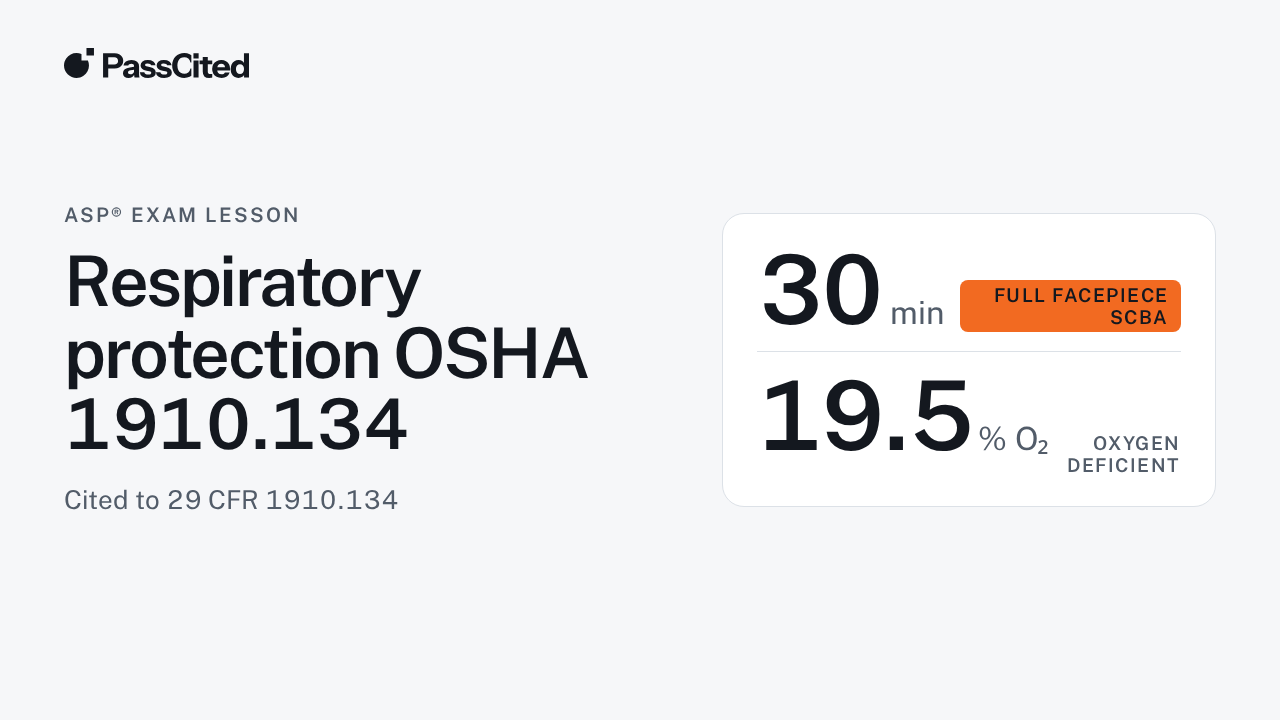 Respiratory protection OSHA 1910.134ASP lesson, 7:41OSHA 1910.134 for the ASP exam: written program, IDLH respirators, APFs and MUC, medical evaluation, fit testing, inspection, air quality, training and records, with the thresholds that get tested.
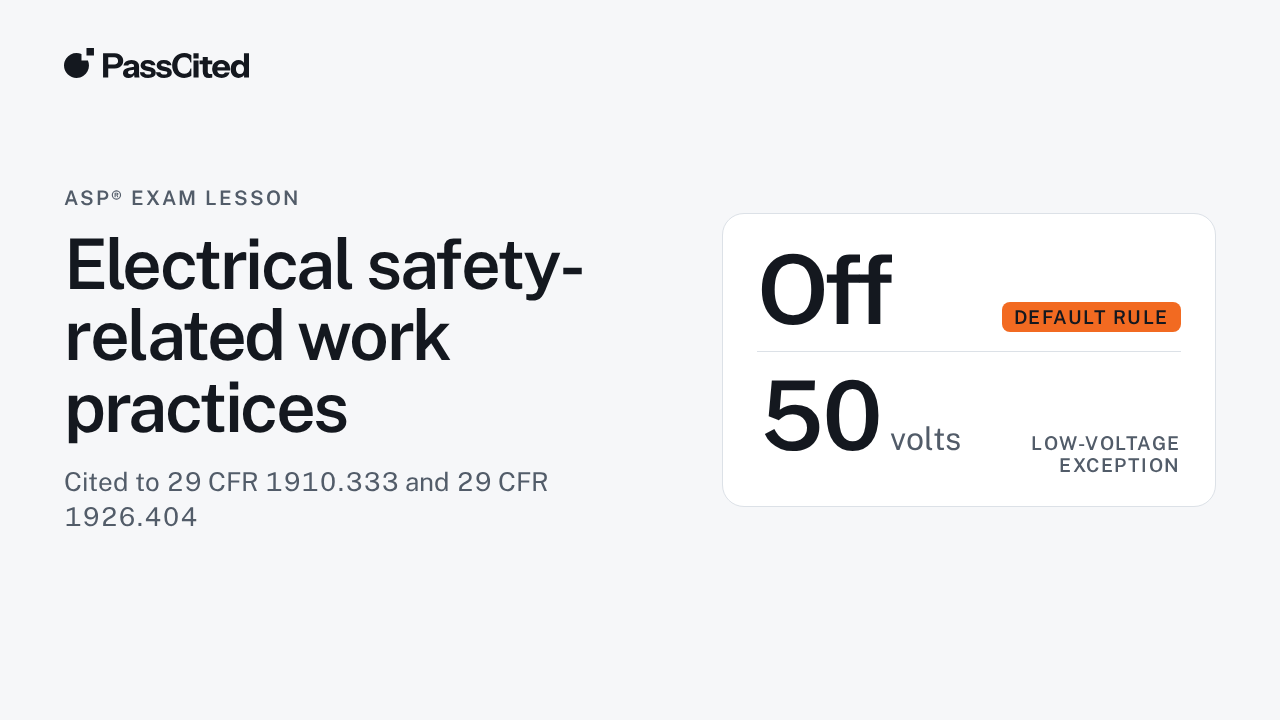 Electrical safety-related work practicesASP lesson, 7:14Deenergize first, lockout and tagging, qualified-person tests, overhead line distances, and construction GFCI and grounding rules from 1910.333 and 1926.404, for the ASP exam.
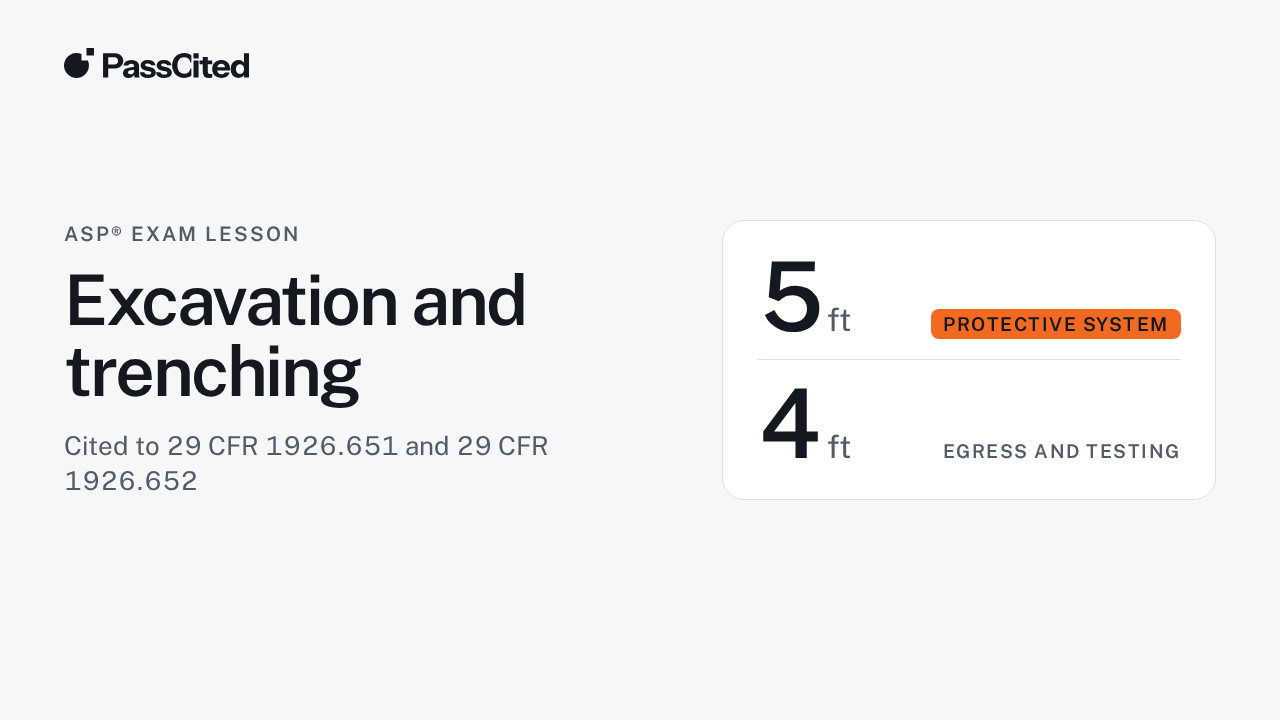 Excavation and trenchingASP lesson, 7:06ASP exam review of 29 CFR 1926 Subpart P: the 5-foot and 4-foot thresholds, utility locates, daily inspections, soil types, maximum allowable slopes, and who does what.
See where you stand on the ASP
25 questions, free, no card. You get a readiness score for each ASP domain.
ASP®, CSP® and CHST® are registered marks of BCSP. PassCited is not affiliated with or endorsed by BCSP.