Ladders and stairways
ASP video lesson, 6:15. ASP Domain 2: Safety Programs and Concepts
ASP review of 29 CFR 1926.1052 and 1926.1053: stairway angles and rails, portable ladder extension and angle, fixed ladder cages, wells and climb thresholds, and who inspects.
Included with every pass, and free to watch with captions. Every rule and number is cited on screen to its primary source.
Transcript
0:00 Intro
Ladders and stairways, for the ASP exam. Every rule and number here is cited to its primary source, on screen.
0:08 Learning objectives
In this lesson, you'll learn to: state stairway angle, landing and rail rules, apply portable ladder extension and angle rules, set fixed ladder fall protection by climb length, and identify who inspects ladders and what to do with defects.
0:26 Stairways · 1926.1052(a)
Stairway geometry is testable. Stairs install between 30 and 50 degrees from horizontal. Temporary stairs need landings of at least 30 by 22 inches every 12 feet of rise or less. Riser and tread variation stays within a quarter inch.
0:43 Stairways · 1926.1052(c)
Rails depend on stairway size. Four or more risers, or more than 30 inches of rise, whichever is less: at least one handrail, plus a stairrail on each unprotected side. Stairrails installed after March 15, 1991 must be at least 36 inches high. Balusters may be no more than 19 inches apart.
1:10 Stairways · 1926.1052(c)
Other members may leave no openings wider than 19 inches. Handrail and stairrail heights differ. A handrail sits between 30 and 37 inches above the tread. If the stairrail top edge also serves as the handrail, it must be 36 to 37 inches. Both must withstand at least 200 pounds within 2 inches of the top edge, down or out.
1:33 Ladders · 1926.1053(b)
Temporary handrails need at least 3 inches of clearance. Two setup numbers matter. Rails extend at least 3 feet above an upper landing. If length prevents that, secure the top to a rigid support that will not deflect, and provide a grabrail or similar grasping device.
1:54 Worked example · setup angle
A non-self-supporting ladder's foot sits about one quarter of its working length out horizontally from the top support.
2:07 Fixed ladders · 1926.1053(a)(18)-(19)
Apply the quarter rule to 24 feet. One quarter of 24 feet puts the foot about 6 feet out horizontally from the top support. A wood job-made ladder with spliced rails uses one-eighth: 3 feet. Fixed ladder protection depends on climb length and height. Climb under 24 feet but top over 24 feet above lower levels: cage, well, safety device, or self-retracting lifeline. Climb of 24 feet or more: a safety device, or self-retracting lifelines with rest platforms every 150 feet at most.
2:39 Fixed ladders · cages and wells
Or a cage or well: sections of 50 feet at most, offset, with landings at most every 50 feet. Cage dimensions get tested. The cage bottom is 7 to 8 feet above the access point; the top is at least 42 inches above the top platform.
3:01 Ladders · 1926.1053(b)
The cage extends 27 to 30 inches from the rung centerline, with bands at most 4 feet apart. Vertical bars are at most 9 and a half inches apart. A well needs at least 30 inches clear width. A competent person inspects ladders for visible defects periodically, and after any occurrence that could affect safe use.
3:21 On the job
Defective portable ladders are immediately marked or tagged "Do Not Use" and withdrawn until repaired. Fixed ladders can also be blocked, such as with plywood spanning several rungs. You're the safety manager on a construction site. A portable ladder, 24-foot working length, leans in a busy doorway.
3:53 Common exam traps
First, secure it or barricade the doorway; traffic can displace it. Next, check setup: foot about 6 feet out. Rails extend at least 3 feet above the landing; only if length prevents it, secure the top to a rigid support and provide a grabrail. A competent person inspects it. A broken rung means mark or tag it Do Not Use and withdraw it until repaired. Now, six traps that catch people on exam day. One: rails start at four risers or over 30 inches of rise, whichever is less. Two: handrails run 30 to 37 inches; a combined stairrail runs 36 to 37. Three: if the 3-foot extension isn't possible, secure the top to a rigid support and provide a grasping device.
4:43 Recap quiz
Four: protection also applies when climb is under 24 feet but the top is over 24 feet up. Five: a chosen cage or well means sections of 50 feet at most, offset, with landings. Six: never step on a stepladder's top or top step, and face the ladder, at least one hand grasping. Question 1. How many degrees from horizontal must stairs be installed? A: 20 to 40. B: 30 to 50. C: 35 to 55. D: 45 to 60. B. Stairs shall be installed between 30 and 50 degrees from horizontal. Question 2. A manufactured non-self-supporting ladder has a 24-foot working length. About what horizontal distance from the top support? A: 3 feet. B: 4 feet. C: 6 feet. D: 8 feet. C. One quarter of 24 feet is 6 feet. Question 3. A fixed ladder climbs 200 feet, no safety device. Which complies? A: cage, one 200-foot section. B: cage, offset 60-foot sections. C: self-retracting lifelines, no rest platforms. D: self-retracting lifelines, rest platforms every 150 feet or less. D. Self-retracting lifelines need rest platforms at intervals not over 150 feet. Cage sections cap at 50 feet. Want to see where you stand on every ASP domain? com.
More ASP lessons
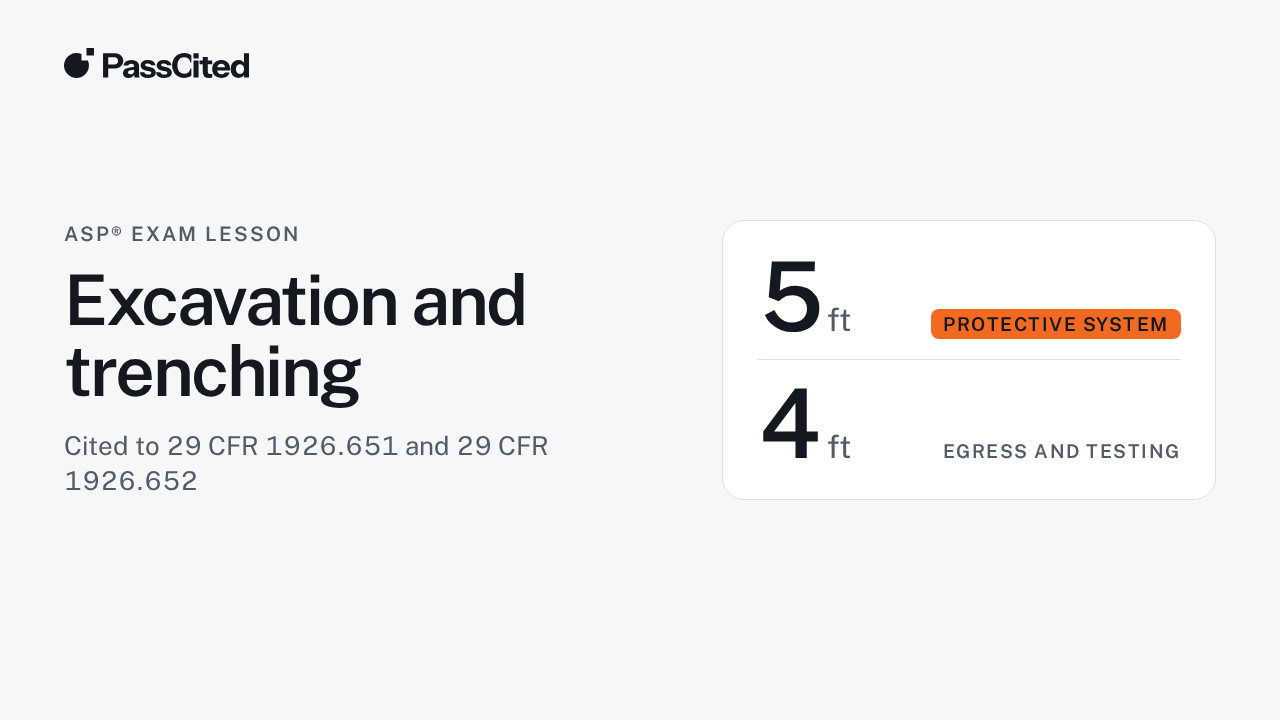 Excavation and trenchingASP lesson, 7:06ASP exam review of 29 CFR 1926 Subpart P: the 5-foot and 4-foot thresholds, utility locates, daily inspections, soil types, maximum allowable slopes, and who does what.
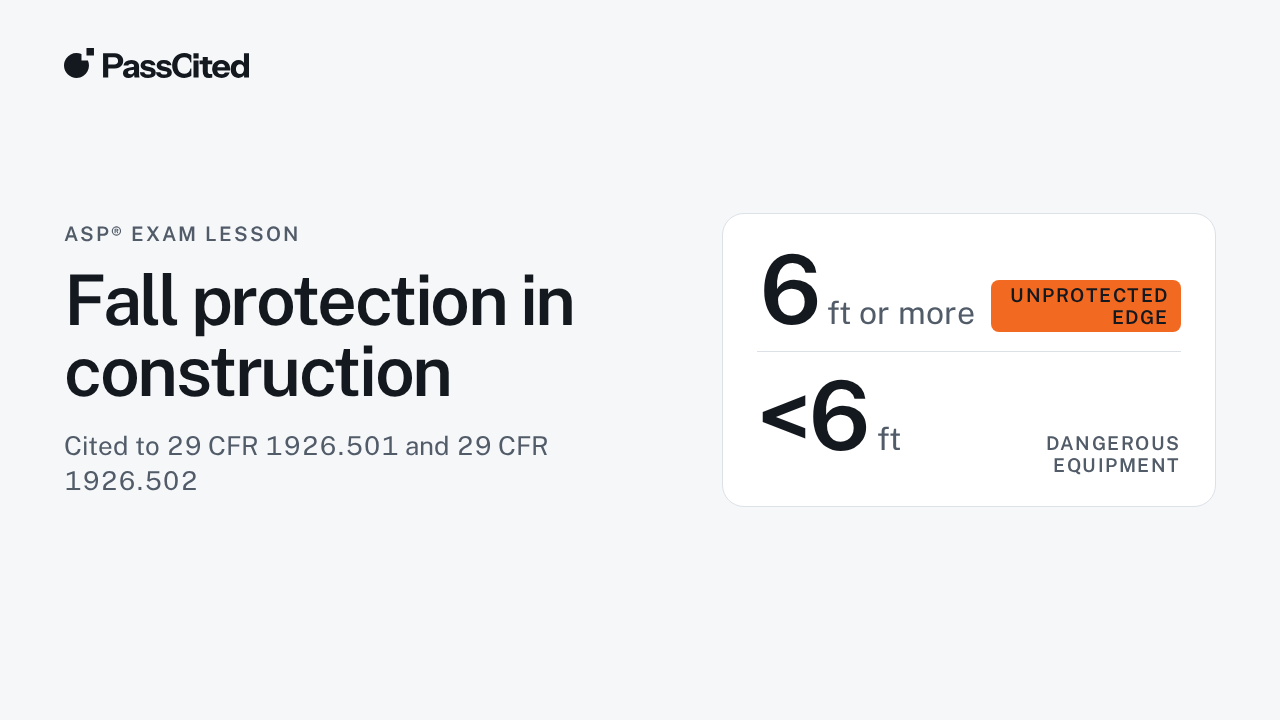 Fall protection in constructionASP lesson, 7:07Construction fall protection under 1926.501 and 1926.502: the 6-foot trigger, system criteria, guardrail, net, arrest and warning line numbers, and who must prepare and supervise.
 Hazard communication and GHSASP lesson, 7:29ASP exam review of OSHA 1910.1200: who classifies chemicals, the six label elements, SDS timing and 16 sections, the written program, training, trade secrets and 2026-2028 dates.
See where you stand on the ASP
25 questions, free, no card. You get a readiness score for each ASP domain.
ASP®, CSP® and CHST® are registered marks of BCSP. PassCited is not affiliated with or endorsed by BCSP.