Lockout/tagout Hazardous energy
ASP video lesson, 7:10. ASP Domain 2: Safety Programs and Concepts
29 CFR 1910.147 for the ASP exam: scope, lockout vs tagout, the application sequence, who applies and removes devices, annual inspection, training, and group lockout.
Included with every pass, and free to watch with captions. Every rule and number is cited on screen to its primary source.
Transcript
0:00 Intro
Lockout/tagout, for the ASP exam. Every rule and number here is cited to its primary source, on screen. In this lesson, you'll learn to: define authorized and affected employees, decide when lockout or tagout is required, put application and release steps in order, and state the inspection, training, and group lockout rules.
0:10 Learning objectives
The standard covers servicing and maintenance where unexpected energization or stored energy release could injure employees.
0:29 Scope
Normal production is not covered. Servicing during production is covered if a guard or safety device is removed or bypassed, or a body part enters the point of operation or danger zone. Minor tool changes and similar minor servicing are excepted only if routine, repetitive, integral, and done with effective alternative measures.
1:05 Definitions
Construction is excluded. Two roles matter most. An authorized employee locks out or tags out equipment to service it. Only authorized employees doing the work apply devices. An affected employee operates the equipment or works in the area, and becomes authorized if duties include servicing.
1:26 Lockout or tagout
The choice depends on the energy isolating device. If the device cannot be locked out, the program uses tagout. If it can be locked out, use lockout, unless the employer shows tagout gives full employee protection. A tag goes where the lock would have gone. After January 2, 1990, new or replaced equipment, or equipment with major repair, renovation or modification, needs devices that accept a lock.
1:55 Application of control
The procedures must cover these actions in sequence. Prepare: know the energy's type, magnitude, hazards and control. Then shut down in an orderly way, and isolate. Next, authorized employees affix a device to each energy isolating device, then render hazardous stored energy safe. Last, before work starts, verify isolation.
2:30 Release
If stored energy can reaccumulate to a hazardous level, keep verifying. Before devices come off, the authorized employee follows set steps. Inspect the work area, and check that all employees are safely positioned or removed. The employee who applied each device removes it. Affected employees are notified after removal and before startup. If that person is unavailable, the employer may direct removal under a documented, trained procedure with equivalent safety: verify they're not at the facility, make all reasonable efforts to contact them, and ensure they know before resuming work.
3:08 Program requirements
The program has three parts: procedures, training, and periodic inspections. Inspect the procedure at least annually, by an authorized employee other than the one using it. The employer certifies each inspection: equipment, date, employees, and inspector. Authorized employees learn energy sources, type, magnitude, and isolation methods. Affected employees learn the procedure's purpose and use.
3:55 Special situations
Others in the area learn the restart prohibition. Retrain when jobs, hazards or procedures change, or deviations appear. Certify training with each name and date. Two situations show up on the exam. Group lockout must equal personal protection.
4:17 Special situations
One authorized employee holds primary responsibility, and each affixes a personal device when starting work. With contractors, the on-site and outside employers inform each other of their procedures. Two more rules keep protection continuous.
4:36 Common exam traps
At shift changes, procedures ensure orderly transfer of protection between off-going and oncoming employees. Affected employees are notified before controls are applied and after they are removed. Now, six traps that catch people on exam day. One: if the device can be locked out, lockout is required unless the employer demonstrates tagout gives full protection. Two: the applier removes the device. Only if unavailable may the employer direct removal under a documented procedure.
5:18 Recap quiz
Three: verification comes before work starts. Four: the annual inspector is not the procedure's user. Five: documentation is waived only when all eight exception elements exist. Six: only authorized employees performing the work apply devices. Question 1. How often must the employer inspect the procedure, and who performs it? A: every two years, by a supervisor. B: annually, by another authorized employee. C: annually, by the user. D: only after an accident. B. At least annually, by an authorized employee other than the procedure's users. Question 2. A device has a hasp, but the employer wants tags only. What must the employer show? A: tags are cheaper. B: employees prefer tags. C: full employee protection. D: nothing. C. Lockout is required unless the employer demonstrates tagout provides full employee protection. Question 3. A worker leaves without removing his lock, and the machine must restart. What is allowed? A: employer-directed removal under a documented procedure. B: a coworker cuts the lock. C: the operator removes it. D: restart with the lock on. A. Only under the documented, trained, equivalent-safety procedure: verify absence, make reasonable efforts to contact the worker, and ensure they know before resuming work. Want to see where you stand on every ASP domain? com.
More ASP lessons
 Excavation and trenchingASP lesson, 7:06ASP exam review of 29 CFR 1926 Subpart P: the 5-foot and 4-foot thresholds, utility locates, daily inspections, soil types, maximum allowable slopes, and who does what.
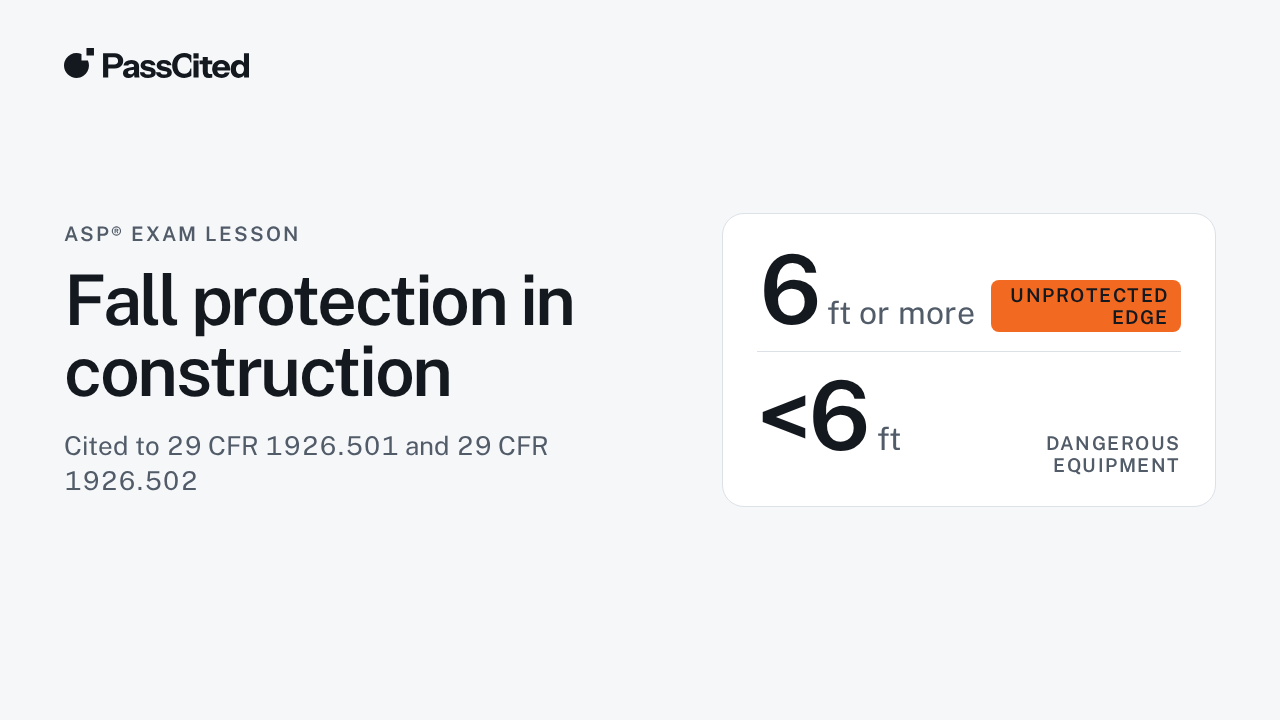 Fall protection in constructionASP lesson, 7:07Construction fall protection under 1926.501 and 1926.502: the 6-foot trigger, system criteria, guardrail, net, arrest and warning line numbers, and who must prepare and supervise.
 Hazard communication and GHSASP lesson, 7:29ASP exam review of OSHA 1910.1200: who classifies chemicals, the six label elements, SDS timing and 16 sections, the written program, training, trade secrets and 2026-2028 dates.
See where you stand on the ASP
25 questions, free, no card. You get a readiness score for each ASP domain.
ASP®, CSP® and CHST® are registered marks of BCSP. PassCited is not affiliated with or endorsed by BCSP.