Personal protective equipment
ASP video lesson, 6:19. ASP Domain 2: Safety Programs and Concepts
General PPE requirements under 1910.132: hazard assessment, written certification, training and retraining, who pays, plus eye, head and foot protection criteria and welding shade numbers.
Included with every pass, and free to watch with captions. Every rule and number is cited on screen to its primary source.
Transcript
0:00 Intro
Personal protective equipment, for the ASP exam. Every rule and number here is cited to its primary source, on screen.
0:08 Learning objectives
In this lesson, you'll learn to: explain the hazard assessment and its written certification, list what training must cover and when retraining is required, decide who pays for PPE and which items are exceptions, and apply the eye, head and foot rules, including welding shade numbers.
0:28 1910.132 general requirements
132 sets the general PPE duties. PPE must be provided, used and maintained in a sanitary and reliable condition wherever hazards require it. All PPE must be of safe design and construction for the work to be performed.
0:50 Hazard assessment
Defective or damaged PPE shall not be used. The employer starts by assessing the workplace for hazards. If hazards are present or likely, select PPE that protects each affected employee, and have them use it. Communicate selection decisions to each employee, and select PPE that properly fits. Verify it with a written certification: workplace, person certifying, date(s), and that it is a certification of hazard assessment.
1:18 Training and retraining
Each employee required to use PPE must be trained. Training covers when and what PPE is necessary, how to don, doff, adjust and wear it, its limitations, and care, maintenance, useful life and disposal. Before working, each employee must demonstrate understanding and the ability to use PPE properly.
1:50 Payment (1910.132(h))
Retrain when workplace or PPE changes make training obsolete, or when inadequate knowledge or use shows. The default: the employer provides PPE at no cost to employees. Exception: non-specialty safety-toe footwear and prescription safety eyewear, if the employer permits wearing them off the job-site.
2:17 1910.133 eye and face
Also excepted: everyday clothing, and ordinary items used solely for weather protection. Replacement PPE is paid by the employer, unless the employee lost or intentionally damaged it. Eye or face protection is required for flying particles, molten metal, chemicals, and injurious light radiation.
2:39 Filter lens shade numbers
For flying object hazards, eye protection must provide side protection. Detachable side shields are acceptable. Prescription wearers need protection that incorporates the prescription or fits over it without disturbing lens position.
3:01 1910.135 and 1910.136
Filter lenses must have a shade number appropriate for the work. The table lists minimum shades. Torch soldering is shade 2. Torch brazing is shade 3. Gas welding by plate thickness: light is 4, heavy is 6. Carbon arc welding is the darkest listed: shade 14.
3:23 Standards and scope
Head and foot protection each have their own triggers. Head: a protective helmet where falling objects could injure the head. Near exposed conductors that could contact the head, it must reduce electrical shock hazard. Foot: falling or rolling objects, objects piercing the sole, or an electrical hazard that remains after other protective measures.
3:48 On the job
Eye, head and foot PPE must each meet listed consensus standards, or be shown at least as effective. 1. 137 standard. You're the safety manager at a fabrication shop. A new welder starts Monday, and no hazard assessment certification exists. First, assess the workplace, then certify it in writing: workplace, your name, the date, and that it is a certification of hazard assessment.
4:22 Common exam traps
Next, select fitted PPE, tell the welder, and choose filter lenses with an appropriate shade number, at no cost to the welder. Finally, train the welder, who must demonstrate proper use before performing the work. Now, four traps that catch people on exam day.
4:46 Recap quiz
One: the employer pays by default; exceptions are specific. Two: the employer is still responsible for the adequacy of employee-owned PPE. Three: the hazard assessment needs a written certification. Four: retraining is required when changes or inadequacies appear. Question 1. Which must the hazard assessment certification identify? A: only the date. B: workplace, certifier, date, and that it is a certification. C: only the PPE selected. D: employees' names. B. It must identify the workplace, the certifier, the date or dates, and that it is a certification of hazard assessment. Question 2. Who must pay for replacement PPE? A: the employer, always. B: the employer, unless the employee lost or intentionally damaged it. C: the employee, always. D: the employer only for safety-toe footwear. B. The employer pays for replacements, except when the employee lost or intentionally damaged the PPE. Question 3. Medium oxygen cutting on 3-inch plate. Minimum shade? A: 3. B: 5. C: 6. D: 4. D, shade 4. Medium oxygen cutting covers 1 to 6 inches. Want to see where you stand on every ASP domain? com.
More ASP lessons
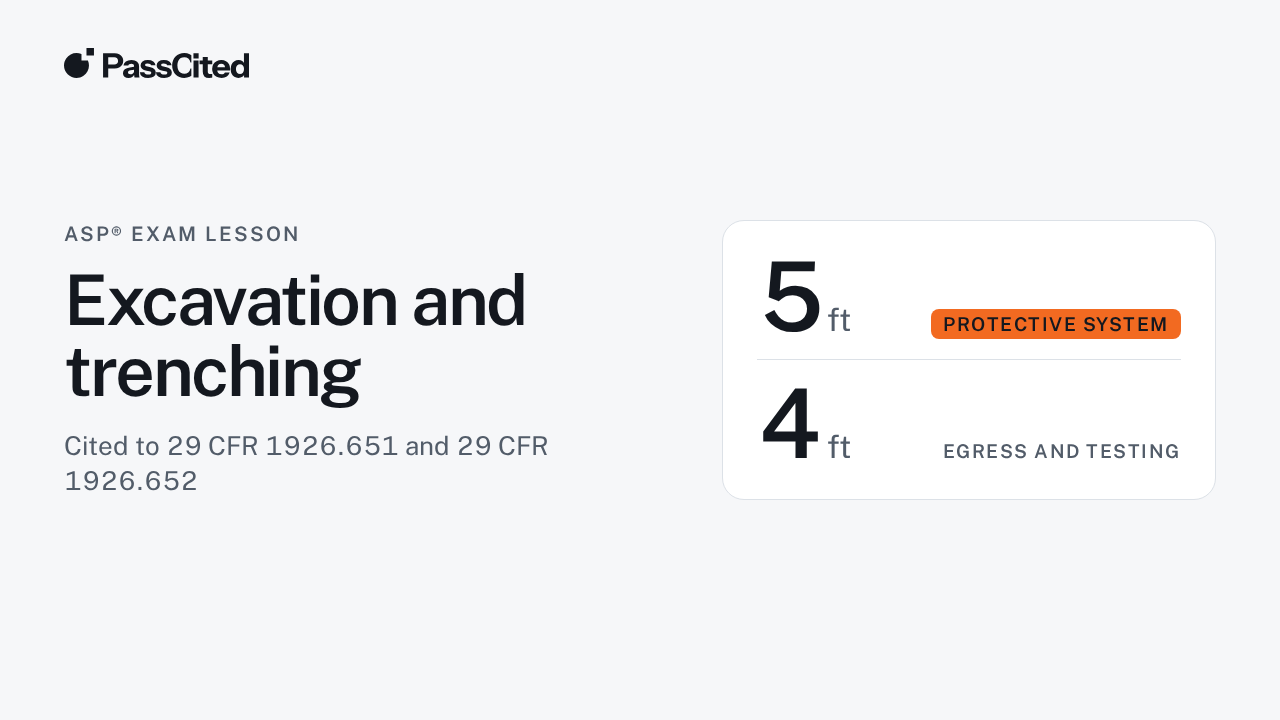 Excavation and trenchingASP lesson, 6:52ASP exam review of 29 CFR 1926 Subpart P: the 5-foot and 4-foot thresholds, utility locates, daily inspections, soil types, maximum allowable slopes, and who does what.
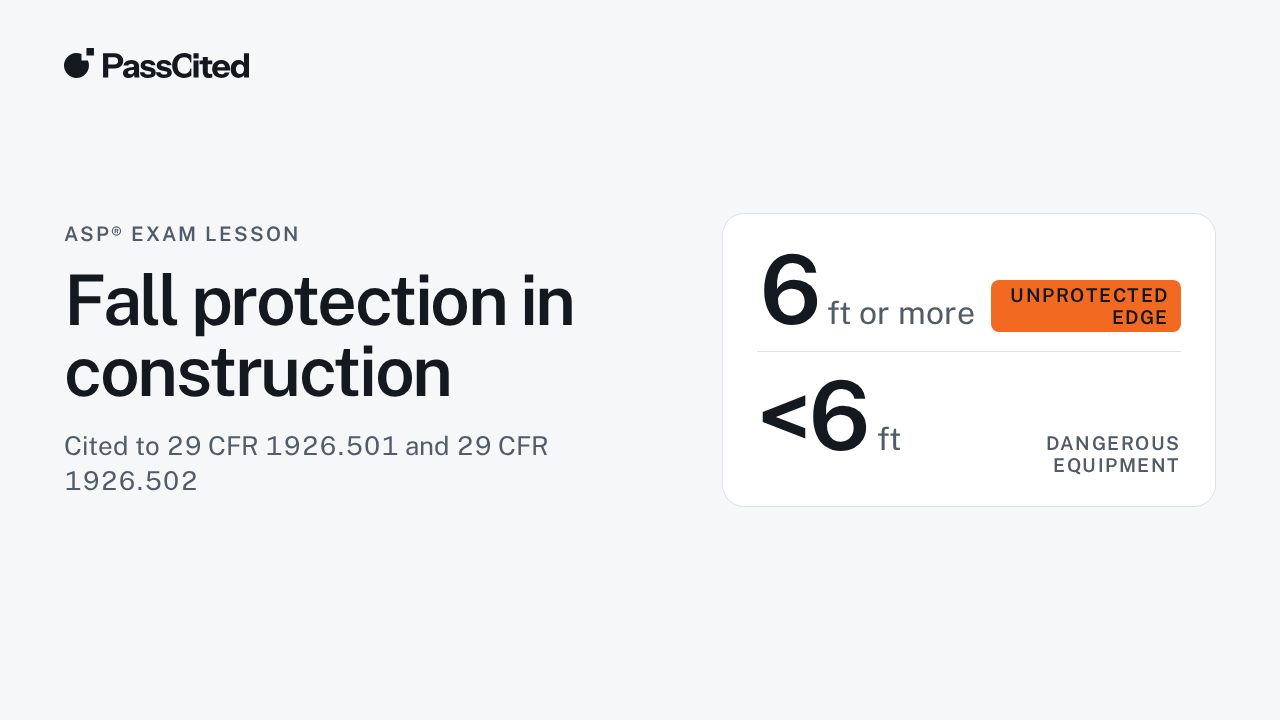 Fall protection in constructionASP lesson, 6:49Construction fall protection under 1926.501 and 1926.502: the 6-foot trigger, system criteria, guardrail, net, arrest and warning line numbers, and who must prepare and supervise.
 Hazard communication and GHSASP lesson, 7:21ASP exam review of OSHA 1910.1200: who classifies chemicals, the six label elements, SDS timing and 16 sections, the written program, training, trade secrets and 2026-2028 dates.
See where you stand on the ASP
25 questions, free, no card. You get a readiness score for each ASP domain.
ASP®, CSP® and CHST® are registered marks of BCSP. PassCited is not affiliated with or endorsed by BCSP.