Process safety management
ASP video lesson, 6:59. ASP Domain 2: Safety Programs and Concepts
PSM under 29 CFR 1910.119 for the ASP exam: coverage thresholds, process safety information, PHA, management of change, pre-startup review, audits and the key time limits.
Included with every pass, and free to watch with captions. Every rule and number is cited on screen to its primary source.
Transcript
0:00 Intro
Process safety management, for the ASP exam. Every rule and number here is cited to its primary source, on screen.
0:08 Learning objectives
In this lesson, you'll learn to: state what triggers PSM coverage and what is exempt, list the process safety information and the PHA rules, apply management of change, pre-startup review and mechanical integrity, and recall the time limits for audits, training and investigations.
0:28 What the standard covers
PSM applies to a process in two ways. One: a chemical at or above the appendix A threshold quantity. Two: a Category 1 flammable gas, or flammable liquid with a flashpoint below 100 °F, on site in one location at 10,000 pounds or more. Exempt: retail, well drilling or servicing, and normally unoccupied remote facilities. From the 10,000-pound trigger only: atmospheric-tank or transferred liquids kept below normal boiling point without chilling, and hydrocarbon fuels used solely for workplace consumption as a fuel, if not part of a process with another covered chemical.
1:11 Process safety information
Compile written process safety information before conducting any process hazard analysis. Chemical hazards: toxicity, PELs, reactivity. Technology: flow diagram, chemistry, maximum intended inventory, safe limits. Equipment: P&IDs, electrical classification, relief system design basis, safety systems.
1:37 Process hazard analysis
The PHA identifies, evaluates and controls process hazards. The team needs engineering and operations expertise, at least one process-experienced employee, and one member who knows the method. At least every 5 years, a qualifying team updates and revalidates it. Keep PHAs, updates and documented resolutions for the life of the process.
2:03 Management of change
Written MOC procedures cover changes to chemicals, technology, equipment and procedures, and facility changes affecting a covered process. Replacements in kind are excluded. Before any change, address its technical basis and its impact on safety and health. Also address procedure changes, the time needed, and authorization requirements.
2:31 Pre-startup and integrity
Affected employees and contractors are informed and trained before start-up. Two often-confused elements. Pre-startup review first. It applies to new facilities, and to modified ones only when the modification requires a change in the process safety information. It confirms readiness, including completed training, before chemicals are introduced. Mechanical integrity covers vessels, tanks, piping, relief and vent systems, shutdown systems, controls and pumps.
3:08 Numbers to memorize
Deficiencies outside acceptable limits are corrected before further use, or safely and timely once necessary means assure safe operation. The most testable numbers. PHA revalidation: at least every 5 years. Compliance audit: at least every 3 years. Refresher training: at least every 3 years, more often if necessary.
3:36 Incidents and audits
Operating procedures: certified annually. Investigations start no later than 48 hours. Incident investigation reports are kept 5 years. Keep the two most recent audit reports. Investigate each incident that resulted in, or could reasonably have resulted in, a catastrophic release. Near misses count. The team includes at least one person knowledgeable in the process, a contract employee if contractor work was involved, and others with appropriate knowledge.
4:06 On the job
Compliance audits are certified at least every 3 years, and conducted by at least one person knowledgeable in the process. Compliance audit findings get a documented response, and deficiencies are documented as corrected. You're the safety manager at a chemical plant. Maintenance proposes swapping a reactor relief valve for a different model.
4:41 Common exam traps
First, ask whether it satisfies the design specification. If so, it's a replacement in kind, excluded from MOC. If the different model does not satisfy the design specification, it is a change. Run MOC before it: technical basis, safety impact, procedures, time, authorization. Train affected employees before start-up. If the PSI must change, a pre-startup review is required. Now, six traps that catch people on exam day. One: replacements in kind are excluded from management of change. Two: a pre-startup review for modified facilities is only needed if the PSI must change.
5:24 Recap quiz
Three: PHA revalidation is at least every 5 years. Audits and refresher training: at least every 3. Four: near misses with catastrophic potential must be investigated. Five: incidental contractor services that do not influence process safety are excluded. Six: keep the two most recent audit reports; incident reports, 5 years. Question 1. How often must a PHA be revalidated? A: every year. B: at least every 3 years. C: at least every 5 years. D: every 10 years. C. At least every 5 years, by a team meeting the (e)(4) requirements. Question 2. A pump is replaced with an identical unit meeting the design specification. What does PSM require? A: full MOC review. B: a new PHA. C: nothing under MOC. D: a pre-startup review. C. A replacement in kind satisfies the design specification and is excluded from MOC. Question 3. A near miss could reasonably have caused a catastrophic release. When must the investigation begin? A: within 24 hours. B: as promptly as possible, but within 48 hours. C: within 5 days. D: only if someone was injured. B. As promptly as possible, but not later than 48 hours. Want to see where you stand on every ASP domain? com.
More ASP lessons
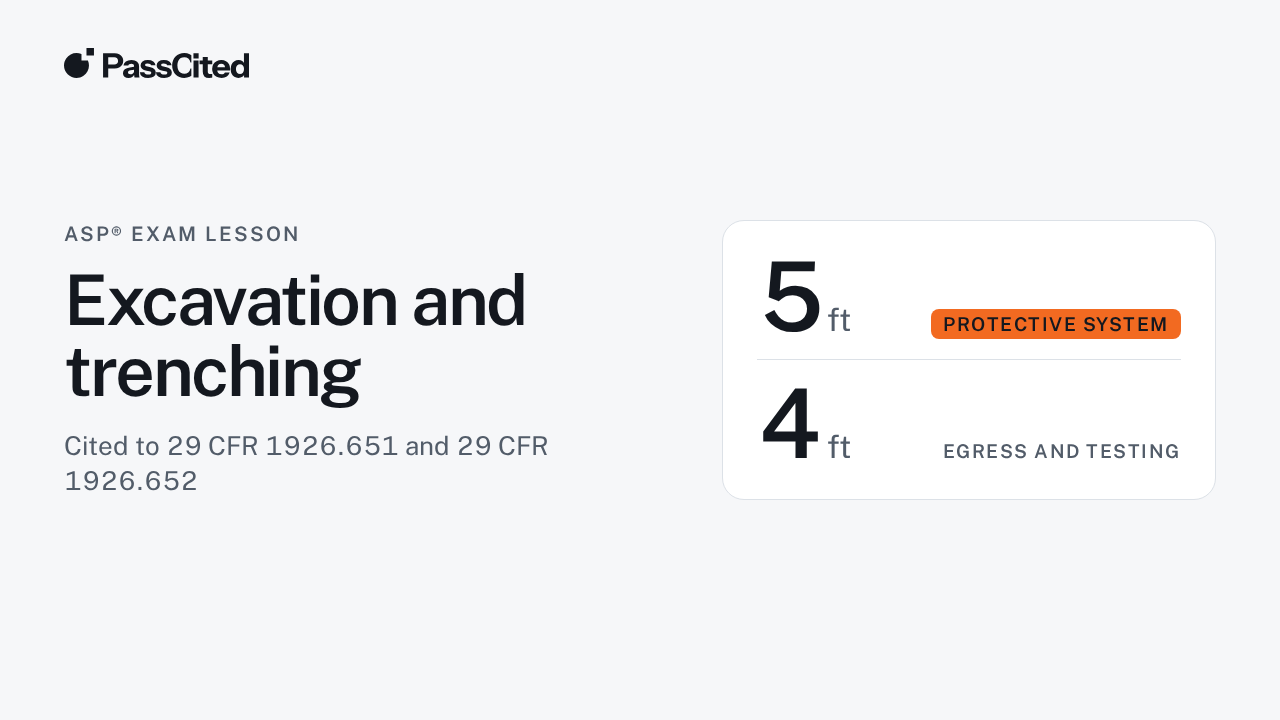 Excavation and trenchingASP lesson, 6:52ASP exam review of 29 CFR 1926 Subpart P: the 5-foot and 4-foot thresholds, utility locates, daily inspections, soil types, maximum allowable slopes, and who does what.
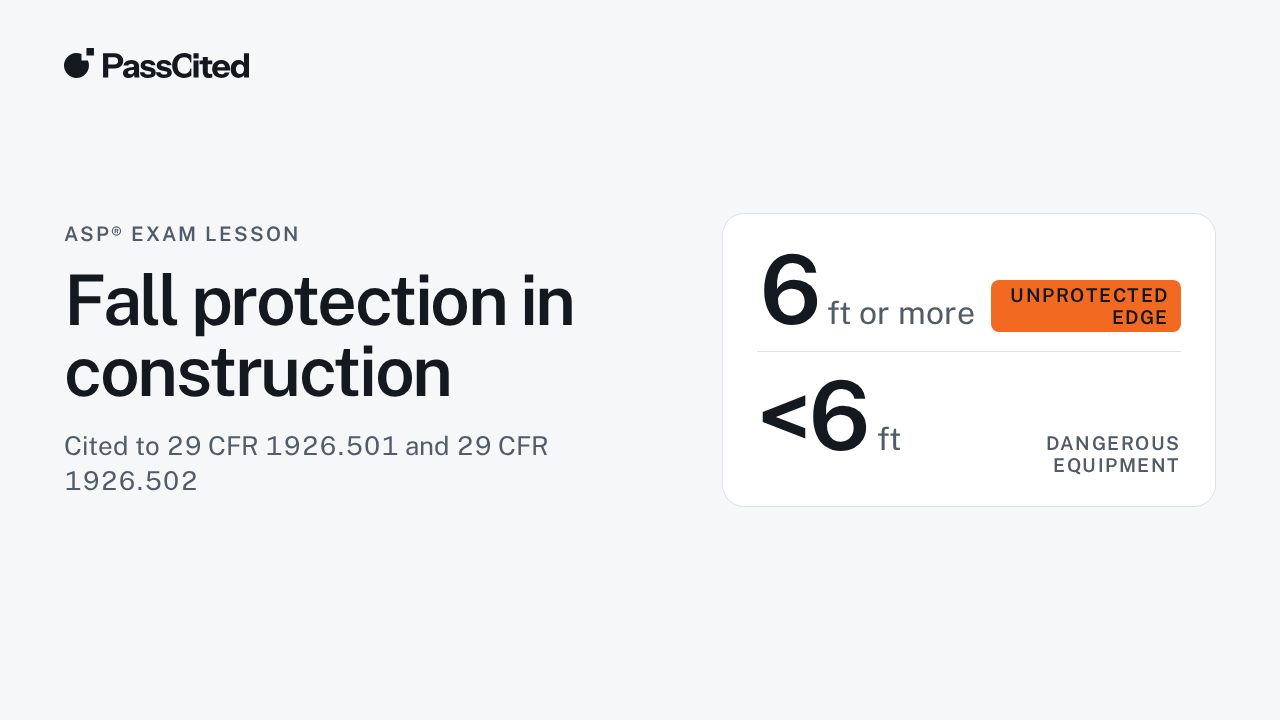 Fall protection in constructionASP lesson, 6:49Construction fall protection under 1926.501 and 1926.502: the 6-foot trigger, system criteria, guardrail, net, arrest and warning line numbers, and who must prepare and supervise.
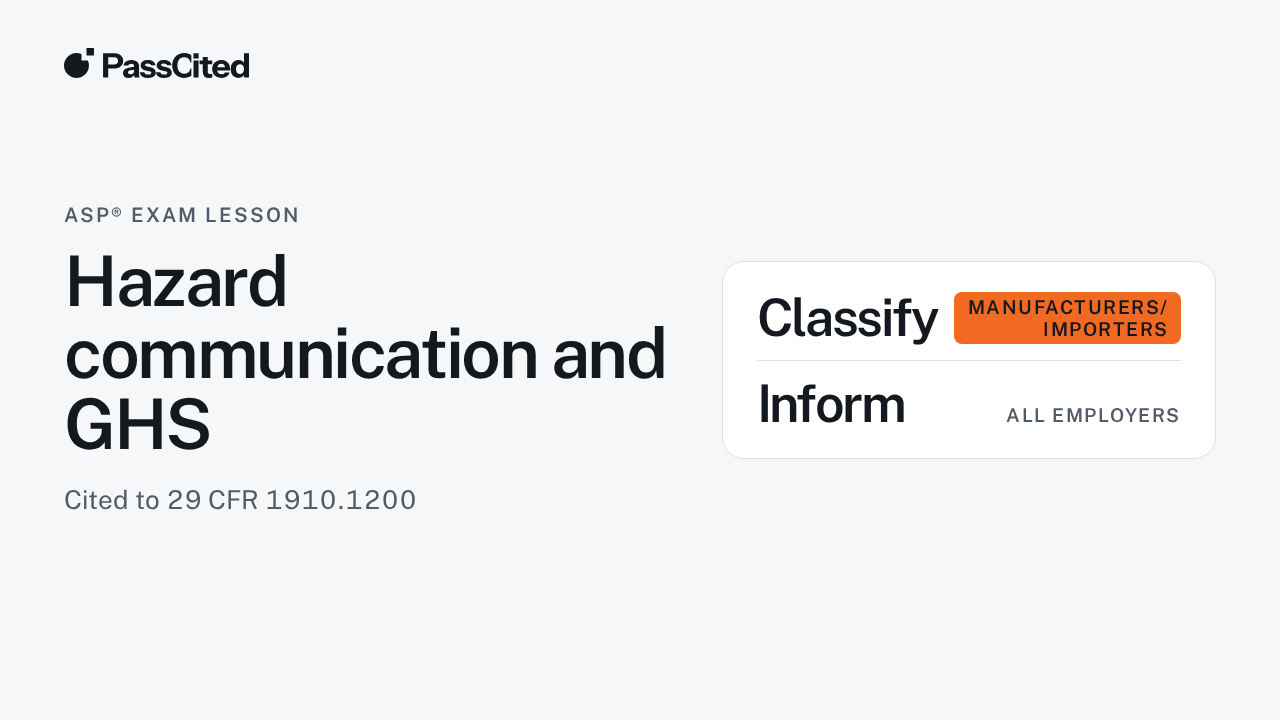 Hazard communication and GHSASP lesson, 7:21ASP exam review of OSHA 1910.1200: who classifies chemicals, the six label elements, SDS timing and 16 sections, the written program, training, trade secrets and 2026-2028 dates.
See where you stand on the ASP
25 questions, free, no card. You get a readiness score for each ASP domain.
ASP®, CSP® and CHST® are registered marks of BCSP. PassCited is not affiliated with or endorsed by BCSP.