Respiratory protection OSHA 1910.134
ASP video lesson, 7:41. ASP Domain 6: Industrial Hygiene and Occupational Health
OSHA 1910.134 for the ASP exam: written program, IDLH respirators, APFs and MUC, medical evaluation, fit testing, inspection, air quality, training and records, with the thresholds that get tested.
Included with every pass, and free to watch with captions. Every rule and number is cited on screen to its primary source.
Transcript
0:00 Intro
Respiratory protection, for the ASP exam. Every rule and number here is cited to its primary source, on screen.
0:10 Learning objectives
In this lesson, you'll learn to: state the program and selection duties, match respirators to IDLH and non-IDLH air, apply medical and fit test timing, and use inspection and air quality limits.
0:28 1910.134(a) and (c)
Controls come first. Respirators are used when controls are not feasible, or while being instituted. Where respirators are necessary, or required by the employer, a written program with worksite-specific procedures is required. A designated administrator, qualified by training or experience, oversees it.
0:59 1910.134(d)(2)
Respirators, training and medical evaluations are provided at no cost to the employee. If exposure cannot be identified or reasonably estimated, the atmosphere is considered IDLH. For IDLH, provide a full facepiece pressure demand SCBA certified for at least thirty minutes. Or a combination full facepiece pressure demand SAR with auxiliary self-contained air supply.
1:34 Selection: APF and MUC
5 percent oxygen, are IDLH, with a narrow altitude-based exception. Maximum use concentration is the APF times the OSHA PEL, STEL or ceiling limit. Take a half mask air-purifying respirator, APF 10, against a PEL of 5 ppm. Ten times five gives fifty ppm. Exposure outside the respirator must stay at or below the MUC. A calculated MUC above the IDLH level or the cartridge limit is set at that lower limit.
2:11 1910.134(d)(3)
Never apply an MUC to IDLH. For gases and vapors: an atmosphere-supplying respirator, or an air-purifying one meeting a condition. A NIOSH-certified ESLI, or else a cartridge change schedule based on objective data. For particulates: an atmosphere-supplying respirator, or an air-purifying one with a HEPA or NIOSH 42 CFR 84 filter.
2:47 1910.134(e) and (f)
If particles are primarily MMAD of at least 2 micrometers, any NIOSH-certified particulate filter is allowed. The sequence matters. Medical evaluation comes before fit testing or required use. A physician or other licensed health care professional gives a written recommendation, with only limitations, any follow-up need, and a copy statement. For tight-fitting respirators, fit test before initial use, when a different facepiece is used, and at least annually.
3:30 1910.134(g)
QLFT only for negative pressure air-purifying respirators needing a fit factor of 100 or less. QNFT passes at 100 for half, 500 for full facepieces. No tight-fitting facepiece with facial hair at the seal or valve, or any condition interfering with seal or valve function. For tight-fitting respirators, a user seal check is performed each time the respirator is put on.
4:00 1910.134(g)(3) and (g)(4)
Employees must leave the area on breakthrough, changed breathing resistance, or leakage. The employer must replace or repair the respirator before the employee returns. For IDLH entry, at least one employee stays outside, with visual, voice or signal line communication. Outside employees are trained and equipped for rescue: positive pressure SCBA or SAR with auxiliary SCBA, plus retrieval equipment or equivalent means.
4:40 1910.134(h) and (i)
Interior structural firefighting adds: at least two employees enter and stay in visual or voice contact. At least two stay outside, and all employees engaged in interior structural firefighting use SCBAs. Routine respirators: inspected before each use and during cleaning.
5:14 Common exam traps
Emergency respirators: inspected at least monthly, and checked before and after each use. SCBA cylinders are kept fully charged, and recharged when pressure falls to 90 percent of the manufacturer's recommended level. 5 percent, CO 10 ppm or less, CO2 1,000 ppm or less. Now, five traps that catch people on exam day.
5:46 Recap quiz
One: medical comes before fit testing or required use. Two: unknown exposure is treated as IDLH. Three: gas cartridges need an ESLI or objective change schedule. Four: seal check every time you put it on. Five: QLFT only for negative pressure air-purifying respirators needing a fit factor of 100 or less. Question 1. Which respirator is acceptable in an IDLH atmosphere? A: Half mask with P100. B: Full facepiece pressure demand SCBA, thirty-minute NIOSH minimum. C: Filtering facepiece with ESLI. D: Loose-fitting PAPR. B. IDLH needs a full facepiece pressure demand SCBA certified for at least 30 minutes, or a combination SAR with auxiliary air. Question 2. Half mask, APF 10, PEL 5 ppm. What is the MUC? 5 ppm. B: 15 ppm. C: 50 ppm. D: 500 ppm. C. MUC is APF times the exposure limit: 10 times 5 is 50 ppm. Question 3. A new employee will use a tight-fitting respirator. What is the correct order? A: Fit test, medical, use. B: Training only. C: Medical, fit test, required use. D: Fit test after 30 days. C. Medical evaluation comes before fit testing or required use, and fit testing happens before initial use. Want to see where you stand on every ASP domain? com.
More ASP lessons
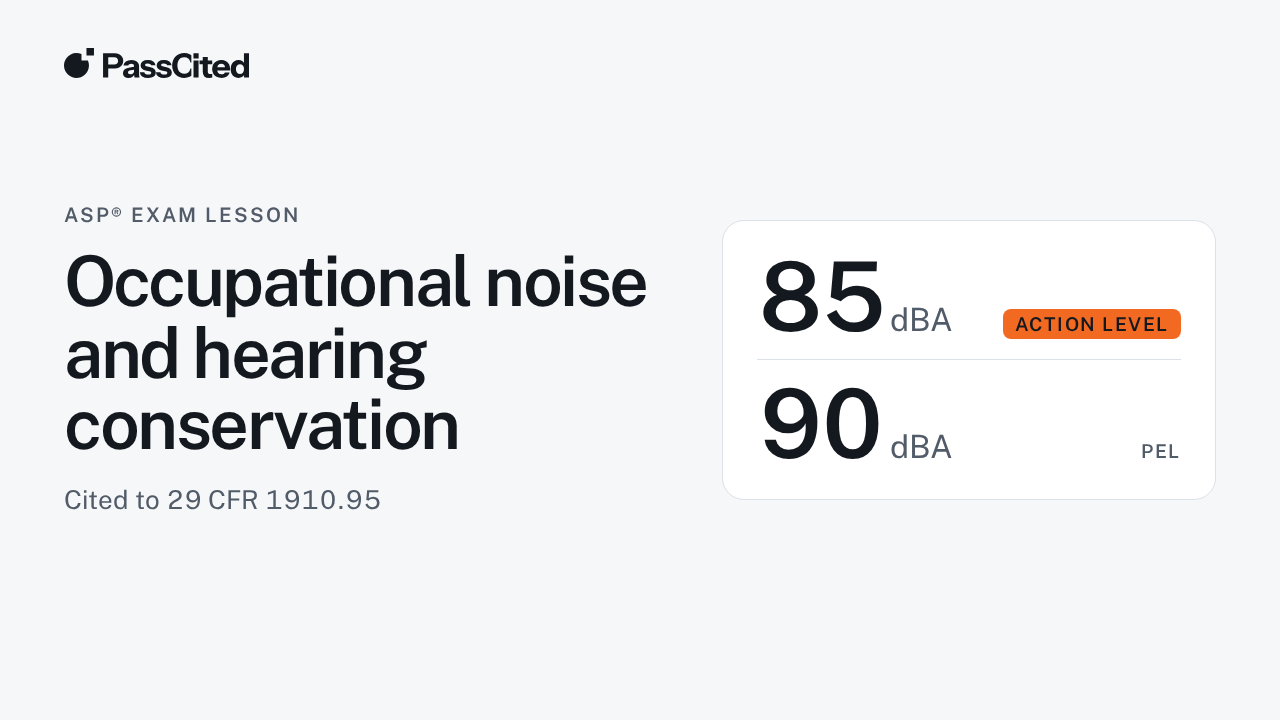 Occupational noise and hearing conservationASP lesson, 6:55Action level vs PEL, the 5 dB exchange rate, audiometric testing and STS, noise dose and TWA math, decibel addition and NRR derating, cited to 29 CFR 1910.95.
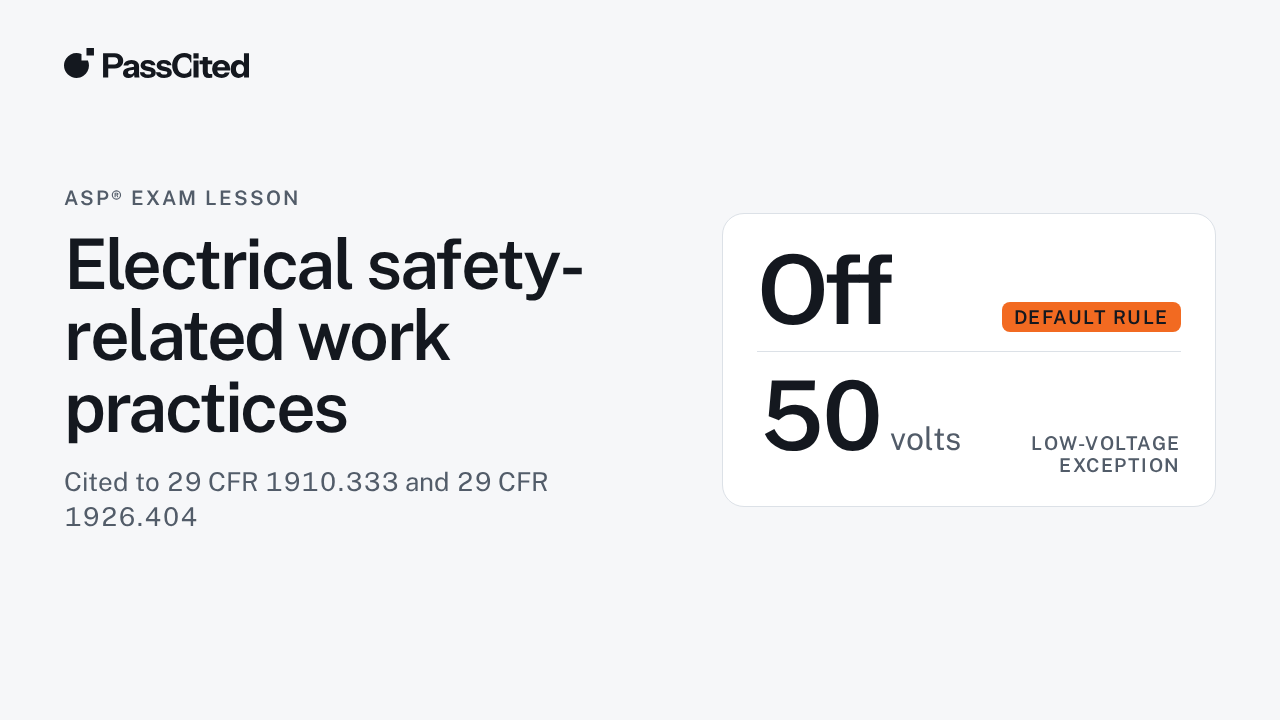 Electrical safety-related work practicesASP lesson, 7:14Deenergize first, lockout and tagging, qualified-person tests, overhead line distances, and construction GFCI and grounding rules from 1910.333 and 1926.404, for the ASP exam.
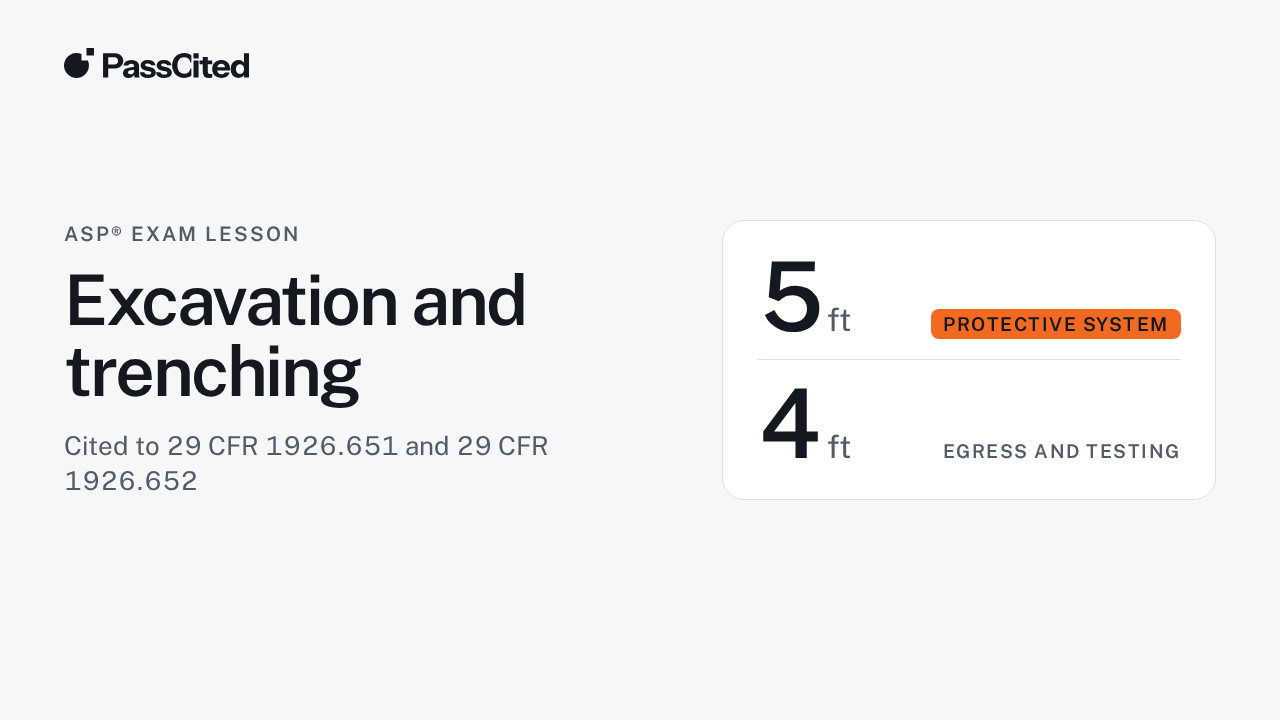 Excavation and trenchingASP lesson, 7:06ASP exam review of 29 CFR 1926 Subpart P: the 5-foot and 4-foot thresholds, utility locates, daily inspections, soil types, maximum allowable slopes, and who does what.
See where you stand on the ASP
25 questions, free, no card. You get a readiness score for each ASP domain.
ASP®, CSP® and CHST® are registered marks of BCSP. PassCited is not affiliated with or endorsed by BCSP.