Walking-working surfaces and fall protection
ASP video lesson, 6:34. ASP Domain 2: Safety Programs and Concepts
General industry fall protection under 29 CFR 1910.22 and 1910.28: the 4-foot trigger, holes, dockboards, pits, fixed ladders, low-slope roofs and falling objects, for the ASP exam.
Included with every pass, and free to watch with captions. Every rule and number is cited on screen to its primary source.
Transcript
0:00 Intro
Walking-working surfaces and fall protection, for the ASP exam. Every rule and number here is cited to its primary source, on screen.
0:09 Learning objectives
In this lesson, you'll learn to: state the 4-foot general industry fall protection trigger, apply the rules for holes, dockboards and pits, match low-slope roof edge distances to the required protection, and recall the fixed ladder dates, intervals, and falling object rules.
0:29 1910.22 general requirements
22 sets the baseline duties. Surfaces stay clean, orderly, sanitary and hazard-free. Each surface must support its maximum intended load. Inspect regularly. Correct hazards before reuse, or guard them. If a repair affects structural integrity, a qualified person performs or supervises it.
0:54 1910.28 the core trigger
28 is the duty to have fall protection. Its core trigger is 4 feet. An unprotected edge 4 feet or more up needs guardrails, safety nets, or personal fall protection. Personal systems: arrest, travel restraint, or positioning.
1:16 Holes, pits and openings
Surfaces not otherwise addressed use the same trigger. Holes split by height. At 4 feet or more: covers, guardrails, travel restraint, or arrest. Under 4 feet, protect against tripping or stepping into the hole with covers or guardrails. Openings apply when the inside bottom edge is under 39 inches and the outside bottom edge is 4 feet or more up. Pits under 10 feet deep need no fall protection system if, among other conditions, access within 6 feet is limited to trained, authorized employees.
1:55 Dockboards and runways
Mark or warn off 6 feet out, and post a Caution, Open Pit sign. Both trigger at 4 feet, with different exceptions. Dockboards need a guardrail or handrails at 4 feet or more. Exception: motorized materials handling only, exposure no greater than 10 feet, trained employees. Runways need a guardrail. On a special-purpose runway, one side may be omitted only if infeasible, the runway is 18 inches wide or more, and each employee uses arrest or restraint.
2:24 Low-slope roofs
On low-slope roofs, protection depends on distance from the edge. Under 6 feet: rail, net, restraint, or arrest. No designated area. From 6 up to 15 feet: the same, but a designated area is allowed for work that is both infrequent and temporary.
2:56 Fixed ladders over 24 feet
At 15 feet or more, fall protection can be skipped only if the work is both infrequent and temporary. A work rule must also bar anyone within 15 feet unprotected. These rules cover fixed ladders extending more than 24 feet above a lower level. Installed before November 19, 2018: a fall arrest system, ladder safety system, cage, or well. On or after that date: a personal fall arrest or ladder safety system. A cage alone no longer qualifies. By November 18, 2036, all fixed ladders need arrest or ladder safety systems.
3:35 Falling object protection
With arrest or ladder safety systems: rest platforms every 150 feet at most. Cage or well sections: landings every 50 feet at most. When employees are exposed to falling objects, head protection is required.
3:57 On the job
In addition, the employer implements one or more of three controls. Toeboards, screens, or guardrails. Or canopies, keeping objects back from the edge. Or barricade the area below, prohibit entry, and keep objects back from the edge. You find a worker servicing a rooftop unit 10 feet from the edge of a low-slope roof.
4:19 Common exam traps
That is the 6-to-15-foot band, so protection is required. Use rails, nets, restraint, or arrest, or a designated area if the work is infrequent and temporary. The 15-foot work rule applies only at 15 feet or more. Now, five traps that catch people on exam day. One: general industry triggers at 4 feet or more, not 6. Two: pits under 10 feet need no fall protection if conditions are met.
4:53 Recap quiz
Three: new fixed ladders need arrest or ladder safety systems, not a cage alone. Four: rest platforms at 150 feet; cage or well landings at 50. Five: past 15 feet, skipping protection requires infrequent and temporary work. Question 1. A general industry worker is on an unprotected edge 6 feet up. What is required? A: nothing, B: guardrail, net, or personal fall protection, C: a sign, D: head protection only. B. At 4 feet or more, guardrails, nets, or personal fall protection are required. Question 2. Which condition must be met for a pit under 10 feet to need no fall protection system? A: under 4 feet from an aisle, B: access within 6 feet limited to trained authorized employees, C: a floor drain, D: covered at night. B. Access within 6 feet is limited to trained authorized employees, with markings and a sign. Question 3. Infrequent, temporary work, 15 feet or more from a low-slope roof edge. 28 require? A: guardrails regardless, B: arrest for each worker, C: no protection but a 15-foot work rule, D: a ladder cage. C. No fall protection is required, but the 15-foot work rule must be enforced. Want to see where you stand on every ASP domain? com.
More ASP lessons
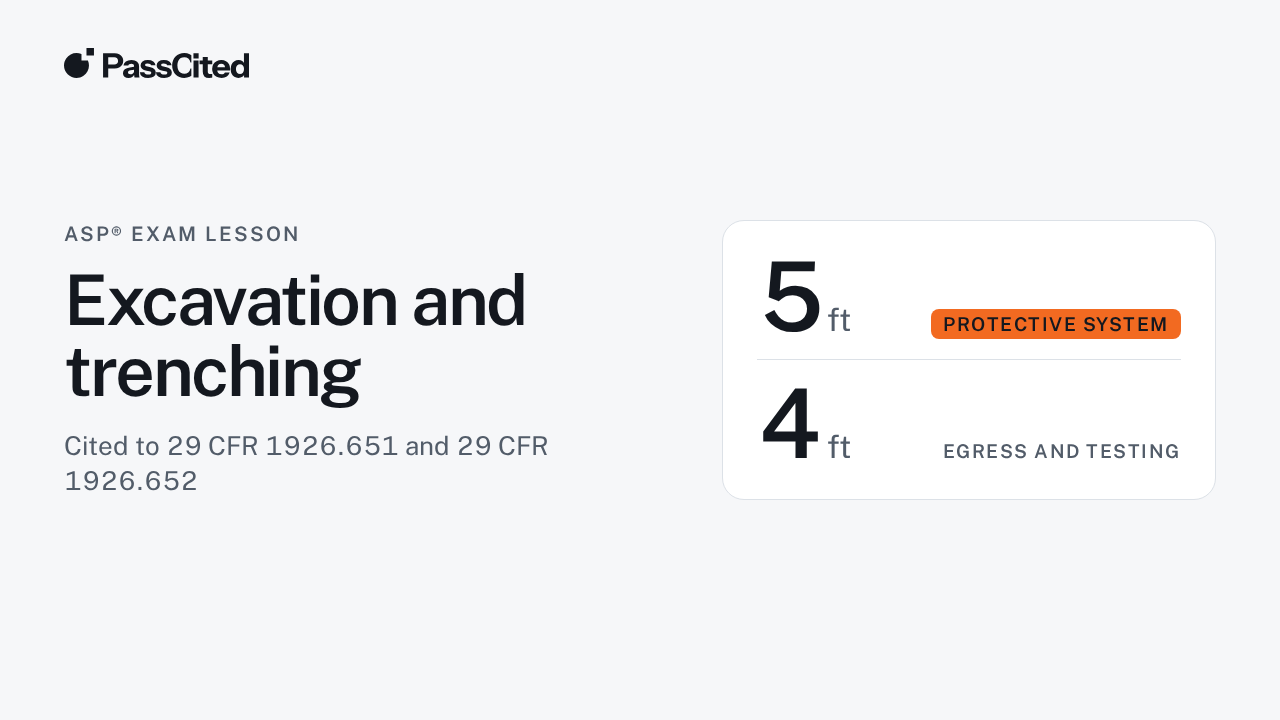 Excavation and trenchingASP lesson, 6:52ASP exam review of 29 CFR 1926 Subpart P: the 5-foot and 4-foot thresholds, utility locates, daily inspections, soil types, maximum allowable slopes, and who does what.
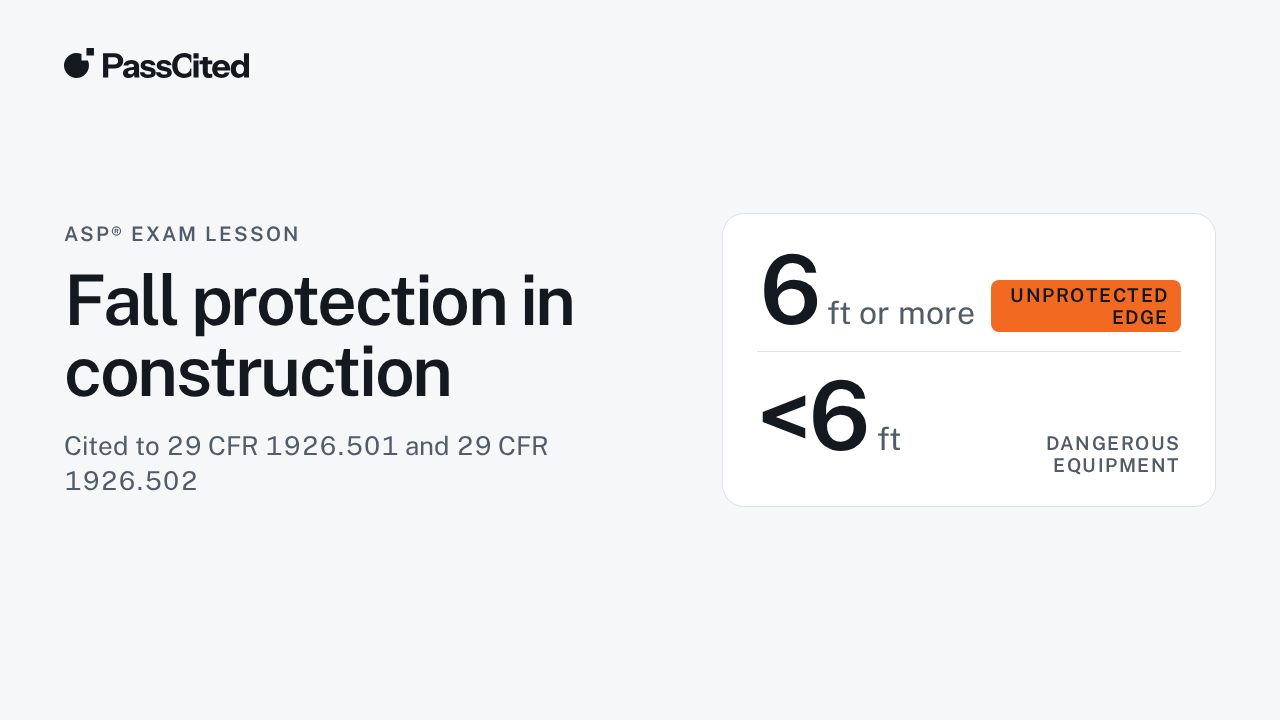 Fall protection in constructionASP lesson, 6:49Construction fall protection under 1926.501 and 1926.502: the 6-foot trigger, system criteria, guardrail, net, arrest and warning line numbers, and who must prepare and supervise.
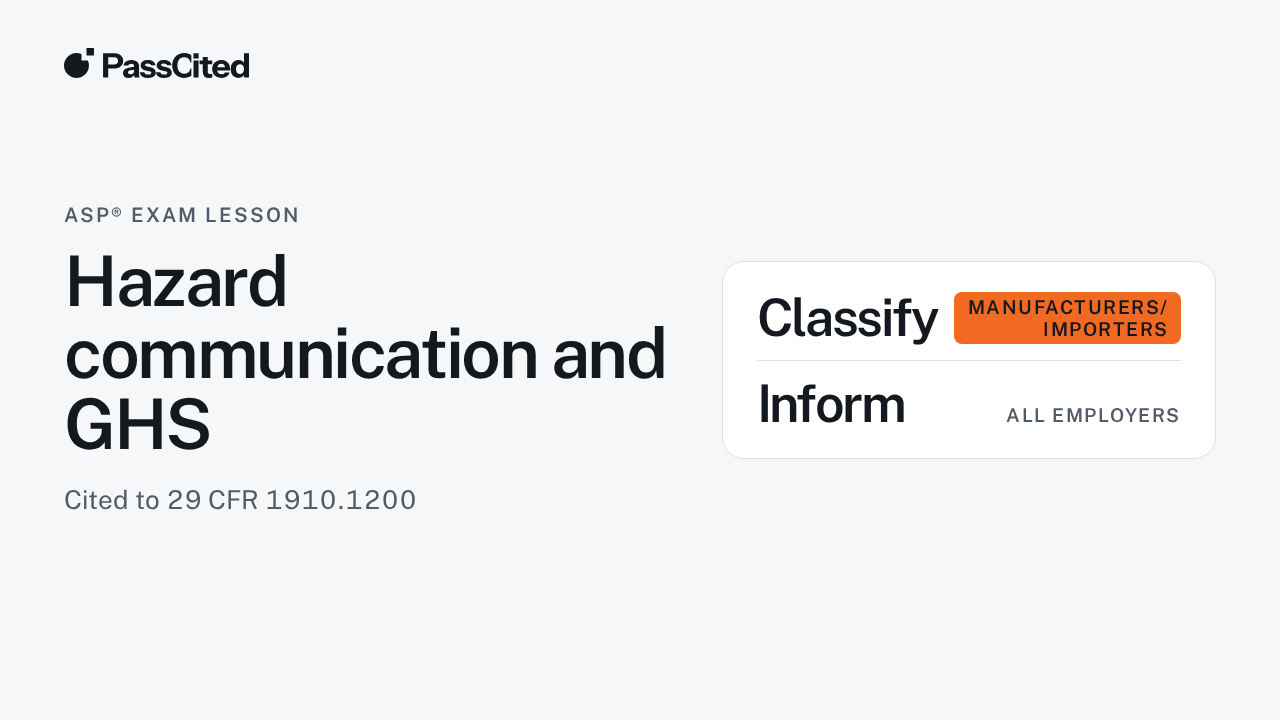 Hazard communication and GHSASP lesson, 7:21ASP exam review of OSHA 1910.1200: who classifies chemicals, the six label elements, SDS timing and 16 sections, the written program, training, trade secrets and 2026-2028 dates.
See where you stand on the ASP
25 questions, free, no card. You get a readiness score for each ASP domain.
ASP®, CSP® and CHST® are registered marks of BCSP. PassCited is not affiliated with or endorsed by BCSP.