Asbestos in construction 29 CFR 1926.1101
CHST video lesson, 7:27. CHST Domain 1: Hazard and Risk Identification and Control
Asbestos in construction under 29 CFR 1926.1101 for the CHST exam: PELs, work classes, competent person duties, regulated areas, monitoring, training hours and notification deadlines.
Included with every pass, and free to watch with captions. Every rule and number is cited on screen to its primary source.
Transcript
0:00 Intro
Asbestos in construction, for the CHST exam. Every rule and number here is cited to its primary source, on screen.
0:11 Learning objectives
In this lesson, you'll learn to: state the PEL and the excursion limit, distinguish Class I through IV work and the competent person's role, apply the 25 linear foot and 10 square foot triggers, and recall the monitoring and notification deadlines.
0:31 Limits and definition
Two limits anchor the standard. 1 fiber per cubic centimeter over 8 hours. 0 fiber per cubic centimeter over 30 minutes. ACM means more than one percent asbestos.
0:49 Work classes
Classification drives every control. Know the four classes. Class I is removal of thermal system insulation and surfacing ACM or PACM. Class II is removal of other ACM, like floor tile, wallboard, roofing and siding. Class III is repair and maintenance likely to disturb ACM. Class IV is maintenance and custodial contact without disturbance, plus cleanup of Class I through III debris.
1:25 Definitions
Two definitions get tested constantly: PACM and the regulated area. PACM is thermal system insulation and surfacing material in buildings constructed no later than 1980. The designation can be rebutted. All Class I, II and III work occurs in regulated areas, limited to authorized persons and those authorized by the Act.
1:59 Who must do what
No eating, drinking, smoking, chewing tobacco or gum, or cosmetics. The competent person is the key role. All asbestos work in regulated areas must be supervised by a competent person. A competent person conducts the initial exposure assessment, immediately before or at the start of the operation. They inspect worksuits for rips or tears at least once per workshift.
2:34 Class I thresholds
For Class I and II, EPA supervisor training or equivalent. For Class III and IV, training consistent with EPA maintenance staff requirements. One threshold keeps appearing: 25 linear feet or 10 square feet of TSI or surfacing material. Above it, Class I jobs need critical barriers or equivalent isolation, with outdoor exceptions, plus protective clothing and a decontamination area: equipment room, shower area and clean room, in series.
3:12 Controls
Below it, an equipment room or area with an impermeable drop cloth is used. Barriers still apply with no negative exposure assessment or adjacent workers. Some controls apply regardless of exposure levels. Others are banned outright. Required regardless of exposure level: HEPA vacuums, wet methods unless infeasible, such as electrical hazards, and prompt cleanup in leak-tight containers.
3:48 Class I methods
Roofing follows its own rules. Prohibited: dry sweeping, uncaptured compressed air, employee rotation to reduce exposure, and high-speed abrasive disc saws lacking point-of-cut ventilation or HEPA-filtered exhaust enclosures.
4:19 Deadlines
Class I specific methods carry numbers the exam likes to test. 02 inches of water. Glovebags are 6 mil plastic, used once, never moved, and not used above 150 degrees Fahrenheit. At least two persons perform glovebag removal. A mini-enclosure holds no more than two. Three clocks to memorize.
4:47 Common exam traps
Newly discovered ACM or PACM: tell the owner and other employers within 24 hours. Monitoring results: notify affected employees no later than 5 working days after receipt. After completing work: tell the owner and area employers about remaining ACM and final monitoring results within 10 days. Now, six traps that catch people on exam day. One: the excursion limit averages 30 minutes, not eight hours. Two: employee rotation is prohibited as an exposure control.
5:32 Recap quiz
Three: dry sweeping is prohibited. Use HEPA vacuums and wet methods. Four: filtering facepiece respirators are not allowed against asbestos fibers. Five: training covers Class I through IV, at assignment and at least annually. Six: TSI and surfacing material in buildings built no later than 1980 are presumed asbestos-containing, PACM. Question 1. A job removes 40 linear feet of thermal system insulation. Which hygiene facility is required? A: drop-cloth equipment area only. B: equipment room, shower, clean room in series. C: clean room only. D: portable shower only. B. Over 25 linear feet, Class I work needs the full equipment room, shower and clean room in series. Question 2. 2 f/cc. Which limit is exceeded? A: neither. B: the TWA only. C: the excursion limit only. D: both. C. 0 excursion limit. Question 3. A contractor discovers asbestos-containing material mid-job. By when must the owner and other employers be told? A: within 24 hours. B: within 5 working days. C: within 10 days. D: by the end of the job. A. Newly discovered ACM or PACM must be reported within 24 hours of discovery. Want to see where you stand on every CHST domain? com.
More CHST lessons
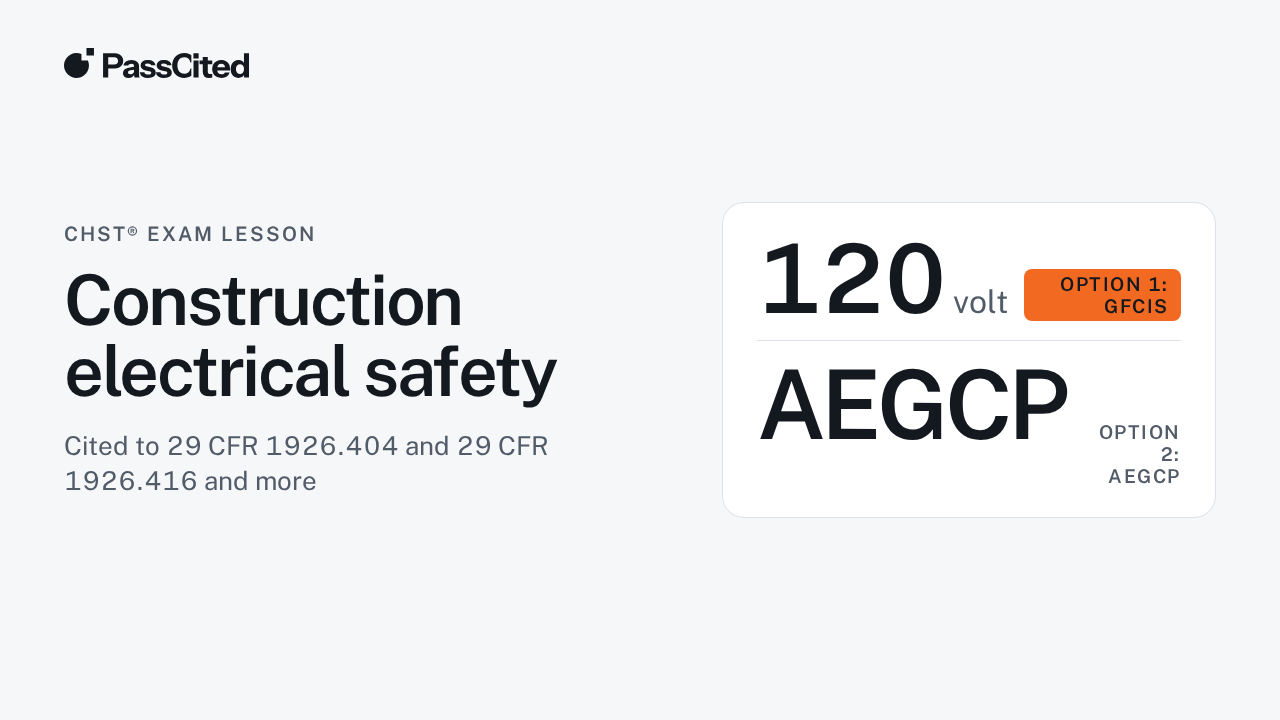 Construction electrical safetyCHST lesson, 7:05Construction electrical safety for the CHST exam: GFCI versus the assured grounding program, test intervals, overhead clearances, grounding distances, and lockout tagging under 1926 Subpart K.
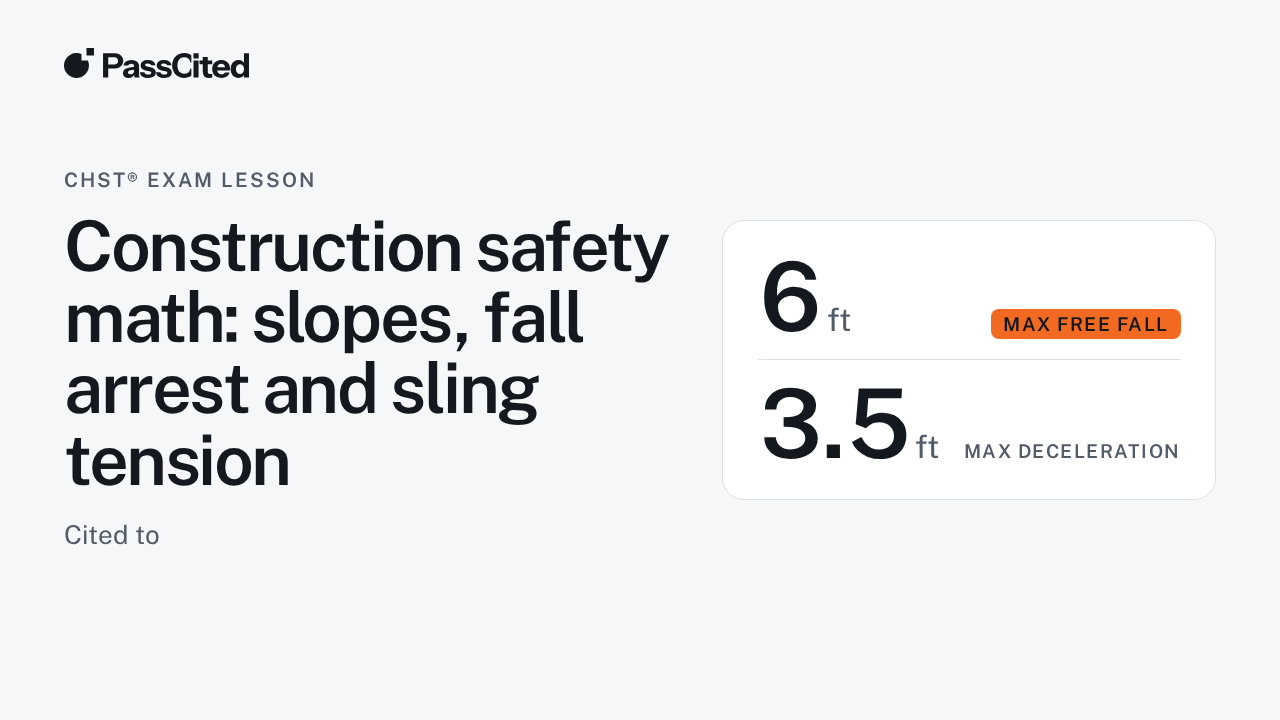 Construction safety math: slopes, fall arrest and sling tensionCHST lesson, 6:17Worked CHST calculations: excavation slope geometry, the 6-foot free fall and 3.5-foot deceleration limits, and sling tension at a 45-degree angle, each tied to its primary source.
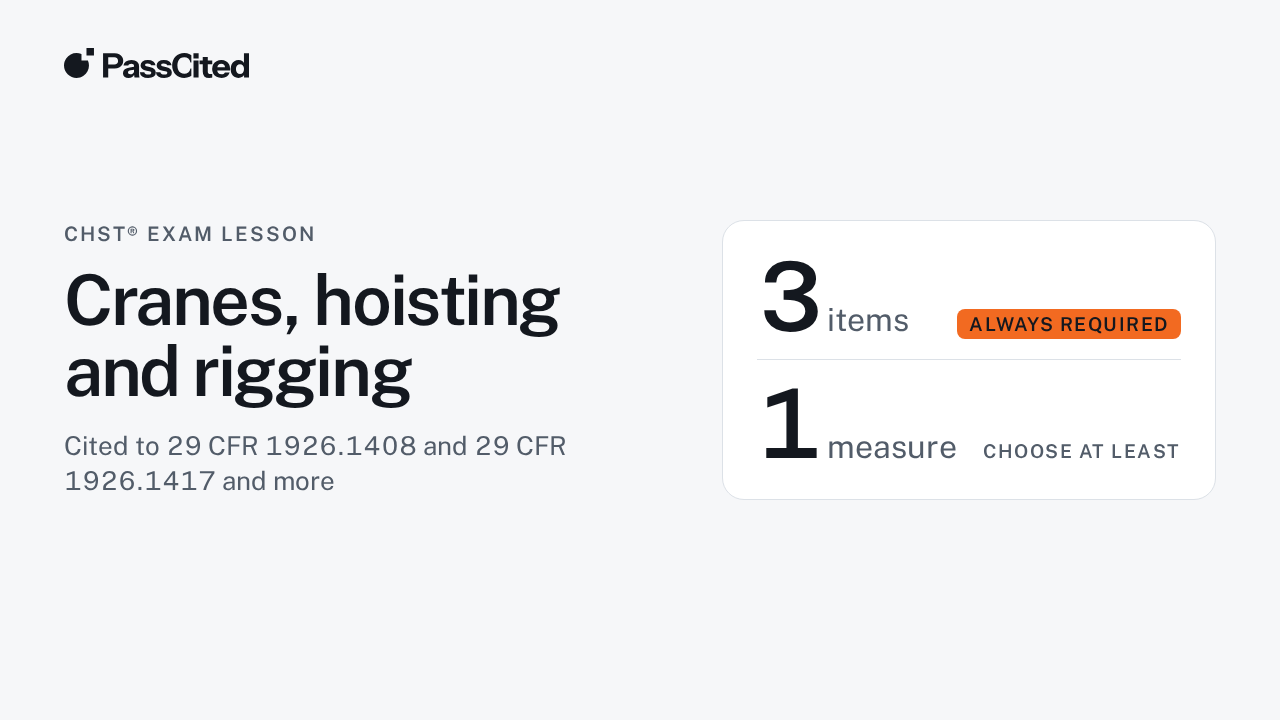 Cranes, hoisting and riggingCHST lesson, 7:22CHST review of crane power line clearances, operator duties, rated capacity checks, sling inspection and removal criteria, plus a worked sling tension example, cited to 29 CFR 1926.
See where you stand on the CHST
25 questions, free, no card. You get a readiness score for each CHST domain.
ASP®, CSP® and CHST® are registered marks of BCSP. PassCited is not affiliated with or endorsed by BCSP.