Construction safety math: slopes, fall arrest and sling tension
CHST video lesson, 6:17. CHST Domain 1: Hazard and Risk Identification and Control
Worked CHST calculations: excavation slope geometry, the 6-foot free fall and 3.5-foot deceleration limits, and sling tension at a 45-degree angle, each tied to its primary source.
Included with every pass, and free to watch with captions. Every rule and number is cited on screen to its primary source.
Transcript
0:00 Intro
Construction safety math, for the CHST exam. Every rule and number here is cited to its primary source, on screen.
0:10 Learning objectives
In this lesson, you'll learn to: apply the maximum allowable slopes to an excavation, state the personal fall arrest free fall and deceleration limits, calculate sling leg tension with a load angle factor, and decide how many sling legs you may count as carrying the load.
0:30 Excavations: simple slopes
Appendix B gives maximum allowable slopes for simple slope excavations 20 feet or less in depth. Three-quarters horizontal to 1 vertical is the steepest figure listed.
0:47 Worked example: slope
Then 1 to 1. And 1 and a half to 1, the flattest of the three. Example: a 10-foot-deep simple slope excavation where the 1 1/2 to 1 maximum applies. Each Appendix B slope applies to a different case, so identify the case first. Run per side equals depth times the horizontal part of the ratio. 5 feet of run for every 1 foot of depth.
1:25 Personal fall arrest limits
5 gives 15 feet of run. Both sides: 15 plus 15, then add the 4-foot bottom. The top width is 34 feet. Flatter slopes are allowed, so that is a minimum. Personal fall arrest systems must be rigged so two distances stay under control: free fall and deceleration distance.
1:49 Worked example: fall distance
Free fall: no more than 6 feet, and the employee must not contact any lower level. Both conditions apply. 5 feet. Example: a worker anchors so free fall is 5 feet, and deceleration is 3 feet. Check free fall against the 6-foot limit. 5-foot limit. Total fall is 5 plus 3, so 8 feet, and each limit is met separately.
2:16 Sling angle math
The system must also be rigged so the worker cannot contact any lower level, so clearance must exceed the total fall. Sling angle changes the tension in each leg.
2:34 Worked example: sling tension
First, the share: the load divided by the legs carrying it. Then multiply by the load angle factor, here for an angle with the horizontal. The sling must be rated for at least that tension. Example from the DOE standard: a 1,000-pound load on a 2-legged bridle at 45 degrees.
3:02 How many legs carry the load?
Each leg lifts 500 pounds in a vertical lift. 414. 414 is 707 pounds in each leg. Each leg needs a rated capacity of at least 707 pounds. Normally, two legs should be considered to carry the load, because in normal lifting practice the load will not be uniformly distributed on all legs.
3:28 On the job
Three legs may be fully used only if rigging techniques, verified by a qualified rigger, ensure the load is evenly distributed. To count four or more legs as evenly loaded, special rigging techniques verified by a member of a qualified engineering organization are required. You're the rigger on a steel erection job. A 1,000-pound load will hang from a two-legged bridle at 45 degrees, and the crew wants to grab whatever slings are nearby.
4:03 Common exam traps
First, count only two legs as carrying the load, then split it: 500 pounds per leg. 414 load angle factor for 45 degrees: 707 pounds of tension in each leg. Last, choose slings with a rated capacity of at least 707 pounds per leg. A sling rated for only the 500-pound share would be undersized.
4:42 Recap quiz
Now, five traps that catch people on exam day. One: free fall is limited to 6 feet. 5 feet is deceleration distance. Two: the 500-pound share is not the tension. 414 for 707. Three: count two legs. A qualified rigger's verification allows full use of three legs. Four: counting four or more legs needs a qualified engineering organization member. Five: three-quarters to 1 is the steepest slope, and 1 and a half to 1 is the flattest. Question 1. Which is the flattest maximum simple slope in Appendix B? A: 3/4 to 1. B: 1 to 1. C: 1 and a half to 1. D: 2 to 1. C. One and a half to one is the flattest listed. Two to one is not in the source. Question 2. Free fall is 5 feet and deceleration is 4 feet. Which limit is violated? A: Free fall. B: Deceleration distance. C: Both. D: Neither. B. 5-foot deceleration limit. Question 3. 414. Minimum rating per leg? A: 500. B: 707. C: 1,000. D: 1,414. B. 414 is 707 pounds per leg. Want to see where you stand on every CHST domain? com.
More CHST lessons
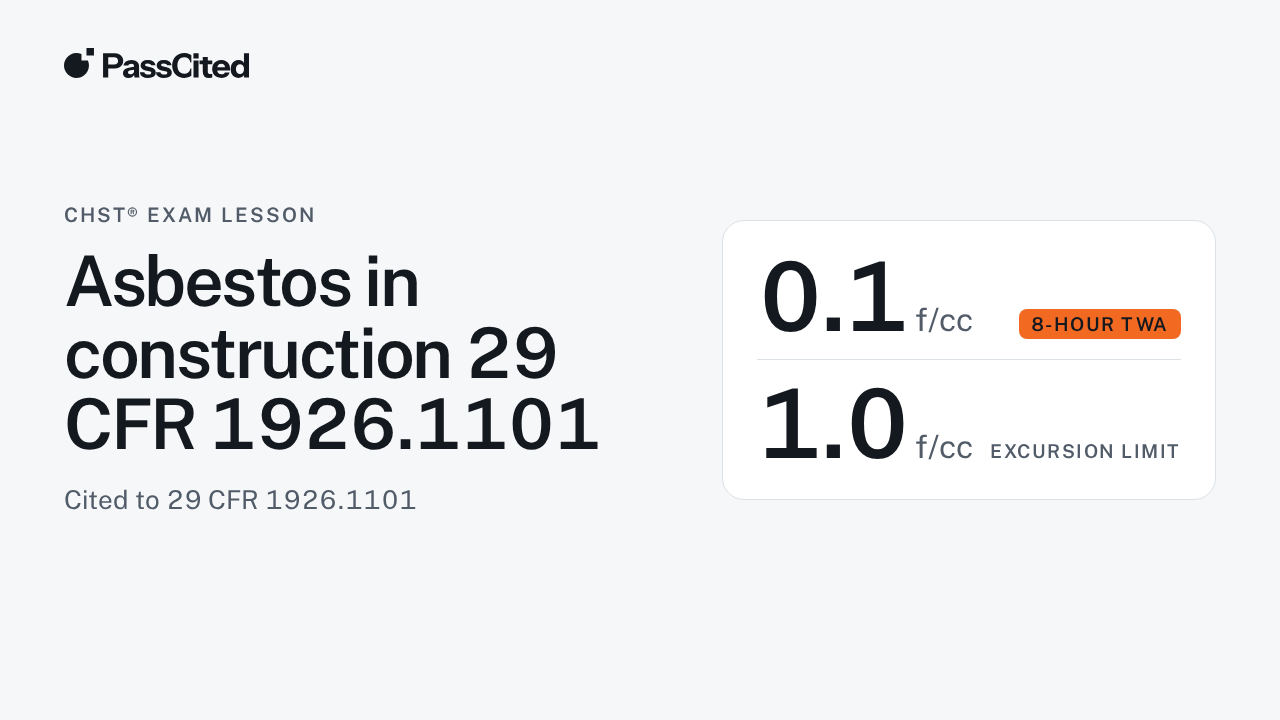 Asbestos in construction 29 CFR 1926.1101CHST lesson, 7:12Asbestos in construction under 29 CFR 1926.1101 for the CHST exam: PELs, work classes, competent person duties, regulated areas, monitoring, training hours and notification deadlines.
 Construction electrical safetyCHST lesson, 6:54Construction electrical safety for the CHST exam: GFCI versus the assured grounding program, test intervals, overhead clearances, grounding distances, and lockout tagging under 1926 Subpart K.
 Construction noise, radiation and lasersCHST lesson, 6:57CHST exam lesson on construction noise (Table D-2, the Fe formula, hearing protection), ionizing radiation, and laser and microwave limits under 29 CFR 1926.52, .53, .54 and .101.
See where you stand on the CHST
25 questions, free, no card. You get a readiness score for each CHST domain.
ASP®, CSP® and CHST® are registered marks of BCSP. PassCited is not affiliated with or endorsed by BCSP.