Construction electrical safety
CHST video lesson, 7:05. CHST Domain 1: Hazard and Risk Identification and Control
Construction electrical safety for the CHST exam: GFCI versus the assured grounding program, test intervals, overhead clearances, grounding distances, and lockout tagging under 1926 Subpart K.
Included with every pass, and free to watch with captions. Every rule and number is cited on screen to its primary source.
Transcript
0:00 Intro
Construction electrical safety, for the CHST exam. Every rule and number here is cited to its primary source, on screen. In this lesson, you'll learn to: state when GFCIs are required, explain the assured equipment grounding conductor program and its test intervals, recall clearance distances for open conductors, and apply the circuit protection and tagging rules.
0:31 1926.404(b)(1) · Ground-fault protection
The employer must use one of two methods to protect employees on construction sites. Option one: GFCIs on 120-volt, single-phase, 15- and 20-ampere outlets not part of permanent wiring and in use. Exempt: two-wire, single-phase generators of 5 kW or less, conductors insulated from frame and grounded surfaces. Option two: an assured grounding program covering cord sets, receptacles not part of the building, and cord-and-plug equipment available for use.
1:09 1926.404(b)(1)(iii) · AEGCP
The employer designates one or more competent persons to implement the program, and keeps a written description at the jobsite. Visual inspection comes before each day's use, except fixed cord sets and receptacles not exposed to damage. Damaged equipment is not used until repaired. Tests check continuity and correct terminal attachment: before first use, after repairs, and after any incident suspected of causing damage. Then at intervals not to exceed 3 months, or 6 months for fixed cord sets and receptacles not exposed to damage.
1:51 1926.404(c)(1)(ii), (iii) · Outside conductors
For open conductors of 600 volts or less run outdoors, minimum clearances depend on what is below. 10 feet above grade, sidewalks, or any reachable platform. 12 feet over areas with vehicular traffic other than trucks. 15 feet over truck traffic areas. 18 feet over public streets, alleys, roads and driveways.
2:24 1926.404(c)(1)(iv) · Roofs
And 3 feet from windows and doors, unless above the window top. Over roof space accessible to employees on foot, clearance depends on the conductor type. Insulated conductors: 8 feet vertical clearance. Covered conductors: 10 feet, vertical or diagonal. Bare: 15 feet. Roof also open to vehicles: 18 feet vertical. Exception: at least 3 feet at 300 volts or less on roofs sloped at least 4 inches in 12.
2:56 1926.404(f)(7)(iii) · Fixed equipment
Exposed noncurrent-carrying metal parts of fixed equipment that may become energized must be grounded under listed conditions. One condition: within 8 feet vertically or 5 feet horizontally of ground or grounded metal, and subject to employee contact. Another: equipment operating with any terminal over 150 volts to ground, with listed exemptions.
3:30 1926.404(f)(7)(iv) · Cord-and-plug
A single made electrode over 25 ohms needs one more, at least 6 feet away. Certain cord-and-plug equipment must be grounded, including hand held motor-operated tools and portable hand lamps. Exemptions exist: tools likely to be used in wet or conductive locations, supplied through an isolating transformer with an ungrounded secondary of not over 50 volts.
3:59 1926.416 and 1926.417
Listed or labeled double-insulated tools need not be grounded, but must be distinctively marked. No employer may permit work so close to a power circuit that an employee could contact it, unless it is deenergized and grounded, or guarded effectively. Before work, the employer ascertains where energized circuits are. Post and maintain warning signs, and advise employees of the location, hazards, and protective measures.
4:40 Common exam traps
Deenergized circuits must be rendered inoperative, with tags at all points where they can be energized. Worn or frayed cords shall not be used. Extension cords shall not be fastened with staples, hung from nails, or suspended by wire. Now, five traps that catch people on exam day. One: the employer may use either GFCIs or an assured grounding program. Either one alone satisfies the rule. Two: the test interval is 3 months, with 6 months only for fixed cord sets and receptacles not exposed to damage.
5:22 Recap quiz
Three: 10 feet is for grade and sidewalks. Public streets need 18 feet. Four: tests also follow repairs and any incident suspected of causing damage. Five: deenergized circuits must be rendered inoperative, and tagged at all points where they can be energized. Question 1. Under an assured grounding program, what is the maximum test interval for portable cord sets that are not fixed? A: 1 month. B: 3 months. C: 6 months. D: 12 months. B. Not to exceed 3 months. Six months applies only to fixed cord sets and receptacles not exposed to damage. Question 2. Open 600-volt conductors cross a public street. Minimum clearance? A: 10 feet. B: 12 feet. C: 15 feet. D: 18 feet. D. 18 feet over public streets, alleys, roads and driveways. Question 3. A cord is run over by a forklift on site. Under the assured grounding program, what must happen before use? A: Nothing if it looks fine. B: Wait for the 3-month test. C: Test it before use. D: Test it only if damaged. C. A test is required before use after any incident suspected of causing damage. Want to see where you stand on every CHST domain? com.
More CHST lessons
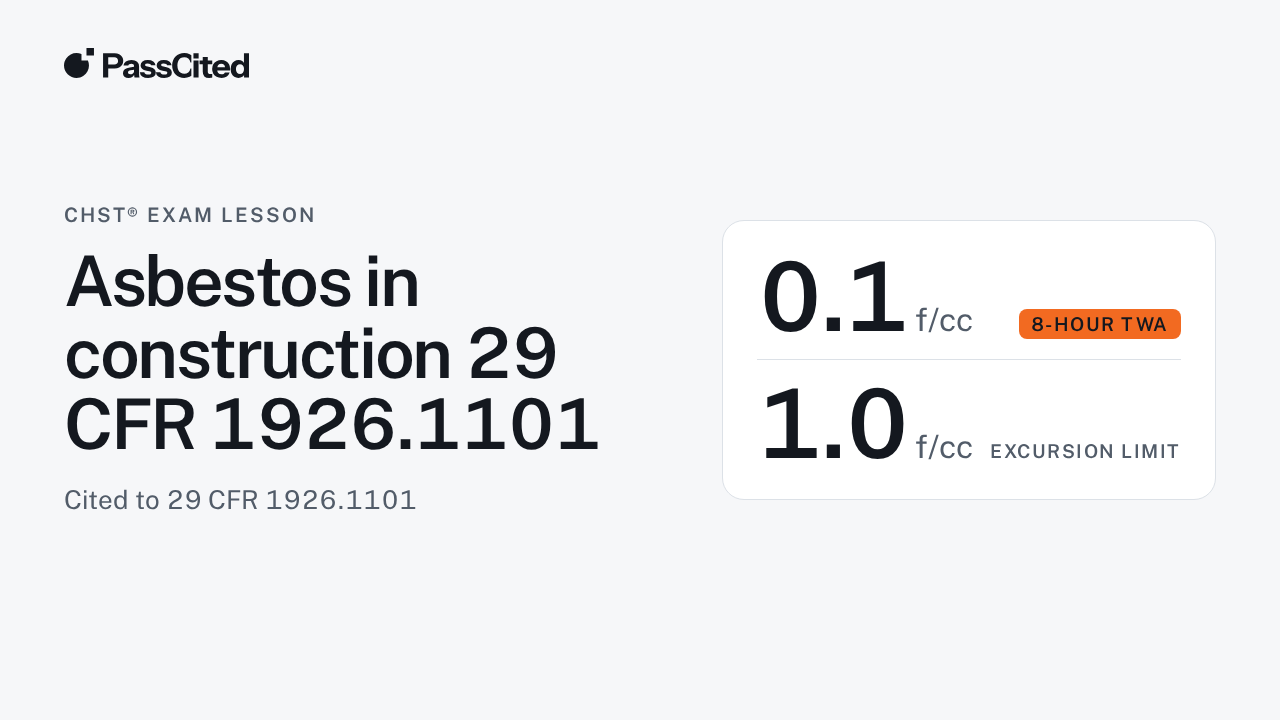 Asbestos in construction 29 CFR 1926.1101CHST lesson, 7:27Asbestos in construction under 29 CFR 1926.1101 for the CHST exam: PELs, work classes, competent person duties, regulated areas, monitoring, training hours and notification deadlines.
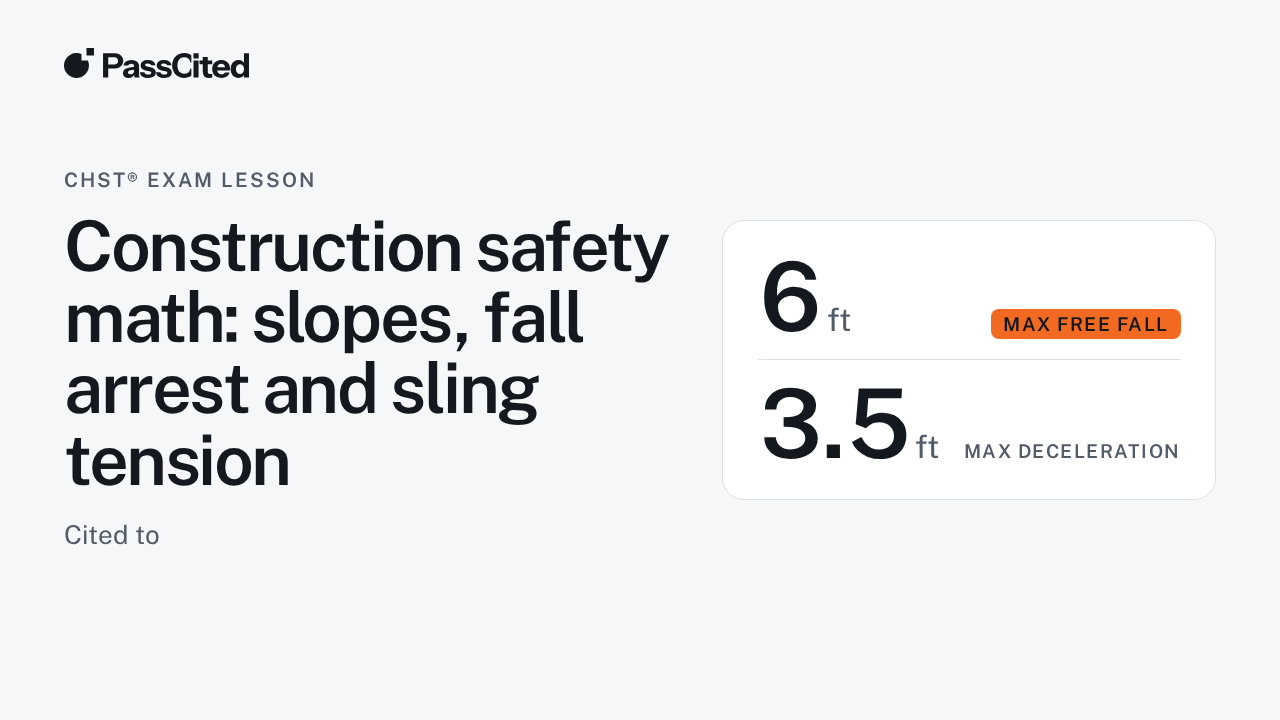 Construction safety math: slopes, fall arrest and sling tensionCHST lesson, 6:17Worked CHST calculations: excavation slope geometry, the 6-foot free fall and 3.5-foot deceleration limits, and sling tension at a 45-degree angle, each tied to its primary source.
 Cranes, hoisting and riggingCHST lesson, 7:22CHST review of crane power line clearances, operator duties, rated capacity checks, sling inspection and removal criteria, plus a worked sling tension example, cited to 29 CFR 1926.
See where you stand on the CHST
25 questions, free, no card. You get a readiness score for each CHST domain.
ASP®, CSP® and CHST® are registered marks of BCSP. PassCited is not affiliated with or endorsed by BCSP.