Hazard communication and GHS
CHST video lesson, 6:46. CHST Domain 1: Hazard and Risk Identification and Control
CHST exam review of OSHA 1910.1200: who classifies chemicals, the six label elements, SDS timing and 16 sections, the written program, training, trade secrets and 2026-2028 dates.
Included with every pass, and free to watch with captions. Every rule and number is cited on screen to its primary source.
Transcript
0:00 Intro
Hazard communication and GHS, for the CHST exam. Every rule and number here is cited to its primary source, on screen. In this lesson, you'll learn to: say who classifies chemicals and who labels them, list the label elements and the small-container rules, state SDS content, update deadlines and employee access, and apply the written program, training and trade secret rules.
0:29 Responsibilities
Start with who does what. Chemical manufacturers and importers must classify the hazards of what they produce or import. All employers inform employees through a program, labels, SDSs and training. Employers needn't classify unless they choose not to rely on the manufacturer.
0:48 Scope
The standard covers chemicals where employees may be exposed in normal use or a foreseeable emergency. Laboratories: don't remove or deface incoming labels, keep SDSs accessible, and train, except on program location.
1:09 Shipped container labels
Sealed-container operations have similar limited duties, training as needed for a spill or leak. A shipped label generally carries six items. Start with the product identifier. The signal word, hazard statements and pictograms must sit together on the label. S. S. phone number of the manufacturer, importer or other responsible party.
1:34 Labeling
Items one through five are prominently displayed, in English. In the workplace, use full shipped-label information, or the product identifier plus general hazards that, with program information, give specifics. Portable containers filled from a labeled container for the transferrer's immediate use need no label. New significant hazard information means revised labels within 6 months. If a manufacturer, importer or distributor shows full labels aren't feasible, containers of 100 milliliters or less get a reduced label; full information goes on the outer package.
2:13 Safety data sheets
At 3 milliliters or less, where a label interferes with use, no label is required; the product identifier is the minimum. Manufacturers and importers obtain or develop an SDS for each hazardous chemical they produce or import. Employers keep one for each hazardous chemical they use. Sections 1 through 16, in order.
2:45 Program and training
Sections 12 through 15 must appear, but OSHA won't enforce their information requirements. New significant hazard information must be added within 3 months. SDSs stay readily accessible every work shift; electronic access is fine without barriers. Each workplace needs a written hazard communication program. It lists hazardous chemicals by a product identifier that matches the SDS.
3:14 Trade secrets
It also covers non-routine tasks and unlabeled pipes. At multi-employer workplaces, tell other employers how to reach SDSs, what precautions apply, and the labeling system. Train at initial assignment, and whenever a new, untrained-on chemical hazard enters the work area.
3:38 Compliance dates
A supported trade secret claim lets identity or concentration be withheld from SDS section 3; the SDS must say so and still disclose properties and effects. In a medical emergency, disclose immediately to the treating PLHCP, with no paperwork first. A denial of a non-emergency written request must be in writing within 30 days. The modified rule took effect July 19, 2024. Compliance dates differ for substances and mixtures.
4:09 On the job
Substances: manufacturers, importers and distributors comply by May 19, 2026; employers update by November 20, 2026. For mixtures: November 19, 2027, then employers by May 19, 2028. In transition, comply with the revised rule, the July 1, 2023 version, or both. You're the safety manager at a warehouse that only handles sealed drums.
4:36 Common exam traps
One arrives without an SDS. First, ensure labels on incoming containers aren't removed or defaced. Shipped-container labeling belongs to the manufacturer, importer or distributor. Next, if an employee requests the SDS, obtain it as soon as possible. Keep SDSs readily accessible each work shift, and train as needed for a spill or leak. Now, six traps that catch people on exam day. One: employers classify only if they choose not to rely on the manufacturer.
5:12 Recap quiz
Two: a shipped label generally needs six items. Three: SDS updates take 3 months. Labels take 6. Four: sections 12 through 15 must appear; OSHA won't enforce their information. Five: among transfer containers, only portable, immediate-use ones are exempt. Six: in a medical emergency, disclose first. Paperwork follows. Question 1. After newly learning significant hazard information, when must an SDS be updated? A: Immediately. B: Within three months. C: Within six months. D: Next annual review. B. Within three months. Labels get six. Question 2. A worker pours solvent from a labeled drum into a can for her own use this shift. What does the can need? A: Full label. B: Pictogram only. C: No label. D: Label with SDS. C. Filled from a labeled drum for her own immediate use, the can needs no label. Question 3. A treating PLHCP says a medical emergency exists and needs a trade secret chemical's identity. What must the manufacturer do? A: Require agreement first. B: Disclose immediately. C: Wait 30 days. D: Give only the range. B. Disclose immediately; paperwork can follow. Want to see where you stand on every CHST domain? com.
More CHST lessons
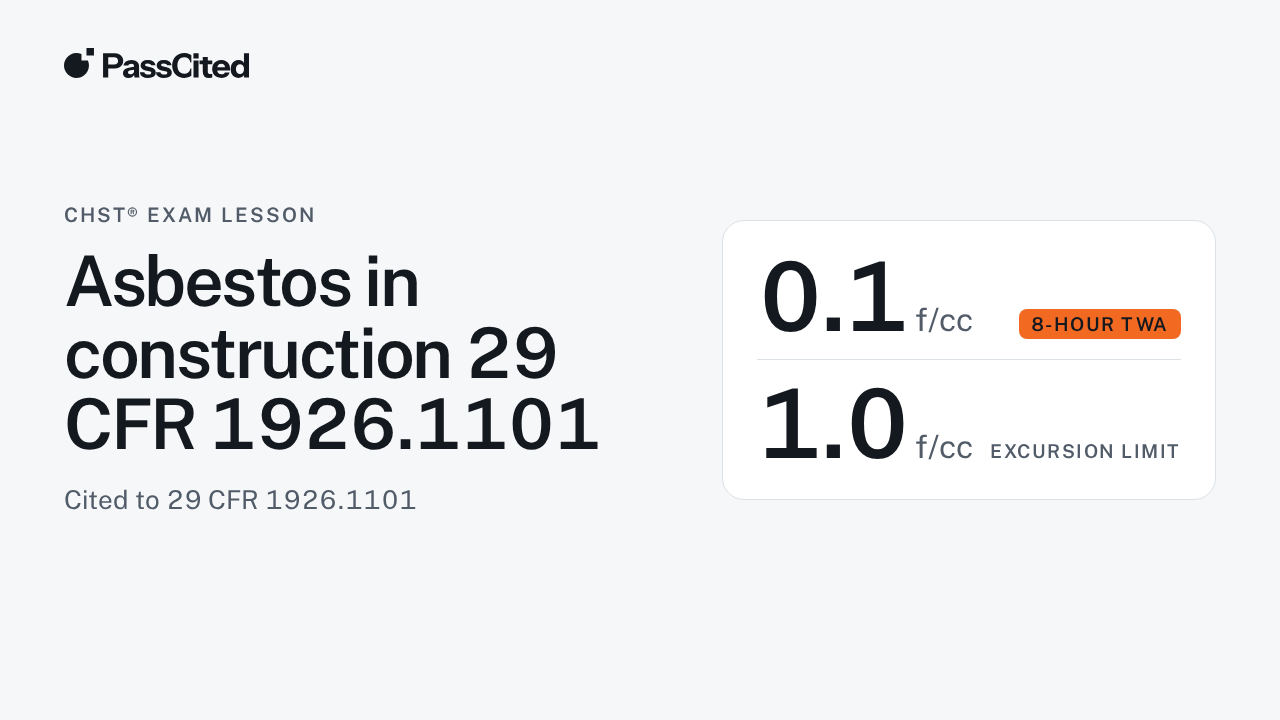 Asbestos in construction 29 CFR 1926.1101CHST lesson, 7:12Asbestos in construction under 29 CFR 1926.1101 for the CHST exam: PELs, work classes, competent person duties, regulated areas, monitoring, training hours and notification deadlines.
 Construction electrical safetyCHST lesson, 6:54Construction electrical safety for the CHST exam: GFCI versus the assured grounding program, test intervals, overhead clearances, grounding distances, and lockout tagging under 1926 Subpart K.
 Construction noise, radiation and lasersCHST lesson, 6:57CHST exam lesson on construction noise (Table D-2, the Fe formula, hearing protection), ionizing radiation, and laser and microwave limits under 29 CFR 1926.52, .53, .54 and .101.
See where you stand on the CHST
25 questions, free, no card. You get a readiness score for each CHST domain.
ASP®, CSP® and CHST® are registered marks of BCSP. PassCited is not affiliated with or endorsed by BCSP.