Lead in construction (29 CFR 1926.62)
CHST video lesson, 6:56. CHST Domain 1: Hazard and Risk Identification and Control
29 CFR 1926.62 for the CHST exam: the action level and PEL, an 8-hour TWA worked example, interim protection tasks, monitoring frequency, medical removal, and who must do what.
Included with every pass, and free to watch with captions. Every rule and number is cited on screen to its primary source.
Transcript
0:00 Intro
Lead in construction, for the CHST exam. Every rule and number here is cited to its primary source, on screen.
0:10 Learning objectives
In this lesson, you'll learn to: state the action level and the PEL, set monitoring frequency from the results, compute an 8-hour TWA for lead, and apply interim protection and medical removal rules.
0:28 Exposure limits
62. Both are airborne lead, averaged over 8 hours. The action level is 30 micrograms per cubic meter, measured without regard to respirators. The PEL is 50. Employees may not be exposed to more than that, averaged over 8 hours. Now the math. A worker spends 4 hours at 80 micrograms and 4 hours at 40.
0:53 Worked example
The TWA sums concentration times hours, then divides by 8. That is 320 plus 160, which is 480, divided by 8. The TWA is 60, above the PEL of 50, so the PEL is exceeded. Work more than 8 hours and the limit drops: 400 divided by hours worked. Until exposure is assessed, listed tasks are presumed to exceed set levels.
1:27 Interim protection
Any other task where you have reason to believe the PEL may be exceeded is treated as above the PEL. On lead coatings: manual demolition, scraping, sanding, heat guns, dust-collected power tools. Also spray painting with lead paint. Treat as above the PEL, up to 10 times. Lead burning and lead mortar, plus on lead coatings rivet busting, power tools without dust collection, dry abrasive cleanup, and moving or removing blasting enclosures: presume above 500. Where lead coatings are on structures, abrasive blasting, welding, cutting and torch burning: presume above 2,500, which is 50 times the PEL.
2:24 Interim protection
Until exposure is assessed, employees on those tasks get a full interim package. That means respirators, protective clothing and equipment. Change areas and hand washing facilities. Biological monitoring: blood lead and zinc protoporphyrin.
2:47 Monitoring frequency
Plus required training. Monitoring frequency follows the results. Notify employees of any results within 5 working days of receipt. Below the action level: no repeat is needed, unless something changes. At or above the action level but at or below the PEL: monitor at least every 6 months. Above the PEL: quarterly. After two consecutive results, at least 7 days apart, at or below the PEL but at or above the action level, drop to every 6 months.
3:31 Medical
Stop only after two consecutive results, at least 7 days apart, fall below the action level. Two medical programs, two different triggers. Do not confuse them. Surveillance is the broader net: initial blood sampling must be made available to anyone exposed at or above the action level on any day. The full surveillance program covers those exposed at or above the action level for more than 30 days in any consecutive 12 months.
4:07 Who must do what
Removal: blood lead at or above 50 on a periodic and a follow-up test. Return when two consecutive tests are below 40. Now who must do what, and when. The written compliance program comes before the job starts, with frequent and regular inspections by a competent person.
4:33 Common exam traps
The program is updated at least annually. Training happens before job assignment, then at least annually for those at or above the action level. Objective data records are kept at least 30 years. Now, five traps that catch people on exam day. One: 30 is the action level, not the PEL. The PEL is 50. Two: the action level ignores respirators.
5:07 Recap quiz
Three: removal is at 50, and return takes two consecutive tests below 40. Four: above the PEL is quarterly, not annual. Five: on lead-coated structures, welding and cutting are presumed above 2,500. Question 1. Lead exposure is 45 micrograms as an 8-hour TWA. A: Below the action level. B: Above the PEL. C: At or above the action level, below the PEL. D: Exactly at the PEL. C. The action level is 30 and the PEL is 50, so 45 falls between them. Question 2. Blood lead is 50 or above on a periodic and a follow-up test. A: Retrain annually. B: Remove from exposure at or above the action level. C: Monitor quarterly. D: Provide a respirator. B. The employer must remove the employee from work at or above the action level. Question 3. A crew welds on structures with lead paint, before any assessment. Which presumed tier applies? A: Above the PEL, not over 10 times. B: In excess of 500. C: In excess of 2,500. D: No presumption; only the action level applies. C. Welding on lead coatings is presumed in excess of 2,500, which is 50 times the PEL. Want to see where you stand on every CHST domain? com.
More CHST lessons
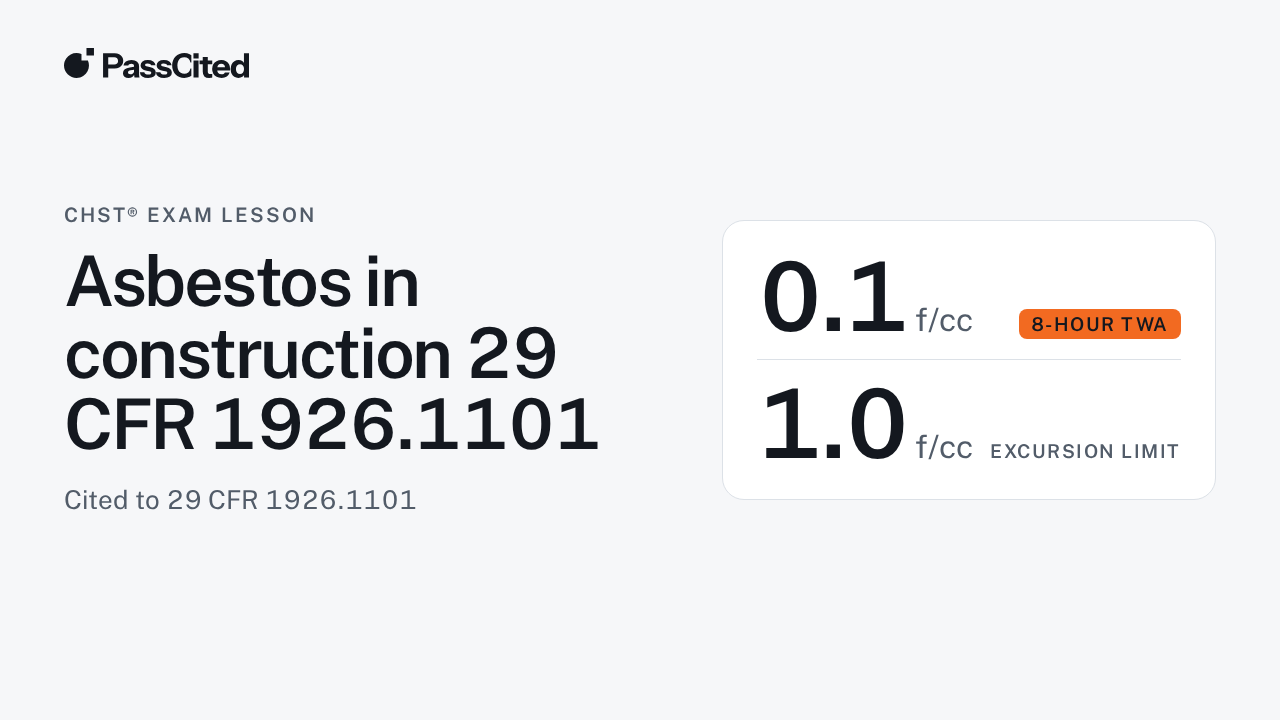 Asbestos in construction 29 CFR 1926.1101CHST lesson, 7:27Asbestos in construction under 29 CFR 1926.1101 for the CHST exam: PELs, work classes, competent person duties, regulated areas, monitoring, training hours and notification deadlines.
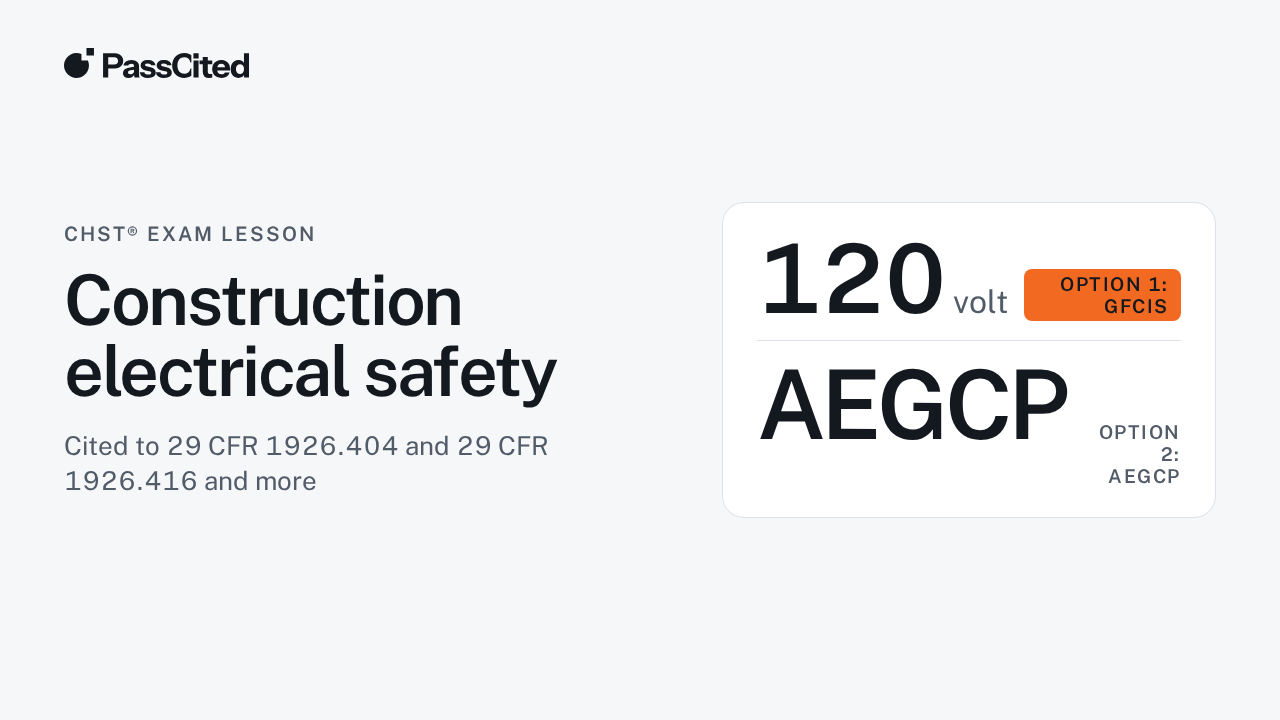 Construction electrical safetyCHST lesson, 7:05Construction electrical safety for the CHST exam: GFCI versus the assured grounding program, test intervals, overhead clearances, grounding distances, and lockout tagging under 1926 Subpart K.
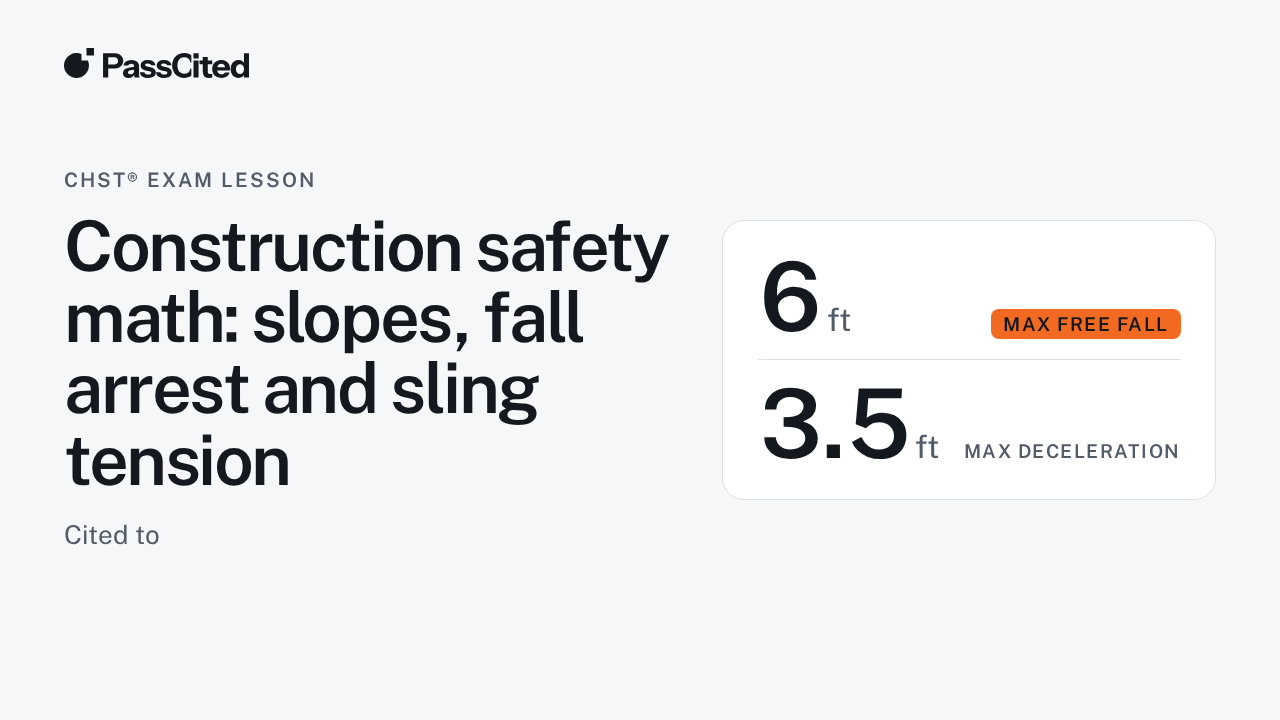 Construction safety math: slopes, fall arrest and sling tensionCHST lesson, 6:17Worked CHST calculations: excavation slope geometry, the 6-foot free fall and 3.5-foot deceleration limits, and sling tension at a 45-degree angle, each tied to its primary source.
See where you stand on the CHST
25 questions, free, no card. You get a readiness score for each CHST domain.
ASP®, CSP® and CHST® are registered marks of BCSP. PassCited is not affiliated with or endorsed by BCSP.