Construction noise, radiation and lasers
CHST video lesson, 6:57. CHST Domain 1: Hazard and Risk Identification and Control
CHST exam lesson on construction noise (Table D-2, the Fe formula, hearing protection), ionizing radiation, and laser and microwave limits under 29 CFR 1926.52, .53, .54 and .101.
Included with every pass, and free to watch with captions. Every rule and number is cited on screen to its primary source.
Transcript
0:00 Intro
Construction noise, radiation and lasers, for the CHST exam. Every rule and number here is cited to its primary source, on screen.
0:11 Learning objectives
In this lesson, you'll learn to: read Table D-2 and compute the equivalent exposure factor, state when and how hearing protection is required, identify who may work with radioactive materials and X-rays, and apply the laser and microwave rules and limits.
0:31 Construction noise rule
Protection is required when sound levels exceed Table D-2. Measure on the A-scale, slow response. Above the table, feasible administrative or engineering controls come first. If they fail, provide and use PPE. A continuing, effective hearing conservation program is required wherever levels exceed the table.
0:58 Permissible exposures
Noise with maxima at intervals of 1 second or less is considered continuous. Table D-2 pairs the daily duration of exposure with a permissible sound level. 8 hours is 90 dBA, 4 is 95, and 2 is 100.
1:19 Mixed exposures
Every halving of time adds 5. At the short end, 1 hour is 105, half an hour is 110, and a quarter hour or less is 115. For two or more periods at different levels, consider their combined effect.
1:38 Worked example
T is time at an essentially constant level. L is the permissible duration from Table D-2. If Fe exceeds unity, 1, the exposure exceeds permissible levels. The regulation's sample: 110 dBA for a quarter hour, 100 for half an hour, 90 for an hour and a half.
1:59 Hearing protection
Each L is the Table D-2 duration. Add the T over L terms. 938. It doesn't exceed unity, so exposure is within limits. If reducing noise levels or exposure duration to Table D-2 isn't feasible, ear protective devices shall be provided and used. Inserted ones are fitted or determined individually by competent persons.
2:29 Ionizing radiation
Plain cotton is not an acceptable protective device. Above the table values, administer a continuing, effective hearing conservation program. Impact noise should not exceed 140 dB peak. The word is should, not shall. 53 applies the NRC's 10 CFR part 20 occupational-exposure provisions.
2:55 Lasers
Any use of radioactive materials or X-rays, whether or not under an NRC license, needs competent persons specially trained. Under an NRC license, only licensed persons, or competent persons under the licensee's direction and supervision, may do the work. Only qualified and trained employees install, adjust and operate laser equipment, and the operator must have proof of qualification in possession at all times. 005 watts, 5 milliwatts, provide antilaser eye protection devices. Post standard laser warning placards, and the equipment must be labeled to indicate maximum output.
3:42 Laser and microwave limits
Use beam shutters or caps, or turn the laser off, when transmission isn't required. Unattended for a substantial period, such as lunch or overnight, it shall be turned off. Never direct the beam at employees. In rain, snow, dust or fog, prohibit operation where practicable, and keep employees out of range.
4:14 On the job
Employees shall not be exposed to light intensities above set limits, all per square centimeter. Learn the units. Direct staring: 1 microwatt. Incidental observing: 1 milliwatt. Diffused reflected light: 2 1/2 watts. Microwave power density: no more than 10 milliwatts. A laser unit in operation should be set up above the heads of employees, when possible.
4:50 Common exam traps
Should, not shall: advisory, not mandatory. You're the site safety lead on a building job. A crew runs a laser alongside a loud saw, and an inserted-plug user stuffs cotton in his ears. First, for the noise: use feasible administrative or engineering controls. Cotton is not acceptable, and inserted devices are fitted individually by competent persons. 005 watts. Finally, post laser placards, and turn the laser off if it will be left unattended overnight.
5:29 Recap quiz
Now, six traps that catch people on exam day. One: plain cotton is not an acceptable protective device. Two: feasible administrative or engineering controls come before PPE. Three: if Fe exceeds 1, the exposure exceeds permissible levels. Four: only specially trained competent persons may use X-rays or radioactive materials. 005 watts, 5 milliwatts. Six: direct staring is 1 microwatt; incidental is 1 milliwatt. Question 1. Permissible level for 4 hours per day? A: 90. B: 92. C: 95. D: 100. C, 95 dBA. 90 is 8 hours, and 100 is 2 hours. Question 2. An Fe above unity, 1. What does that indicate? A: within limits. B: exceeds permissible levels. C: only PPE needed. D: cotton plugs suffice. B. Fe above unity exceeds permissible levels. Question 3. 005 watts. Required? A: nothing if trained. B: antilaser eye protection. C: only placards. D: plain safety glasses. B. 005 watts. Want to see where you stand on every CHST domain? com.
More CHST lessons
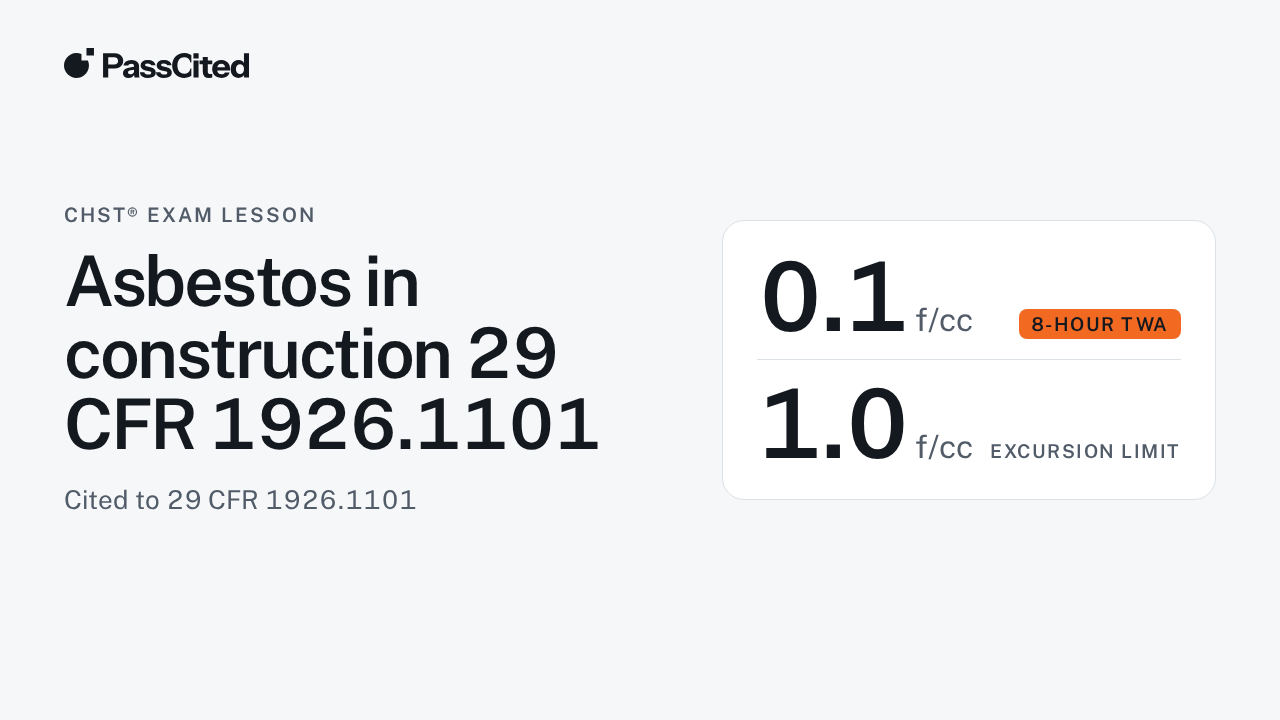 Asbestos in construction 29 CFR 1926.1101CHST lesson, 7:12Asbestos in construction under 29 CFR 1926.1101 for the CHST exam: PELs, work classes, competent person duties, regulated areas, monitoring, training hours and notification deadlines.
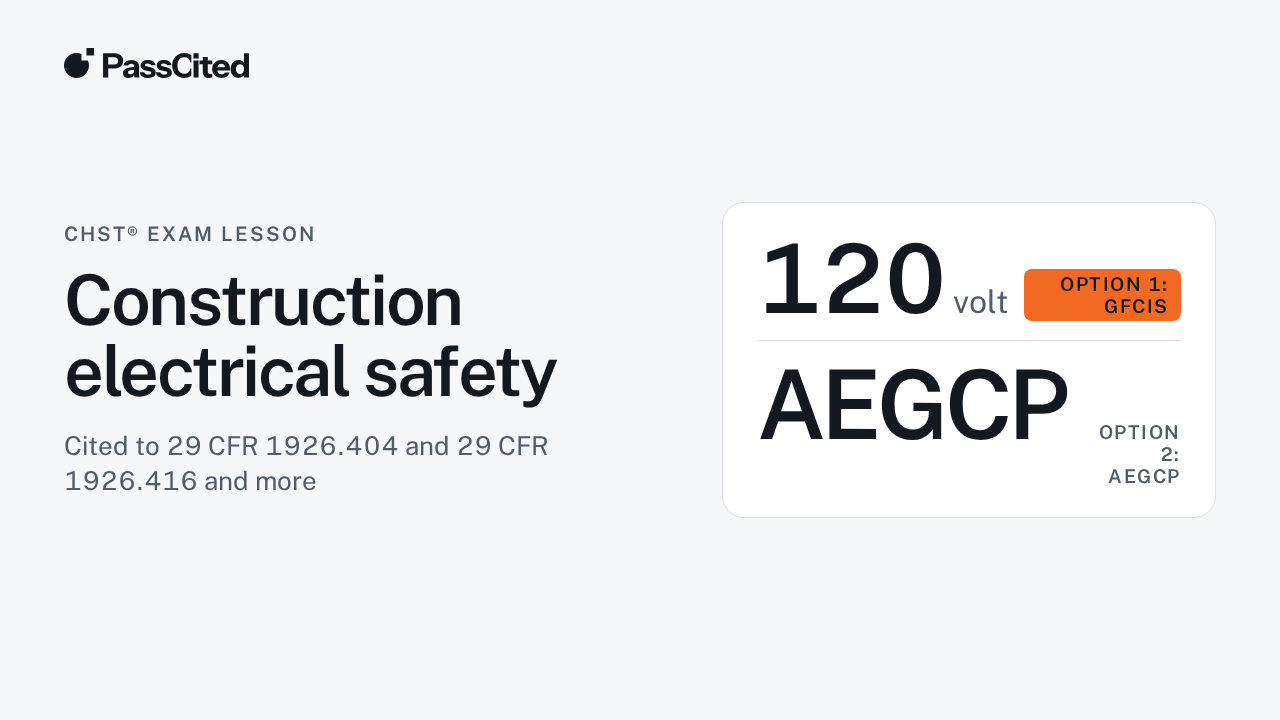 Construction electrical safetyCHST lesson, 6:54Construction electrical safety for the CHST exam: GFCI versus the assured grounding program, test intervals, overhead clearances, grounding distances, and lockout tagging under 1926 Subpart K.
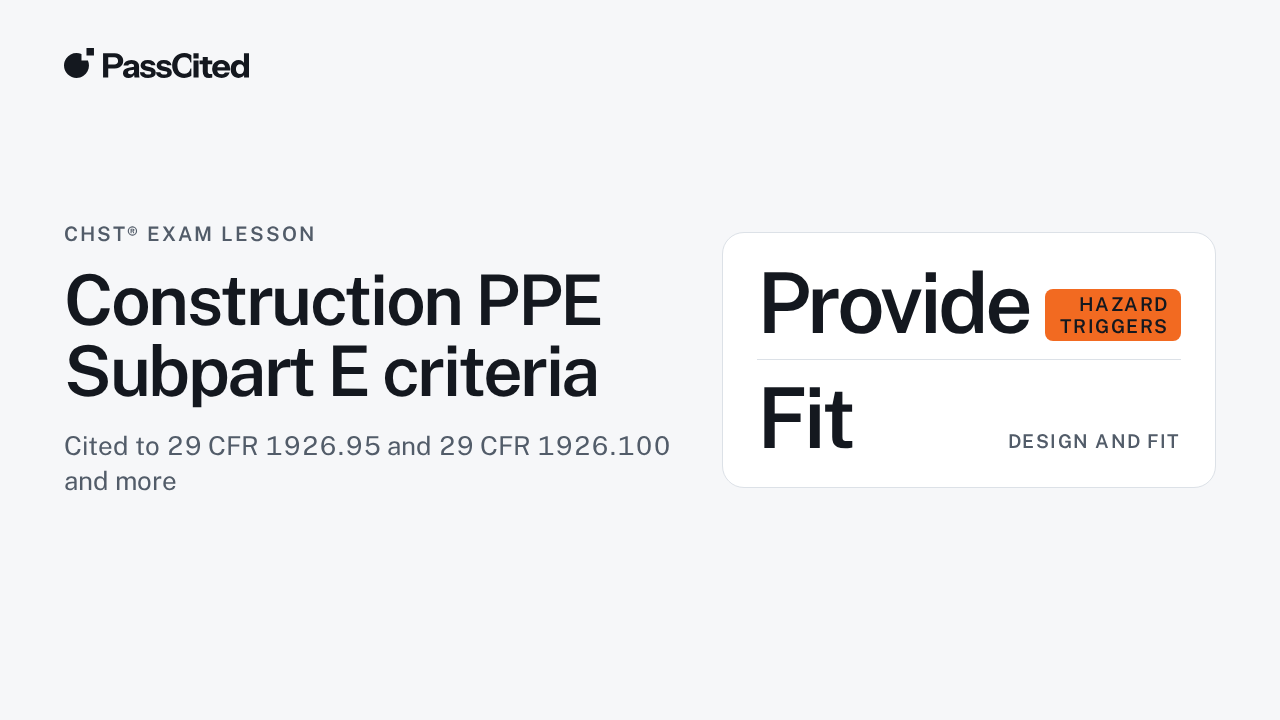 Construction PPE Subpart E criteriaCHST lesson, 7:01Construction PPE under 29 CFR 1926.95, .100 and .102 for the CHST exam: who pays, head protection standards, eye and face rules, welding shade numbers and laser goggle labels.
See where you stand on the CHST
25 questions, free, no card. You get a readiness score for each CHST domain.
ASP®, CSP® and CHST® are registered marks of BCSP. PassCited is not affiliated with or endorsed by BCSP.