Construction PPE Subpart E criteria
CHST video lesson, 7:01. CHST Domain 1: Hazard and Risk Identification and Control
Construction PPE under 29 CFR 1926.95, .100 and .102 for the CHST exam: who pays, head protection standards, eye and face rules, welding shade numbers and laser goggle labels.
Included with every pass, and free to watch with captions. Every rule and number is cited on screen to its primary source.
Transcript
0:00 Intro
Construction PPE, for the CHST exam. Every rule and number here is cited to its primary source, on screen.
0:09 Learning objectives
In this lesson, you'll learn to: state when the employer must provide PPE, apply the payment exceptions, select head, eye and face protection, and choose welding shade numbers and laser goggles. 95, protective equipment must be provided, used and maintained in sanitary, reliable condition wherever hazards require it.
0:27 1926.95: when PPE is required
Hazards include processes, environment, chemical and radiological hazards, and mechanical irritants. Design and selection: safe design for the work, and selected to fit each affected employee.
0:51 1926.95(d): who pays
The default: PPE used to comply with Part 1926 is provided by the employer at no cost. Not required to pay: non-specialty safety-toe footwear and non-specialty prescription safety eyewear, if the employer permits wearing them off the job-site. Everyday clothing and weather-only items, like winter coats, rubber boots and sunscreen, are also excepted.
1:20 1926.95(b), (d)(3), (d)(6)
Replacement PPE is paid by the employer, unless the employee lost or intentionally damaged it. The employer may allow employees to use adequate equipment they own, but cannot require them to provide or pay for PPE, except items excepted in (d)(2) through (d)(5). The employer stays responsible for its adequacy, including proper maintenance and sanitation.
1:49 1926.100: head protection
If the employer provides metatarsal guards and allows the employee, at the employee's request, to use boots with built-in metatarsal protection, no reimbursement is required. Helmets are required where there is possible danger of head injury from impact, falling or flying objects, or electrical shock and burns.
2:19 1926.102: eye and face
1-2009, 2003 or 1997. 7, Electrical Insulation. Equipment shown to be at least as effective as a listed standard is deemed compliant. Eye or face protection is required for flying particles, molten metal, liquid chemicals, acids or caustics, chemical gases or vapors, or potentially injurious light radiation. For flying objects, eye protection must provide side protection. Detachable clip-on or slide-on side shields meeting the section are acceptable. Prescription wearers need protection that incorporates the prescription, or fits over it without disturbing the proper position of the prescription lenses or the protective lenses.
3:12 1926.102(a)(5)
Eye and face PPE must be marked to identify the manufacturer. 1-1989 (R-1998), or are shown at least as effective. Eye and face protectors must meet minimum requirements.
3:30 1926.102(c)(1): Table E-1
They provide adequate protection against the particular hazards, and are reasonably comfortable. They fit snugly without unduly interfering with movement, and are durable. They can be disinfected and are easily cleanable. Table E-1 is a guide for choosing filter shade. Denser shades than listed may be used to suit the individual.
3:59 1926.102(c)(2): lasers
Shielded metal-arc welding with 1/16- to 5/32-inch electrodes is shade 10. Ferrous gas-shielded arc, same sizes, is 12. Shielded metal-arc with 3/16- to 1/4-inch electrodes is guided at 12. Carbon-arc welding is 14. Soldering is shade 2.
4:20 On the job
Torch brazing is 3 or 4. Laser goggles must protect for the specific wavelength of the laser, with optical density adequate for the energy involved. D. 5 through 8. Output between lines requires the higher optical density. Every pair of goggles must be labeled with the wavelengths, the optical density and the visible light transmission.
4:42 Common exam traps
A new welder asks who pays for gear. Required PPE is provided at no cost. Non-specialty safety-toe boots are excepted only if the employer permits off-site wear. Check that eye protection incorporates or fits over the prescription and is marked with the manufacturer. Then select the filter shade from Table E-1 for the welding operation. Now, six traps that catch people on exam day.
5:24 Recap quiz
One: employees do not buy required PPE; the employer provides it, except for listed exceptions. Two: non-specialty steel-toe boots are excepted only when off-site wear is permitted. Three: replacement is employer-paid unless the employee lost or intentionally damaged it. 7 electrical insulation. Five: flying objects require side protection; clip-on shields qualify. Six: denser shades than Table E-1 lists may be used. Question 1. 95(d), which item must the employer pay for? A: everyday long-sleeve shirts. B: winter coats worn only for weather. C: required respirator or goggles. D: sunscreen used only for weather. C. Required PPE is employer-paid; everyday clothing and weather-only items are excepted. Question 2. An electrician faces high-voltage shock and burns. The helmet must also meet which section? 1. 7, Electrical Insulation. 2. D: no added requirement. B. 7, Electrical Insulation. Question 3. Shielded metal-arc welding, 1/8-inch electrodes. Table E-1 guide shade? A: 2. B: 14. C: 12. D: 10. D. Shade 10 for 1/16- to 5/32-inch electrodes. Want to see where you stand on every CHST domain? com.
More CHST lessons
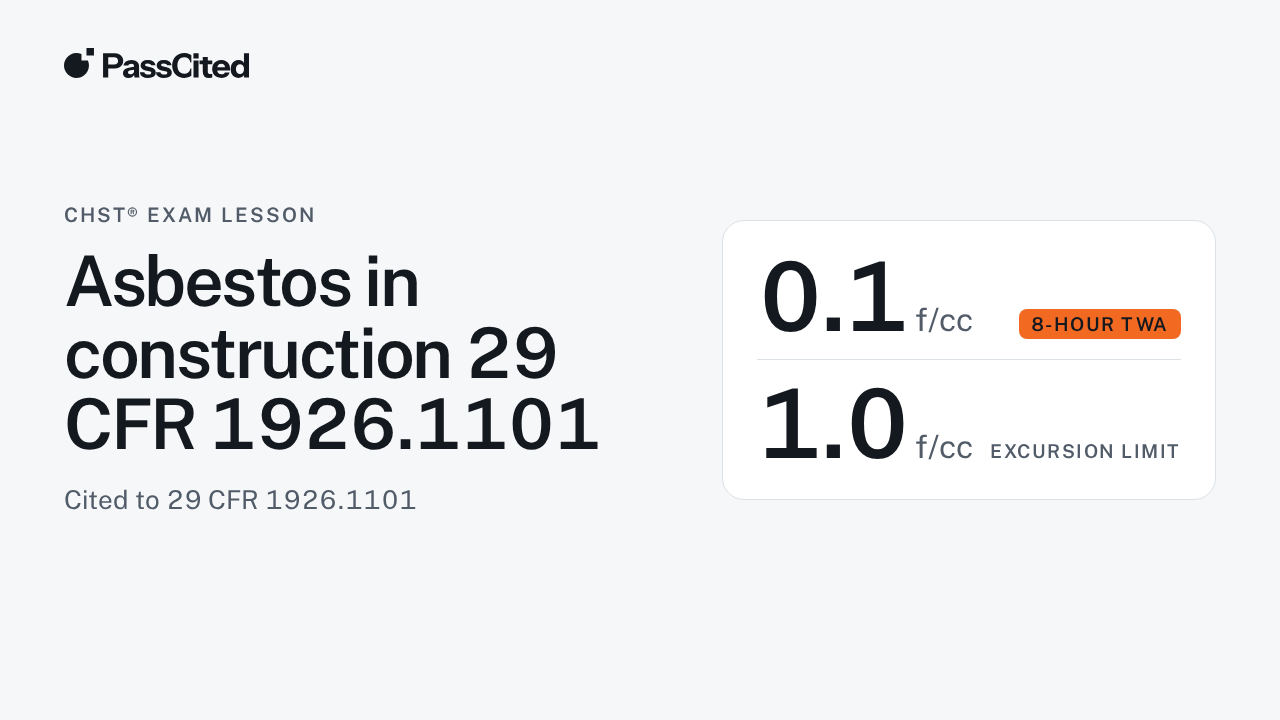 Asbestos in construction 29 CFR 1926.1101CHST lesson, 7:12Asbestos in construction under 29 CFR 1926.1101 for the CHST exam: PELs, work classes, competent person duties, regulated areas, monitoring, training hours and notification deadlines.
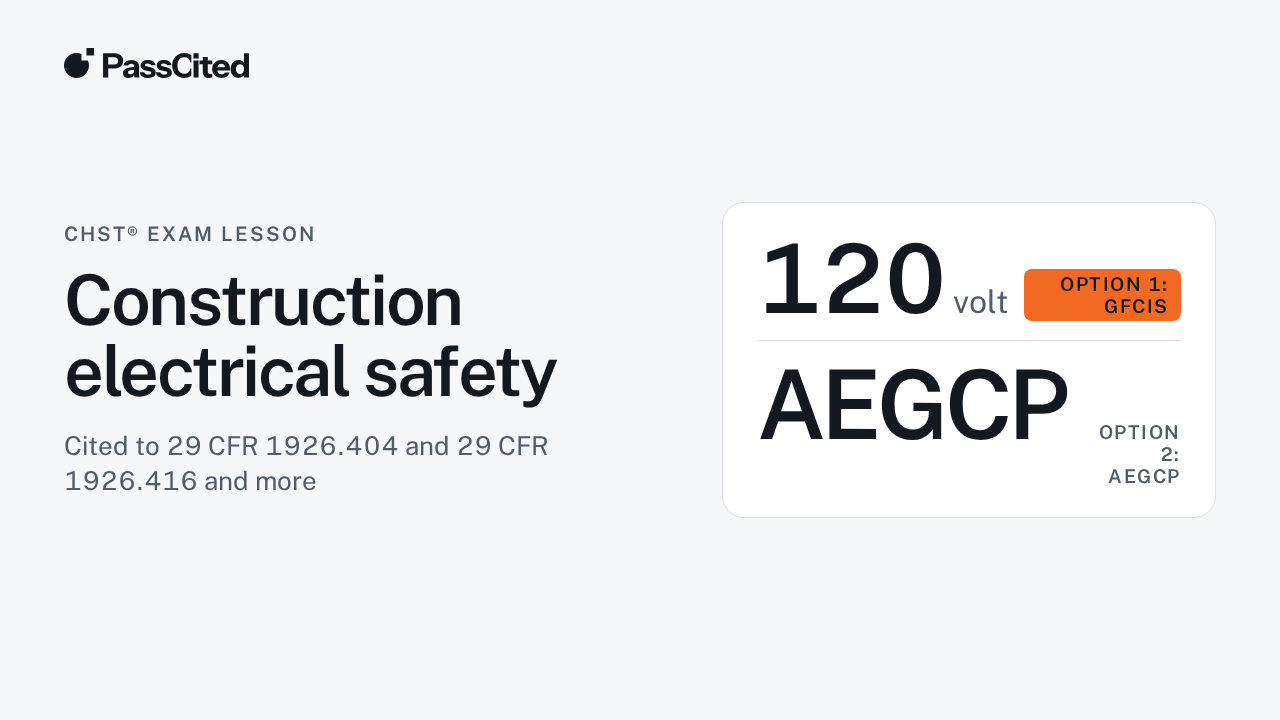 Construction electrical safetyCHST lesson, 6:54Construction electrical safety for the CHST exam: GFCI versus the assured grounding program, test intervals, overhead clearances, grounding distances, and lockout tagging under 1926 Subpart K.
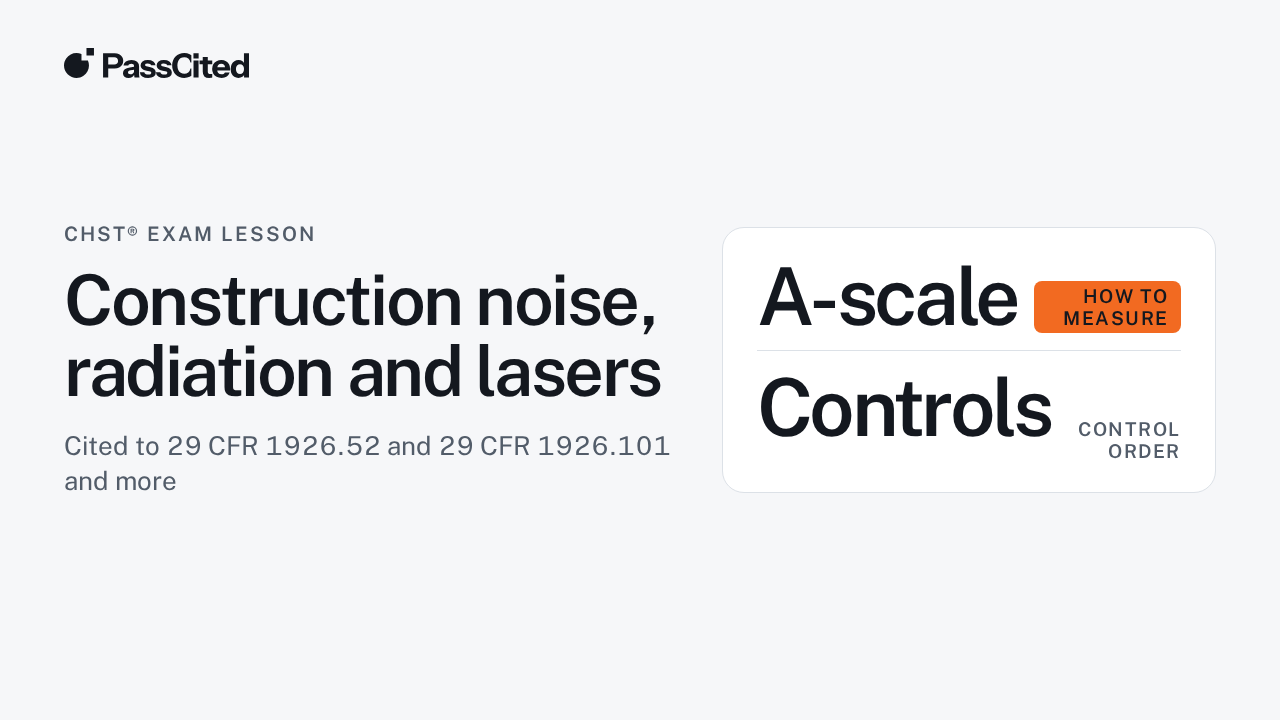 Construction noise, radiation and lasersCHST lesson, 6:57CHST exam lesson on construction noise (Table D-2, the Fe formula, hearing protection), ionizing radiation, and laser and microwave limits under 29 CFR 1926.52, .53, .54 and .101.
See where you stand on the CHST
25 questions, free, no card. You get a readiness score for each CHST domain.
ASP®, CSP® and CHST® are registered marks of BCSP. PassCited is not affiliated with or endorsed by BCSP.