Respirable crystalline silica in construction
CHST video lesson, 7:29. CHST Domain 1: Hazard and Risk Identification and Control
CHST review of 29 CFR 1926.1153: action level, PEL, Table 1, monitoring schedules, the competent person, medical surveillance, and a worked 8-hour TWA example.
Included with every pass, and free to watch with captions. Every rule and number is cited on screen to its primary source.
Transcript
0:00 Intro
Respirable crystalline silica in construction, for the CHST exam. Every rule and number here is cited to its primary source, on screen.
0:12 Learning objectives
In this lesson, you'll learn to: state the action level and the PEL, apply Table 1 versus alternative methods, set the monitoring and medical surveillance deadlines, and calculate an 8-hour TWA.
0:30 The two numbers
1153, both 8-hour TWAs. The action level is 25 micrograms per cubic meter. Below it under any foreseeable conditions, the section does not apply. The PEL is 50. It applies under alternative exposure control methods. Two compliance paths. Table 1: fully and properly implement the specified controls, work practices and respirators.
0:55 Two ways to comply
Do that, and you meet the respirator requirements of paragraph (e)(1). Alternative: tasks not on Table 1, or not fully implemented, require meeting the PEL and assessing each employee exposed, or reasonably expected to be, at or above the action level.
1:25 Table 1 details
Table 1 pairs controls with respirator duty, split at four hours per shift. A water-fed handheld power saw outdoors: no respirator up to four hours, APF 10 beyond. The same saw indoors or enclosed requires APF 10 at either duration. Mortar-removal grinders need APF 10 up to four hours and APF 25 beyond. Several Table 1 tasks in one shift: if combined time exceeds four hours, use the over-four-hour column for each.
2:04 Scheduled monitoring
Under scheduled monitoring, the latest result sets your next sample date. Initial result below the action level: you may stop. A later result below it: repeat within six months until two consecutive results, seven or more days apart, are below. Reassess when a change may reasonably be expected to cause new or additional exposures at or above the action level, or you believe they occurred. At or above the action level, up to the PEL: repeat within six months.
2:44 Worked example
Above the PEL: repeat within three months. Example: one shift, three exposure periods. Three hours at 80, four hours at 40, one hour at 20. Multiply each concentration by its hours: 240, 160 and 20. The sum is 420. 5 micrograms per cubic meter. Above the PEL: reduce exposure. Scheduled monitoring repeats within three months.
3:19 Who does what
Each covered employer needs a written exposure control plan. It covers tasks, controls, housekeeping and access restriction. Review it at least annually. The employer designates a competent person for frequent and regular inspections of job sites, materials and equipment.
3:41 Medical surveillance
Surveillance covers employees required to use a respirator 30 or more days per year, at no cost to them. Baseline exam: within 30 days after initial assignment, unless a qualifying exam occurred in the last three years. Periodic exams: at least every three years, or more often if the PLHCP recommends. Specialist exam: within 30 days after receiving a PLHCP opinion calling for one, such as an X-ray classified 1/0 or higher.
4:21 Housekeeping and notice
The employer's opinion includes that only with written authorization. Housekeeping and communication rules. No dry sweeping or brushing that could add exposure, unless wet sweeping, HEPA vacuuming and other methods are not feasible. No compressed air cleaning of clothing or surfaces that could add exposure, unless ventilation captures the dust cloud or no alternative is feasible. Within five working days after an exposure assessment, notify each affected employee in writing or post the results.
5:02 Common exam traps
Employees must demonstrate knowledge of hazards, tasks, controls, the standard, the competent person and medical surveillance. Now, six traps that catch people on exam day. One: 25 is the action level, not the PEL. The PEL is 50. Two: fully implementing Table 1 means no exposure assessment. Three: six months at or above the action level up to the PEL, three months above the PEL.
5:45 Recap quiz
Four: surveillance needs required respirator use of 30 or more days per year. Five: add up Table 1 task time. Over four hours, use the over-four-hour column. Six: employee exposure is measured as if no respirator were worn. Question 1. Under scheduled monitoring, the latest TWA is 40 micrograms per cubic meter. When must monitoring repeat? A: within three months. B: within six months. C: within one year. D: never. B. At or above the action level but at or below the PEL means repeat within six months. Question 2. Who inspects job sites for the plan? A: qualified person. B: competent person. C: the PLHCP. D: authorized person. B. The employer designates a competent person for frequent and regular inspections. Question 3. A worker must use a respirator 30 or more days a year, with no exam in three years. Baseline due within? A: 30 days. B: three months. C: six months. D: one year. A. Thirty or more respirator days triggers surveillance. With no qualifying exam in three years, baseline is due within 30 days. Want to see where you stand on every CHST domain? com.
More CHST lessons
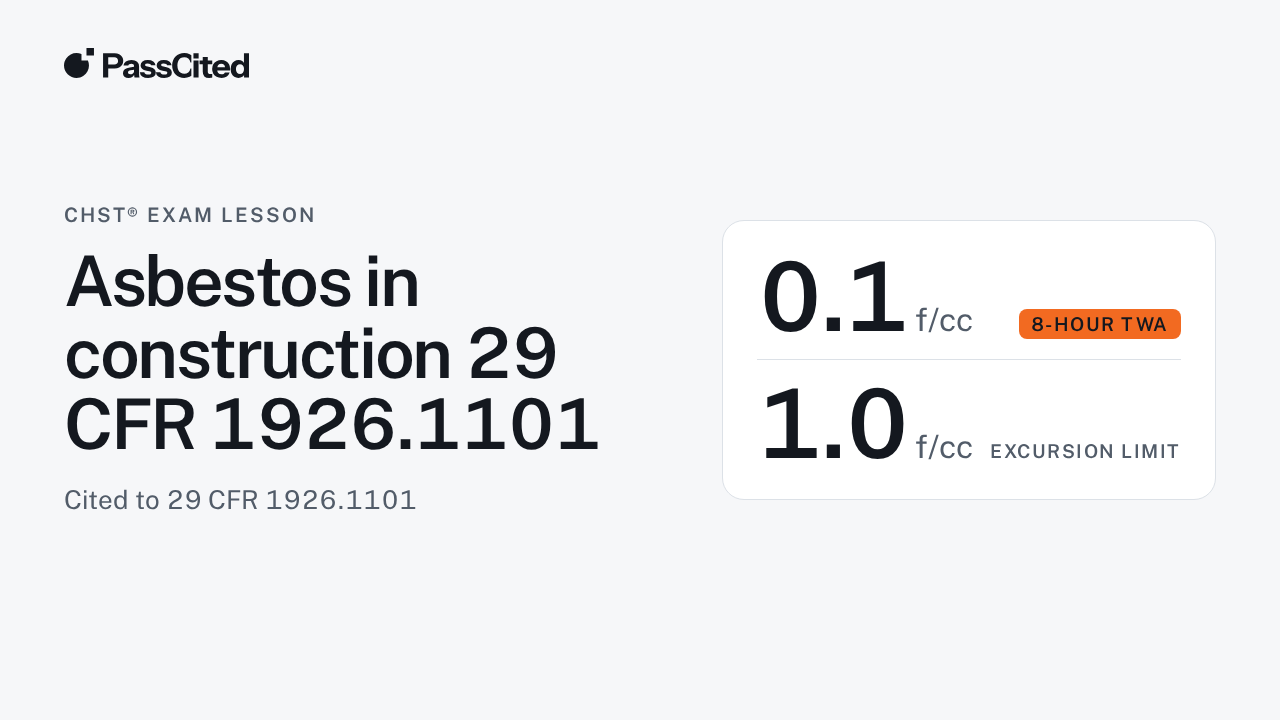 Asbestos in construction 29 CFR 1926.1101CHST lesson, 7:27Asbestos in construction under 29 CFR 1926.1101 for the CHST exam: PELs, work classes, competent person duties, regulated areas, monitoring, training hours and notification deadlines.
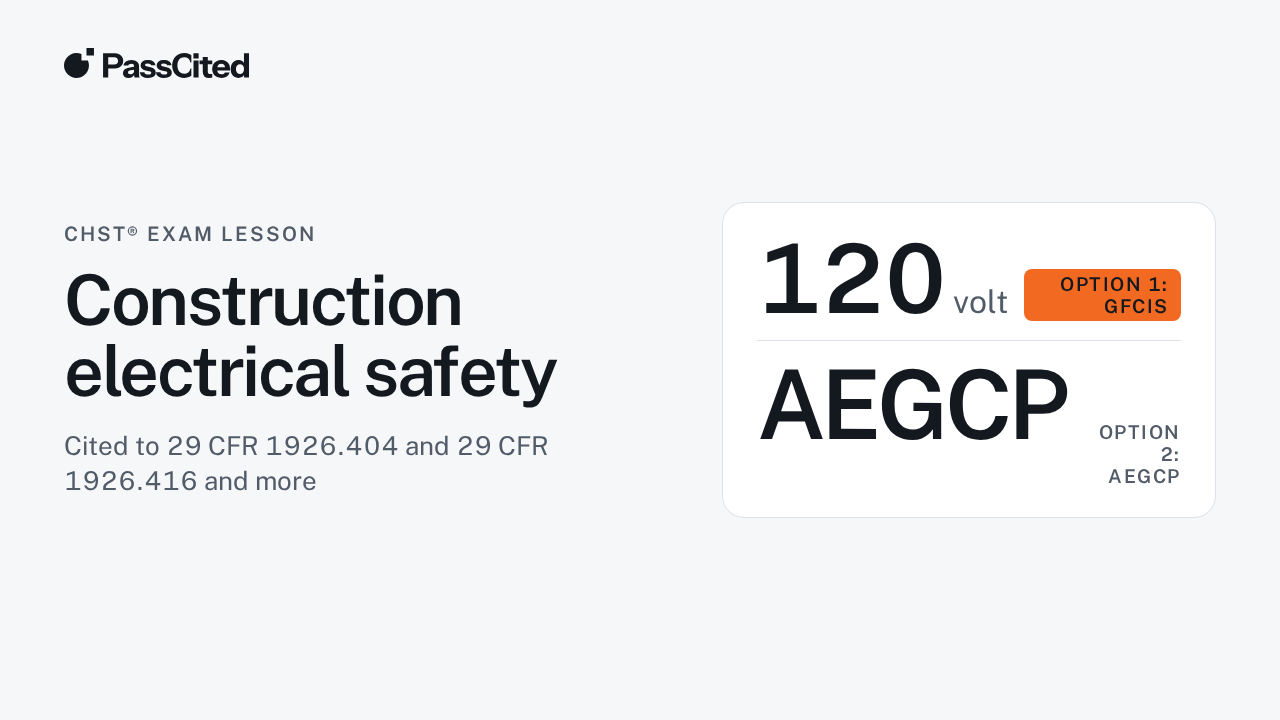 Construction electrical safetyCHST lesson, 7:05Construction electrical safety for the CHST exam: GFCI versus the assured grounding program, test intervals, overhead clearances, grounding distances, and lockout tagging under 1926 Subpart K.
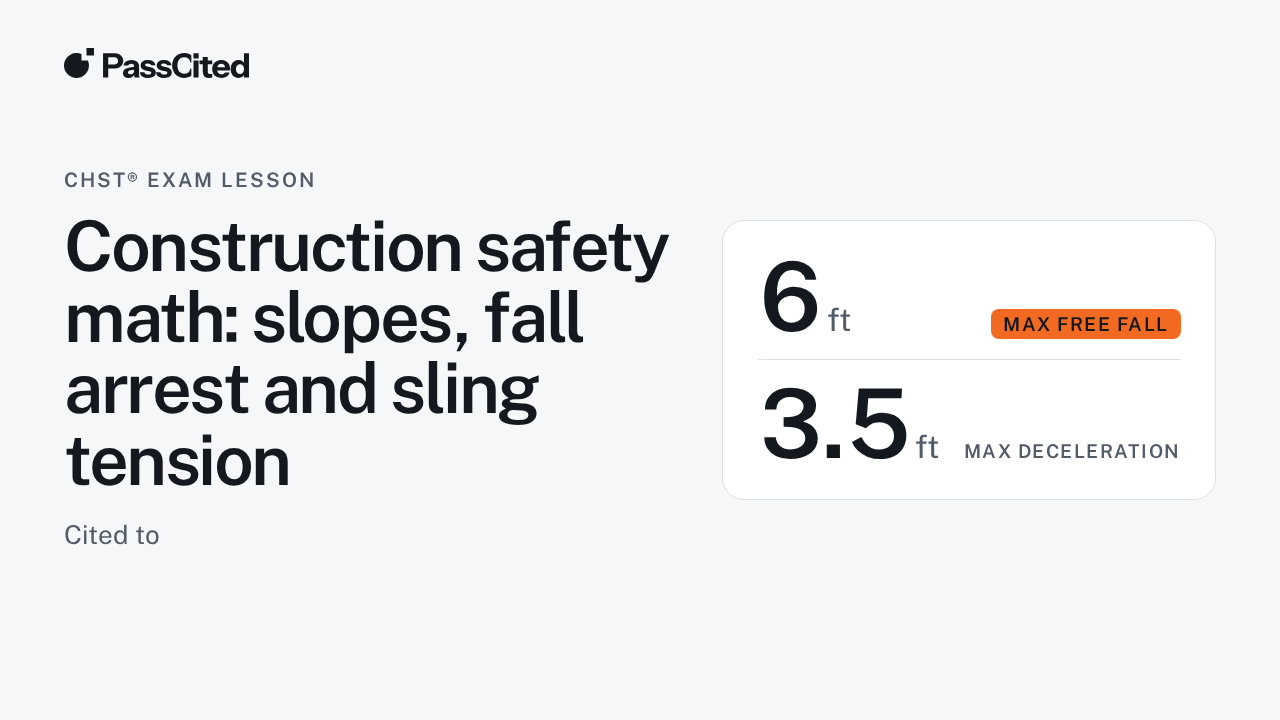 Construction safety math: slopes, fall arrest and sling tensionCHST lesson, 6:17Worked CHST calculations: excavation slope geometry, the 6-foot free fall and 3.5-foot deceleration limits, and sling tension at a 45-degree angle, each tied to its primary source.
See where you stand on the CHST
25 questions, free, no card. You get a readiness score for each CHST domain.
ASP®, CSP® and CHST® are registered marks of BCSP. PassCited is not affiliated with or endorsed by BCSP.