Steel erection: start and fall protection
CHST video lesson, 7:00. CHST Domain 3: Safety Program Development, Implementation, and Sustainment
CHST review of 1926 Subpart R: concrete strength before erection, controlling contractor duties, the 15-foot rule, connectors, controlled decking zones and custody of fall protection.
Included with every pass, and free to watch with captions. Every rule and number is cited on screen to its primary source.
Transcript
0:00 Intro
Steel erection, for the CHST exam. Every rule and number here is cited to its primary source, on screen. In this lesson, you'll learn to: state the written approval needed to start steel erection, apply the 15 foot and 30 foot fall protection thresholds, describe the limits of a controlled decking zone, and say who controls fall protection after the erector leaves.
0:30 Approval to begin
Before steel erection starts, two parties have written-notice duties. 755(b). The erector must not erect steel until it receives written notice of the required strength. The notice rests on a specific test. Concrete in footings, piers and walls must reach 75 percent of intended minimum compressive design strength, or sufficient strength for erection loads.
0:55 Strength test
An appropriate ASTM test method on field-cured samples judges it. The same applies to mortar in masonry piers and walls. The controlling contractor also owns site layout.
1:20 Site layout and planning
It ensures adequate access roads, with pedestrian and vehicular control (not roads outside the site), plus a firm, properly graded, drained area for storage and equipment. Hoisting must be pre-planned. If employers elect alternate means and methods due to site conditions, a qualified person develops a site-specific erection plan, kept on site.
1:51 General rule
The general trigger is 15 feet. Except connectors and CDZ workers, anyone with an unprotected side or edge more than 15 feet above a lower level needs guardrails, nets, arrest, positioning or restraint. On multi-story structures, perimeter safety cables go in at the final interior and exterior perimeters as soon as the metal decking is installed.
2:19 Connectors
Connectors get their own rule, in three parts. Over 15 and up to 30 feet, a connector needs arrest, positioning or restraint equipment and wears gear able to tie off, or has other qualifying protection. Beyond two stories or 30 feet, whichever is less, the general rule's full protection applies.
2:50 Controlled decking zone
761. A CDZ may be set up over 15 and up to 30 feet, where metal decking is first installed at the leading edge. It is capped at 90 feet wide and 90 feet deep from any leading edge, with boundaries clearly marked by control lines or the equivalent. Unsecured decking may not exceed 3,000 square feet.
3:22 Inside the CDZ
Only leading edge workers may enter. Each employee working in a CDZ must have completed CDZ training. Work inside a CDZ is restricted. Leading edge employees must be protected from falls of more than two stories or 30 feet, whichever is less. Safety deck attachments run from the leading edge back to the control line, at least two per panel.
3:48 Custody of fall protection
Final deck attachments and shear connector installation are not allowed in the CDZ. Erector-provided fall protection may stay for other trades only under conditions. First, the controlling contractor or its authorized representative directs the erector to leave it in place. Second, it inspects and accepts control and responsibility before other trades work there.
4:22 Common exam traps
502. Perimeter cables meet guardrail criteria; restraint systems use a belt or harness. Now, six traps that catch people on exam day. One: the erector cannot erect without written notice, which the controlling contractor ensures. Two: 75 percent of intended minimum compressive design strength, or sufficient strength for erection loads. Three: apart from connectors and CDZ workers, protection starts above 15 feet. Four: a CDZ is capped at 90 by 90 feet, and unsecured decking may not exceed 3,000 square feet.
5:15 Recap quiz
Five: final deck attachments and shear connectors stay out of the CDZ. Six: other trades get erector fall protection only after the controlling contractor or its representative directs, inspects and accepts it. Question 1. Before authorizing steel erection, who must ensure the erector gets written notice of concrete strength? A: The erector. B: The controlling contractor. C: The crane operator. D: The site owner only. B. The controlling contractor must ensure the written notification is provided. Question 2. A CDZ has which maximum dimensions from any leading edge? A: 30 by 30 feet. B: 45 by 45 feet. C: 90 by 90 feet. D: 3,000 wide by 90 deep. C. Not more than 90 feet wide and 90 feet deep. Question 3. An erector finishes a floor and others will work there. When may the erector's fall protection stay? A: Left without notice. B: A foreman verbally agrees. C: Workers reach 30 feet. D: The controlling contractor directs, inspects and accepts it. D. The controlling contractor directs it left, then inspects and accepts responsibility. Want to see where you stand on every CHST domain? com.
More CHST lessons
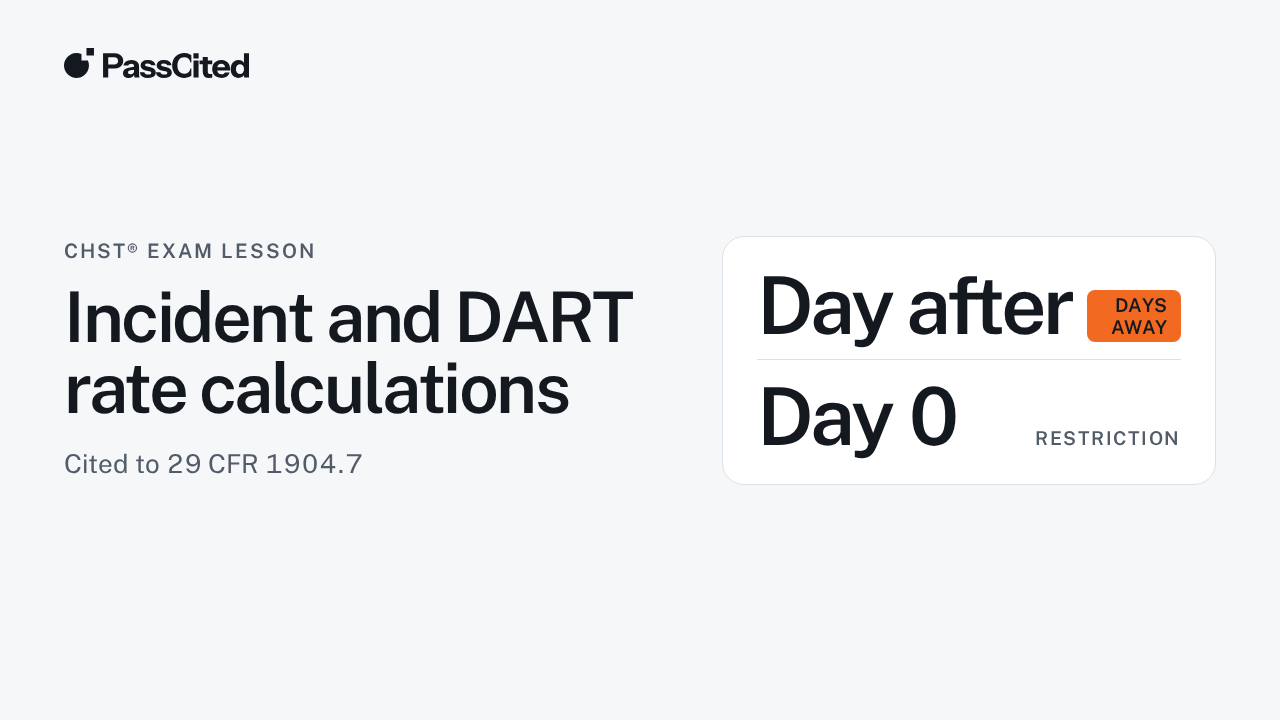 Incident and DART rate calculationsCHST lesson, 6:22Calculate TRIR and DART as cases per 100 full-time workers using the 200,000-hour base. Learn what counts in each numerator, work through examples, and avoid the common CHST exam traps.
 OSHA inspections and citationsCHST lesson, 6:52What a compliance officer may do on site, how citations are issued and posted, and the abatement deadlines an employer must meet under 29 CFR part 1903. Built for the CHST exam.
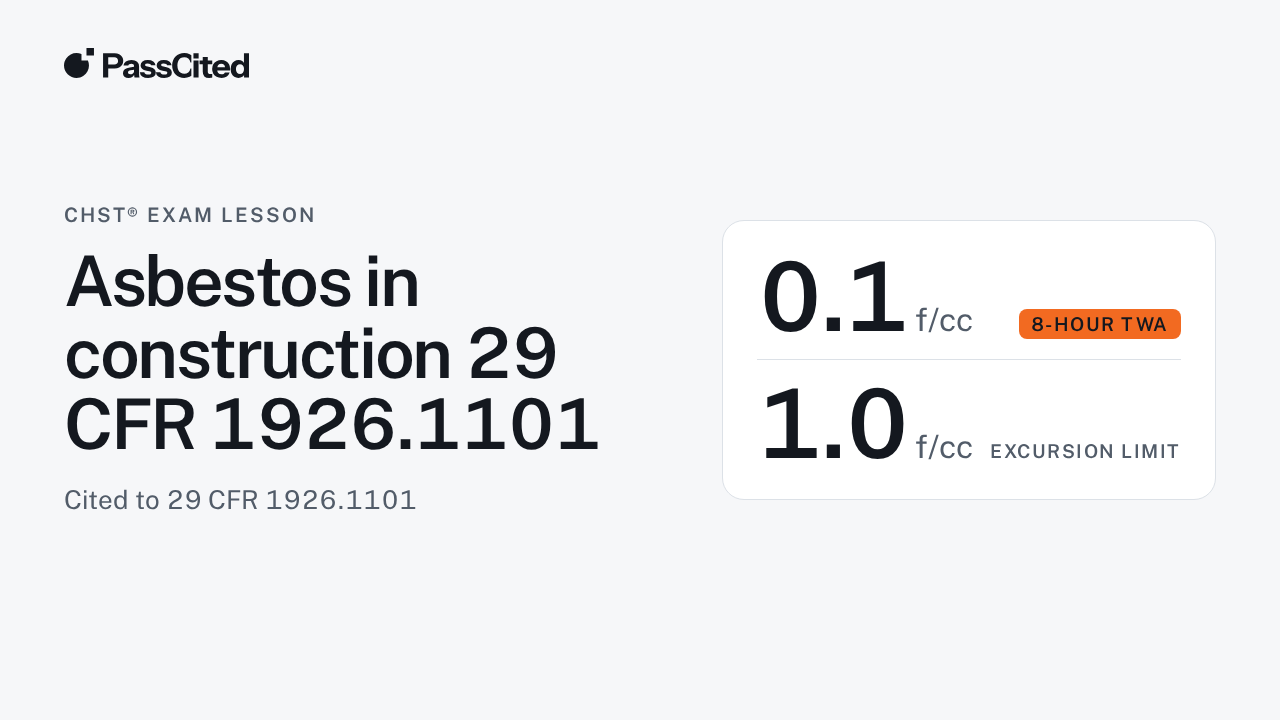 Asbestos in construction 29 CFR 1926.1101CHST lesson, 7:27Asbestos in construction under 29 CFR 1926.1101 for the CHST exam: PELs, work classes, competent person duties, regulated areas, monitoring, training hours and notification deadlines.
See where you stand on the CHST
25 questions, free, no card. You get a readiness score for each CHST domain.
ASP®, CSP® and CHST® are registered marks of BCSP. PassCited is not affiliated with or endorsed by BCSP.