Permit-required confined spaces
ASP video lesson, 7:19. ASP Domain 2: Safety Programs and Concepts
ASP exam review of 29 CFR 1910.146 (general industry): confined vs permit space, hazardous atmosphere thresholds, the alternate procedures, attendant and entry supervisor roles, testing order, and program review timing.
Included with every pass, and free to watch with captions. Every rule and number is cited on screen to its primary source.
Transcript
0:00 Intro
146, for the ASP exam. Construction is covered separately. Every rule and number here is cited to its primary source, on screen. In this lesson, you'll learn to: separate a confined space from a permit-required confined space, state the hazardous atmosphere thresholds, apply the alternate procedures and reclassification rules, and assign entry roles and meet the program review timing.
0:17 Learning objectives
A confined space meets three tests.
0:39 Definitions
Fail any one and it is not a confined space. It is large enough to enter and work in, has limited or restricted entry or exit, and is not designed for continuous occupancy. It is permit-required if it has one or more of four characteristics: hazardous atmosphere, engulfing material, converging walls or a tapering floor, or any other recognized serious hazard.
1:09 Hazardous atmosphere
Know the atmospheric triggers cold. Flammable gas, vapor or mist: more than 10 percent of its lower flammable limit. Combustible dust: at or above its LFL, roughly where dust obscures vision at 5 feet or less. 5 percent. Toxics above a published dose or PEL also qualify, as does any other atmospheric condition that is immediately dangerous to life or health.
1:46 Testing
When testing atmospheres, the order is fixed. Test first for oxygen, then combustible gases and vapors, then toxic gases and vapors. Test before entry is authorized, and monitor as needed. If isolation is infeasible because the space is large or part of a continuous system, such as a sewer, test to the extent feasible and continuously monitor where entrants work. Entrants may observe testing, get results immediately, and request reevaluation in their presence if they believe the evaluation was inadequate.
2:25 Alternate procedures
Some permit spaces qualify for alternate procedures, which waive paragraphs (d) through (f) and (h) through (k). The (c)(5)(ii) entry procedures still apply. The employer must demonstrate that the only hazard is an actual or potential hazardous atmosphere, and that continuous forced air ventilation alone keeps the space safe. Monitoring and inspection data must support that, documented and made available to entrants.
3:13 Reclassification
Any initial entry to gather it must follow (d) through (k). No hazardous atmosphere may exist while anyone is inside. If one is detected, everyone leaves immediately. Classification can change in either direction. A permit space may be reclassified only if all hazards are eliminated, and only while they stay eliminated.
3:41 Roles
Entry to eliminate hazards must follow the full program. Ventilation is not elimination. If a non-permit space changes in a way that might increase hazards, reevaluate and reclassify if necessary. Know the roles and who may combine them.
4:05 Host and contractor
The attendant is stationed outside, monitors the authorized entrants, and at least one is required for the duration of entry. The entry supervisor authorizes, oversees and terminates entry, and may also serve as attendant or entrant if trained and equipped for each role. When a contractor enters your permit spaces, duties run both ways.
4:31 Program review
The host informs the contractor, shares hazards and precautions, coordinates when both crews work in or near permit spaces, and debriefs afterward. The contractor obtains hazard information, coordinates, and informs the host of its program and hazards confronted or created.
4:59 Common exam traps
The program is reviewed on triggers and on a clock. Triggers: reason to believe measures may not protect employees, such as unauthorized entry or a near-miss. Fix deficiencies before any subsequent entry is authorized. Also review using canceled permits within 1 year after each entry. One annual review may cover all entries in 12 months. Now, six traps that catch people on exam day.
5:38 Recap quiz
One: a confined space needs one or more of the four characteristics to be a permit space. 5 percent. Three: test oxygen, then combustibles, then toxics. Four: ventilation controls a hazard but does not eliminate it. Five: a supervisor may also be attendant or entrant, if trained and equipped. Six: no entry in 12 months means no annual review. Question 1. What is the correct order for testing? A: toxics, oxygen, combustibles. B: oxygen, combustibles, toxics. C: combustibles, oxygen, toxics. D: oxygen, toxics, combustibles. B. Oxygen first, then combustibles, then toxics. Question 2. Which atmosphere is hazardous? 9 percent. B: flammable vapor at 8 percent of LFL. C: oxygen at 24 percent. D: oxygen at 21 percent. C. 5 percent is hazardous. Question 3. A crew chief authorizes entry, then acts as attendant. Allowed? A: yes, if trained and equipped for each role. B: no, never. C: only with a contractor. D: only for non-permit spaces. A. A supervisor may also be attendant or entrant if trained and equipped for each role. Want to see where you stand on every ASP domain? com.
More ASP lessons
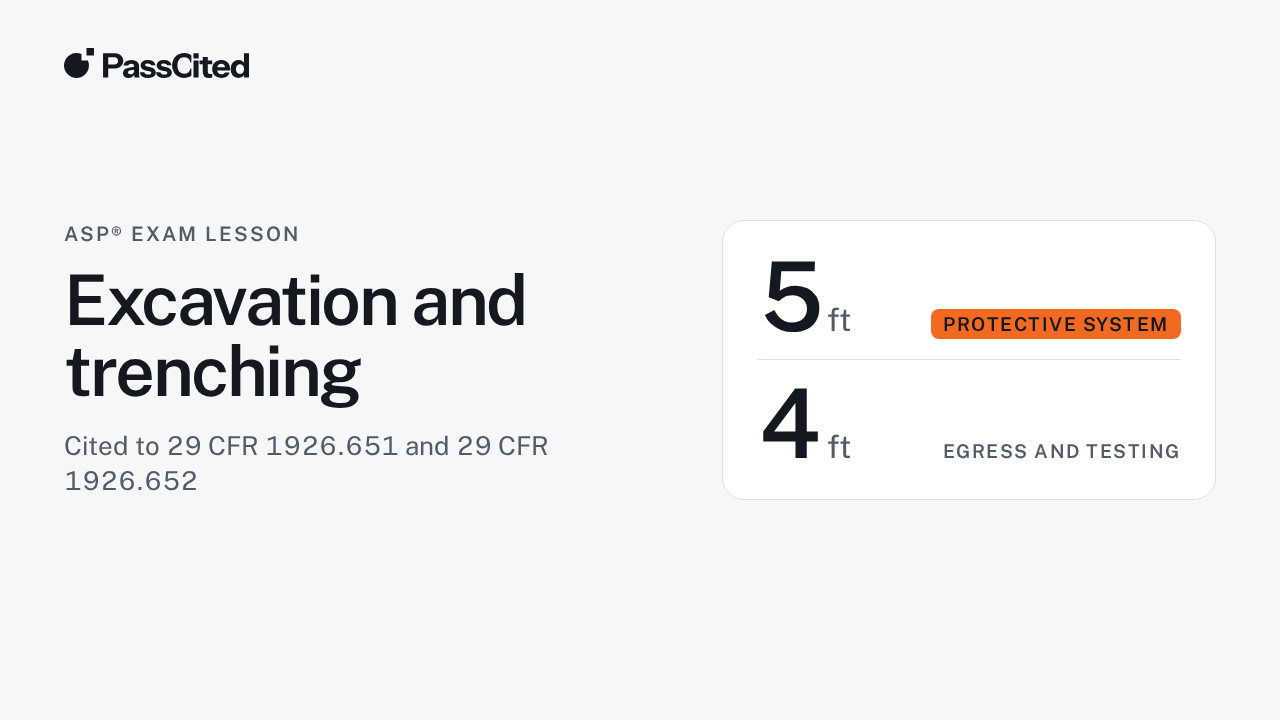 Excavation and trenchingASP lesson, 7:06ASP exam review of 29 CFR 1926 Subpart P: the 5-foot and 4-foot thresholds, utility locates, daily inspections, soil types, maximum allowable slopes, and who does what.
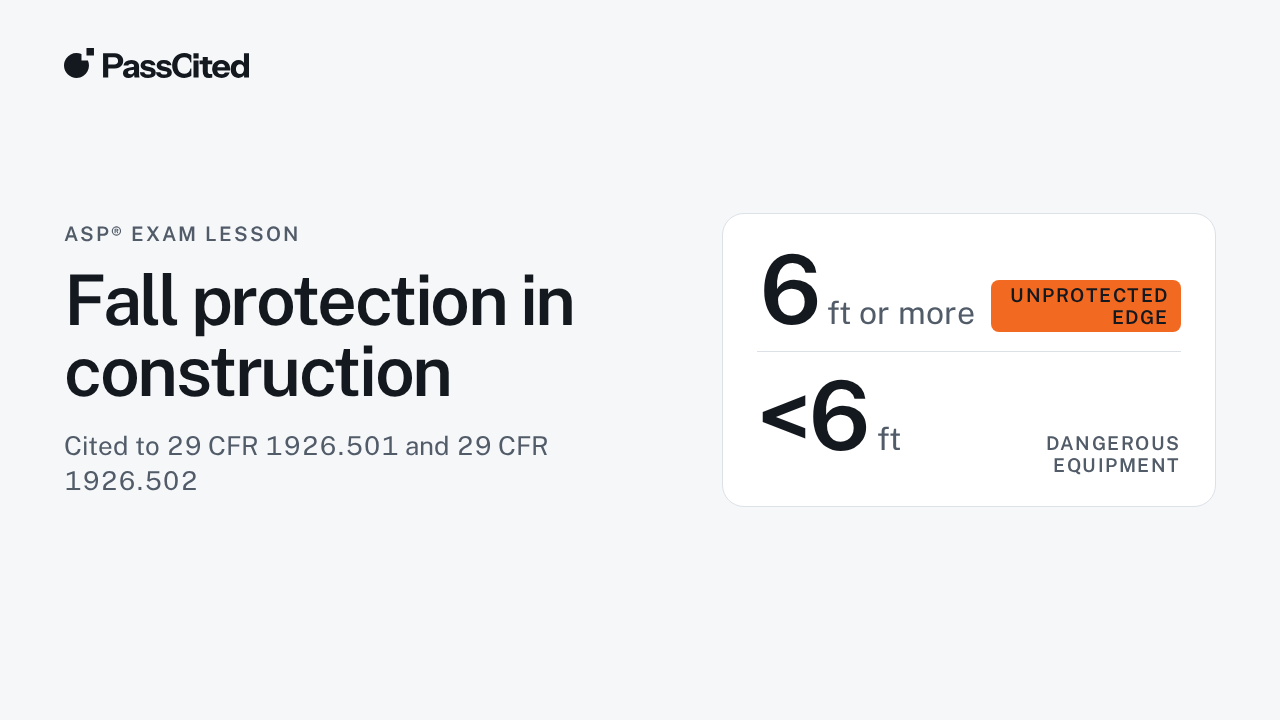 Fall protection in constructionASP lesson, 7:07Construction fall protection under 1926.501 and 1926.502: the 6-foot trigger, system criteria, guardrail, net, arrest and warning line numbers, and who must prepare and supervise.
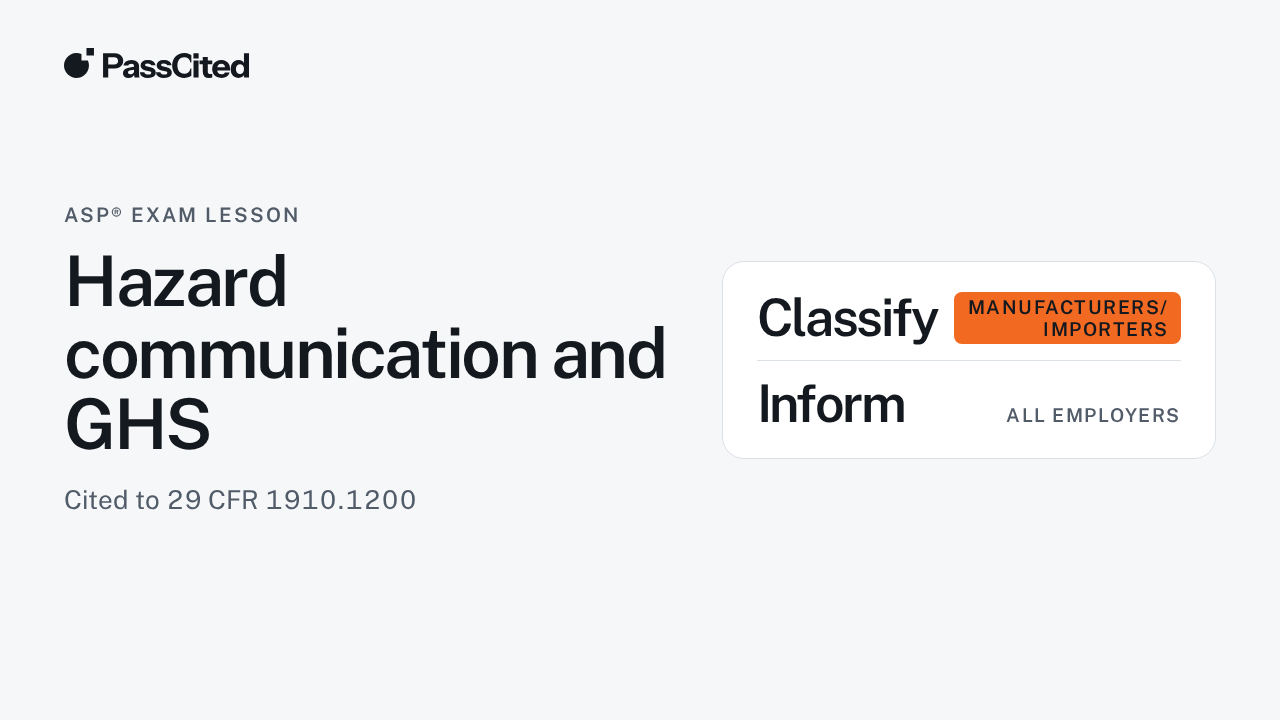 Hazard communication and GHSASP lesson, 7:29ASP exam review of OSHA 1910.1200: who classifies chemicals, the six label elements, SDS timing and 16 sections, the written program, training, trade secrets and 2026-2028 dates.
See where you stand on the ASP
25 questions, free, no card. You get a readiness score for each ASP domain.
ASP®, CSP® and CHST® are registered marks of BCSP. PassCited is not affiliated with or endorsed by BCSP.