Electrical safety-related work practices
ASP video lesson, 7:14. ASP Domain 4: Fire Prevention and Protection
Deenergize first, lockout and tagging, qualified-person tests, overhead line distances, and construction GFCI and grounding rules from 1910.333 and 1926.404, for the ASP exam.
Included with every pass, and free to watch with captions. Every rule and number is cited on screen to its primary source.
Transcript
0:00 Intro
Electrical safety-related work practices, for the ASP exam. Every rule and number here is cited to its primary source, on screen.
0:11 Learning objectives
In this lesson, you'll learn to: state when live parts must be deenergized, order the lockout, tagging, and verification steps, apply overhead line distances and clearances, and choose G-F-C-I or A-E-G-C-P protection on construction sites.
0:32 General rule
Live parts must be deenergized before work on or near them. Exception: the employer can demonstrate deenergizing adds hazards or is infeasible due to equipment design or operational limitations. Under 50 volts to ground: no need to deenergize if no increased exposure to electrical burns or arc explosion.
0:57 Deenergized work
Exposed to deenergized fixed equipment? Lock out or tag, in order. First, a written copy of the procedures, available for inspection. Determine safe procedures, then disconnect all sources. Push buttons and interlocks cannot be the sole means. Release hazardous stored electric energy: discharge capacitors, short and ground high capacitance elements. Block or relieve stored non-electrical energy that could reenergize circuits.
1:37 Application of locks and tags
Then apply a lock and a tag to each disconnecting means. Default: a lock and a tag on each disconnecting means. A tag alone is allowed if a lock cannot be applied, or equivalent safety is shown, plus at least one more lock-equivalent measure, such as blocking a controlling switch.
2:02 Who does what
A lock alone needs three conditions: one circuit or piece of equipment, within the work shift, familiar employees. Verification is a qualified-person task. A qualified person verifies the equipment cannot restart. A qualified person tests, including for induced voltage and backfeed. Over 600 volts nominal, check the tester immediately before and after. Reenergize in order: tools and grounds verified removed; employees warned; lock and tag removed by the applier or under direct supervision.
2:48 Energized work
If the applier is absent, a designated qualified person may remove it if the employer ensures the applier is unavailable and will be told before resuming. Then a visual clear check. Deenergized but not locked out or tagged?
3:09 Overhead lines
Treat as energized. Only qualified persons may work on parts not deenergized under paragraph b. Only a qualified person may defeat an interlock, temporarily while working on the equipment, and must restore it afterward. Near overhead lines, deenergize and ground them, or provide protective measures, first. Qualified persons stay outside Table S-5 distances unless insulated as specified.
3:44 Unqualified persons and equipment
300 volts and less: avoid contact. Over 300 to 750: 1 foot. Over 750 volts to 2 kilovolts: 1 foot 6 inches. Over 2 to 15 kilovolts: 2 feet. Over 15 to 37 kilovolts: 3 feet. Unqualified persons working elevated keep themselves and the longest conductive object they may contact 10 feet from unguarded, energized lines, at 50 kilovolts to ground or below. Over 50 kilovolts, add 4 inches for every 10 kilovolts over 50. Vehicles keep 10 feet, or 4 in transit lowered, plus 4 inches per 10 kilovolts over 50.
4:26 Construction: 1926.404
Rated barriers not on the vehicle allow less. So does an insulated aerial lift worked by a qualified person: its uninsulated portion may come as close as the Table S-5 distance. On construction sites, use either GFCIs or an assured equipment grounding conductor program. GFCIs cover 120-volt, single-phase, 15- and 20-ampere outlets in use, not permanent wiring. Exempt: two-wire, single-phase portable or vehicle-mounted generators of 5 kilowatts or less, with conductors insulated from frame and grounded surfaces.
5:07 Common exam traps
Under the assured program, test before first use, after repairs or suspected damage, and every 3 months, or 6 if fixed and not exposed to damage.
5:32 Recap quiz
Now, four traps that catch people on exam day. One: deenergized but not locked out or tagged is treated as energized. Two: only qualified persons work on parts not deenergized. Three: a tag without a lock needs an additional safety measure. Four: it's GFCIs or an assured program, either one. Question 1. An unqualified person works elevated near an unguarded 40 kilovolt to ground line. Minimum distance? A: 3 feet. B: 6 feet. C: 10 feet. D: 15 feet. C. For voltages to ground of 50 kilovolts or below, stay 10 feet away. Question 2. A lock is placed without a tag. Which condition is not required? A: one circuit deenergized. B: lockout within the shift. C: a tag added next shift. D: employees know the procedure. C. A lock alone needs one circuit, no longer than the shift, and familiar employees. Question 3. A qualified person works near a 10 kilovolt phase-to-phase line; no insulation exception applies. Table S-5 minimum? A: 1 foot 6 inches. B: 2 feet. C: 3 feet. D: 4 feet. B. Over 2 kilovolts but not over 15 kilovolts is 2 feet. Want to see where you stand on every ASP domain? com.
More ASP lessons
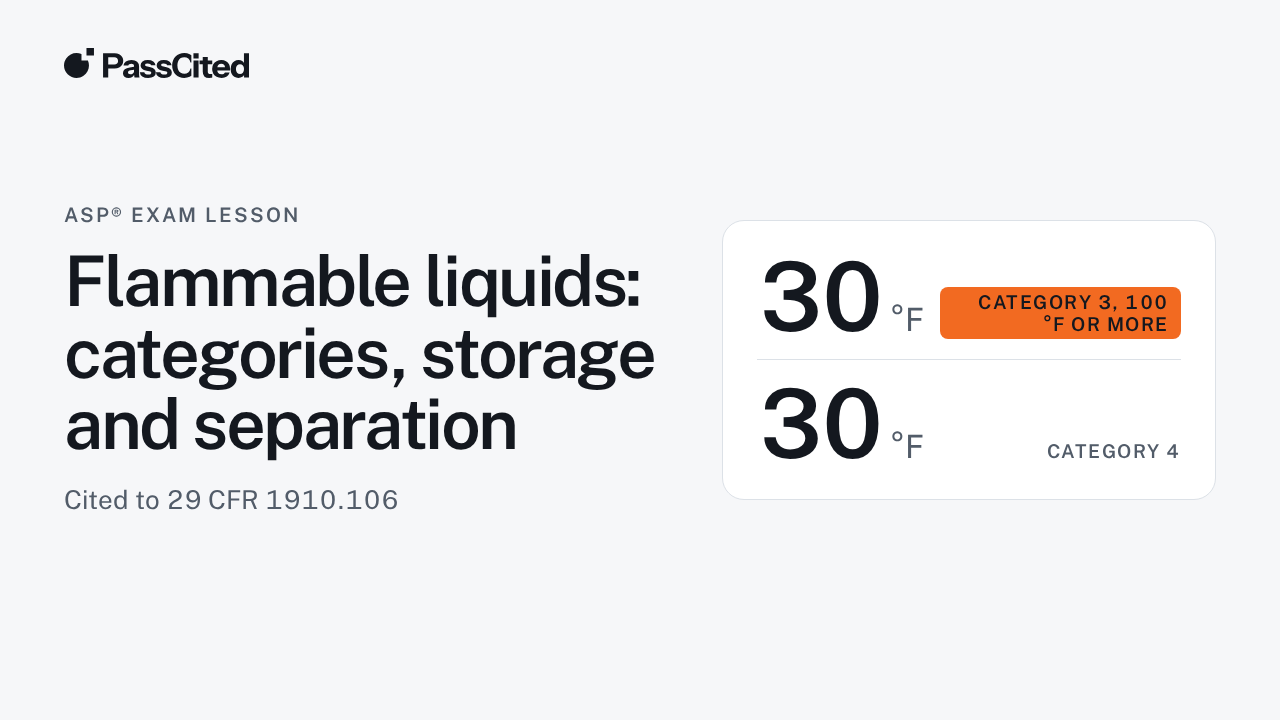 Flammable liquids: categories, storage and separationASP lesson, 7:421910.106 for the ASP exam: the four flammable liquid categories, safety cans, storage cabinets, inside rooms, outdoor distances and tank spacing, with cited numbers.
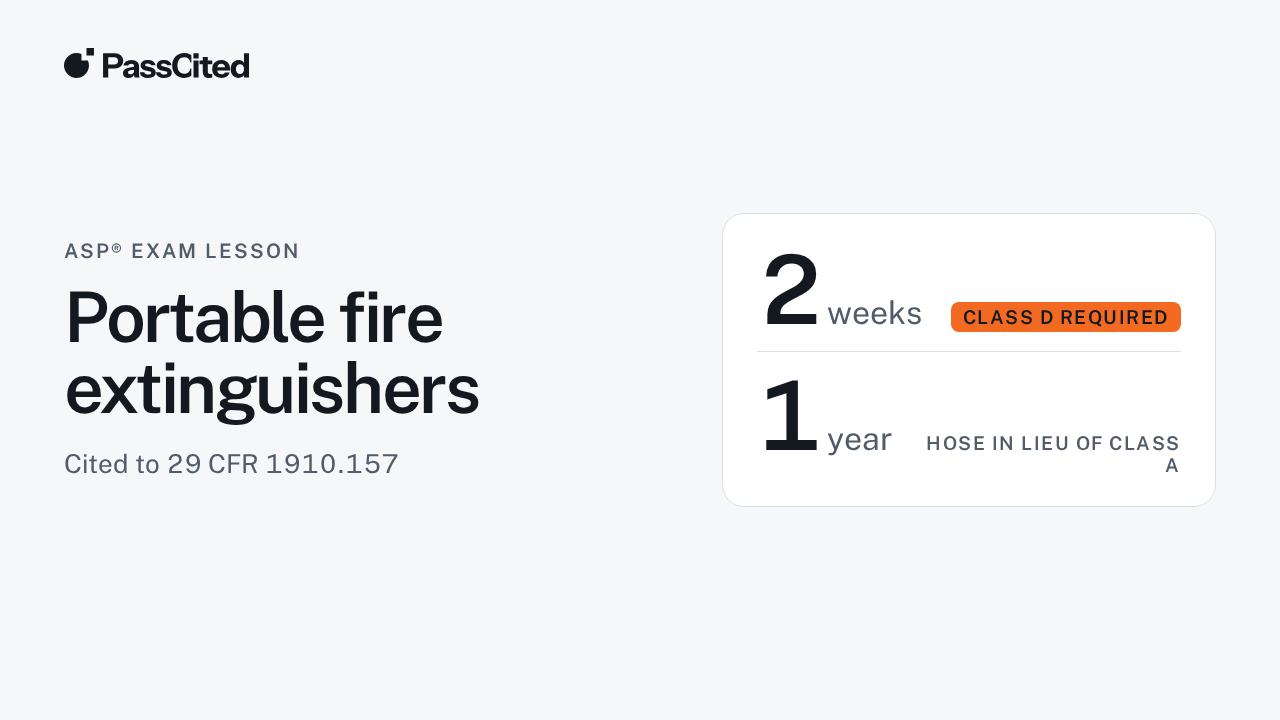 Portable fire extinguishersASP lesson, 7:46Portable fire extinguishers under 29 CFR 1910.157 for the ASP exam: travel distances by class, inspection and maintenance, hydrostatic test intervals, records, and annual employee education.
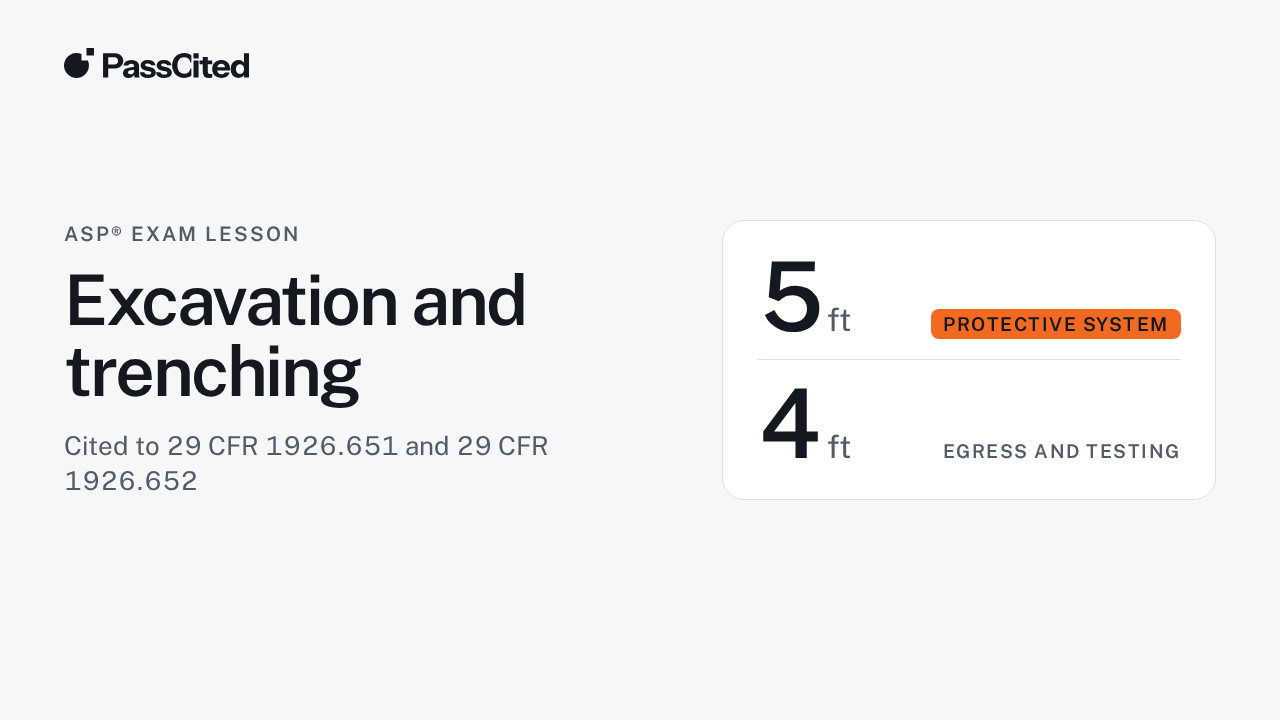 Excavation and trenchingASP lesson, 7:06ASP exam review of 29 CFR 1926 Subpart P: the 5-foot and 4-foot thresholds, utility locates, daily inspections, soil types, maximum allowable slopes, and who does what.
See where you stand on the ASP
25 questions, free, no card. You get a readiness score for each ASP domain.
ASP®, CSP® and CHST® are registered marks of BCSP. PassCited is not affiliated with or endorsed by BCSP.