Employee alarm systems
ASP video lesson, 6:21. ASP Domain 5: Emergency Preparedness and Response
Narrated with an AI-generated voice. The script is AI-drafted from the cited rules and fact-checked against them.
Employee alarm systems under 29 CFR 1910.165 for the ASP exam: perception, distinctive signals, the 10-employee rule, two-month and annual testing, supervised circuits and manual devices.
Included with every ASP pass, with captions, chapters and the full transcript. Every rule and number is cited on screen to its primary source.
What this lesson covers
In this lesson, you'll learn to: state what an employee alarm must do and who must perceive it, apply the 10-or-fewer employee exception, match test intervals to non-supervised and supervised systems, and explain maintenance, backups and manual actuation devices. 1910.165 applies to emergency employee alarms installed to meet a particular OSHA standard.
- Intro
- Learning objectives
- Scope
- General requirements
- Reporting and procedures
- Installation and restoration
- Testing
- Maintenance
- On the job
- Common exam traps
- Recap quiz
The video, captions and full transcript are included with every ASP pass. See passes
More ASP lessons
 Emergency action and fire prevention plansASP lesson, 5:59What OSHA 1910.38 and 1910.39 require in an emergency action plan and a fire prevention plan: minimum elements, written versus oral plans, alarms, training and when to review.
 Emergency drills and exercises (HSEEP)ASP lesson, 6:28HSEEP exercise types, drills versus tabletops, the exercise planning meetings, SMART objectives, the hotwash and debrief, and the AAR/IP: what the ASP exam tests on emergency exercises.
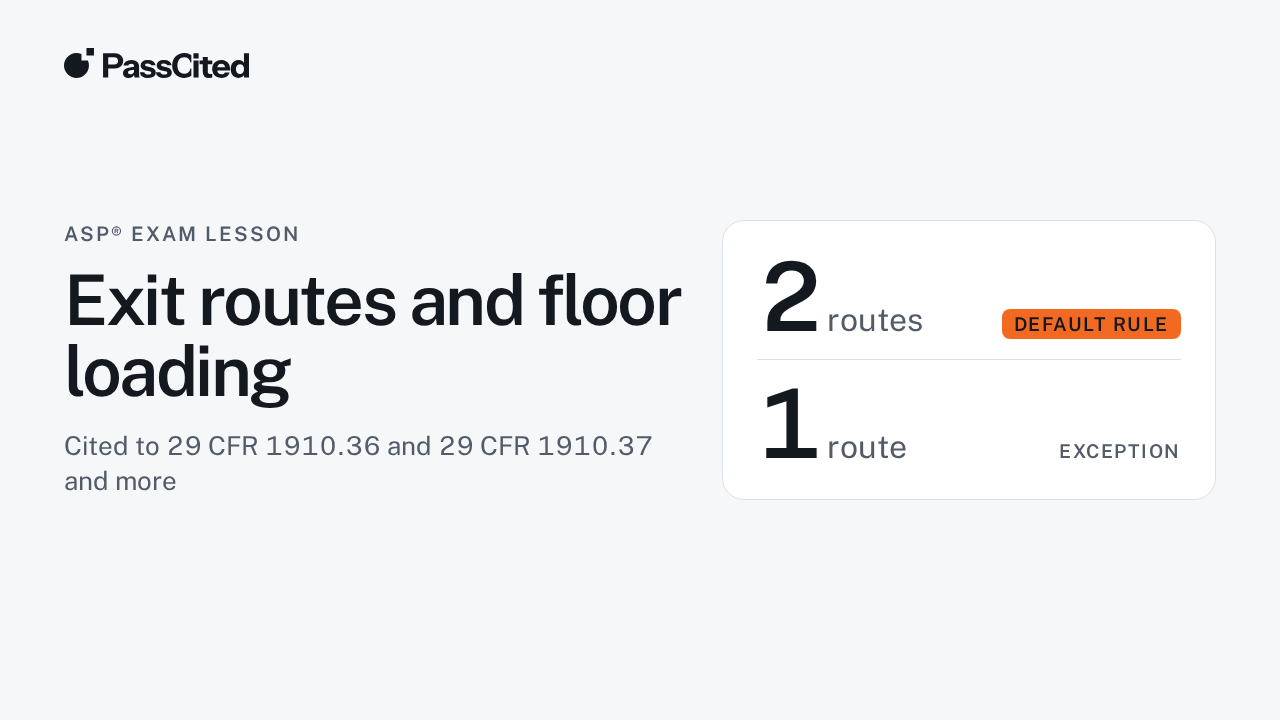 Exit routes and floor loadingASP lesson, 5:55The ASP-tested rules for exit routes under 29 CFR 1910.36 and 1910.37, plus the walking-working surface load and repair rules in 1910.22: counts, dimensions, doors, signs and who repairs.
See where you stand on the ASP
25 questions, free, no card. You get a readiness score for each ASP domain.
ASP®, CSP® and CHST® are registered marks of BCSP. PassCited is not affiliated with or endorsed by BCSP.