Heat index, WBGT and wind chill
ASP video lesson, 6:55. ASP Domain 1: Mathematical Calculations
Calculate indoor and outdoor WBGT, the NWS heat index regression and wind chill, with worked examples, the formulas as published, and the traps that show up on the ASP exam.
Included with every pass, and free to watch with captions. Every rule and number is cited on screen to its primary source.
Transcript
0:00 Intro
Heat index, WBGT and wind chill calculations, for the ASP exam. Every rule and number here is cited to its primary source, on screen.
0:11 Learning objectives
In this lesson, you'll learn to: compute indoor and outdoor WBGT, choose the right WBGT formula for the setting, apply the National Weather Service heat index regression, and calculate wind chill from temperature and wind speed.
0:28 WBGT
WBGT, the wet bulb globe temperature, has two formulas. Which one you use depends on the setting. 3 times globe temperature. 1 air. Symbols are tested: t-nwb is natural wet bulb and t-g is globe temperature.
1:04 Worked example
Air temperature, t-a, is the third input, and it appears only outdoors. Example: a foundry floor, indoors. Natural wet bulb is 24 degrees, globe temperature is 40. Indoors, so use the indoor formula. 8. 3 times 40 is 12.
1:34 Worked example
8 degrees C WBGT. Remember, the indoor formula has no air temperature term, only natural wet bulb and globe temperature. Now outdoors, a roofing job. Natural wet bulb 25, globe 45, air temperature 35. 5. 2 times 45 is 9. 5. The sum is 30 degrees C WBGT. 0, the wrong answer. The heat index combines air temperature in degrees F with relative humidity in percent.
2:10 Heat index
In practice, the simple formula is computed first, and the result averaged with the temperature. If that value is 80 degrees F or higher, the full regression equation is applied.
2:39 Worked example
The regression is the long polynomial in T and RH. Any adjustment the National Weather Service describes is then applied. Heat index and WBGT are different measures. Example: 90 degrees F, 70 percent relative humidity. Assume the first-pass value is 80 or higher, so the full regression applies.
3:07 Wind chill
Plug T equals 90 and RH equals 70 into the regression. The result is a heat index of about 106 degrees F. It feels about 16 degrees hotter than the air temperature. Remember, heat index and WBGT are different measures.
3:40 Worked example
Wind chill uses air temperature, T, in degrees F, and wind speed in miles per hour. Convert first if your data is in other units. 16. T is in degrees F and wind is in miles per hour. The result is the wind chill in degrees F. Example: a cold storage yard. Air temperature is 20 degrees F, wind 15 miles per hour. 54. 2, so the wind chill is about 6 degrees F.
4:22 On the job
Wind chill is a cold-weather calculation, not WBGT or heat index. Convert units before you plug in. That is 14 degrees colder than the air temperature alone suggests. Always report the wind chill with the units used. You're the safety manager on a roofing job.
4:55 Common exam traps
Your meter reads natural wet bulb 26, globe 46, air 34. The crew is outdoors, so use the outdoor formula, with the air temperature term. Indoors, that term is not used. 4. 8 degrees C, calculated with the outdoor formula. Now, five traps that catch people on exam day. 1 air temperature. Two: indoor WBGT has no air temperature term.
5:31 Recap quiz
Three: if the simple-formula heat index, averaged with the temperature, is 80 degrees F or higher, the full regression equation applies. Four: heat index takes degrees F and percent humidity. Five: wind chill needs degrees F and miles per hour. Convert first. Question 1. Outdoors, natural wet bulb 25, globe 45, air 35, all degrees C. What is WBGT? A: 28. B: 30. 5. D: 35. B. 5 is 30. Question 2. Indoors, natural wet bulb 24 and globe 40. 4. 2. 8. D: 32. 8. 8 plus 12. Question 3. Air at 20 degrees F with a 15 mile per hour wind. Wind chill is closest to: A: 20. B: 14. C: 11. D: 6. D, about 6 degrees F. Want to see where you stand on every ASP domain? com.
More ASP lessons
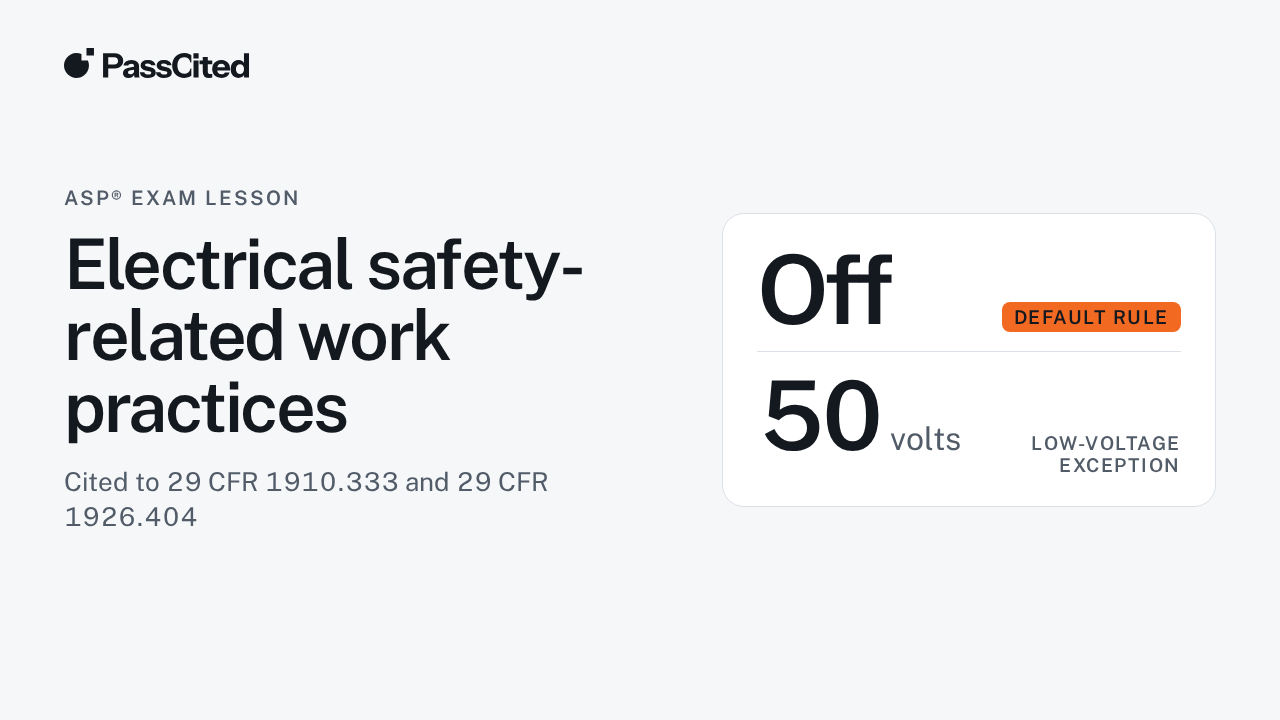 Electrical safety-related work practicesASP lesson, 7:11Deenergize first, lockout and tagging, qualified-person tests, overhead line distances, and construction GFCI and grounding rules from 1910.333 and 1926.404, for the ASP exam.
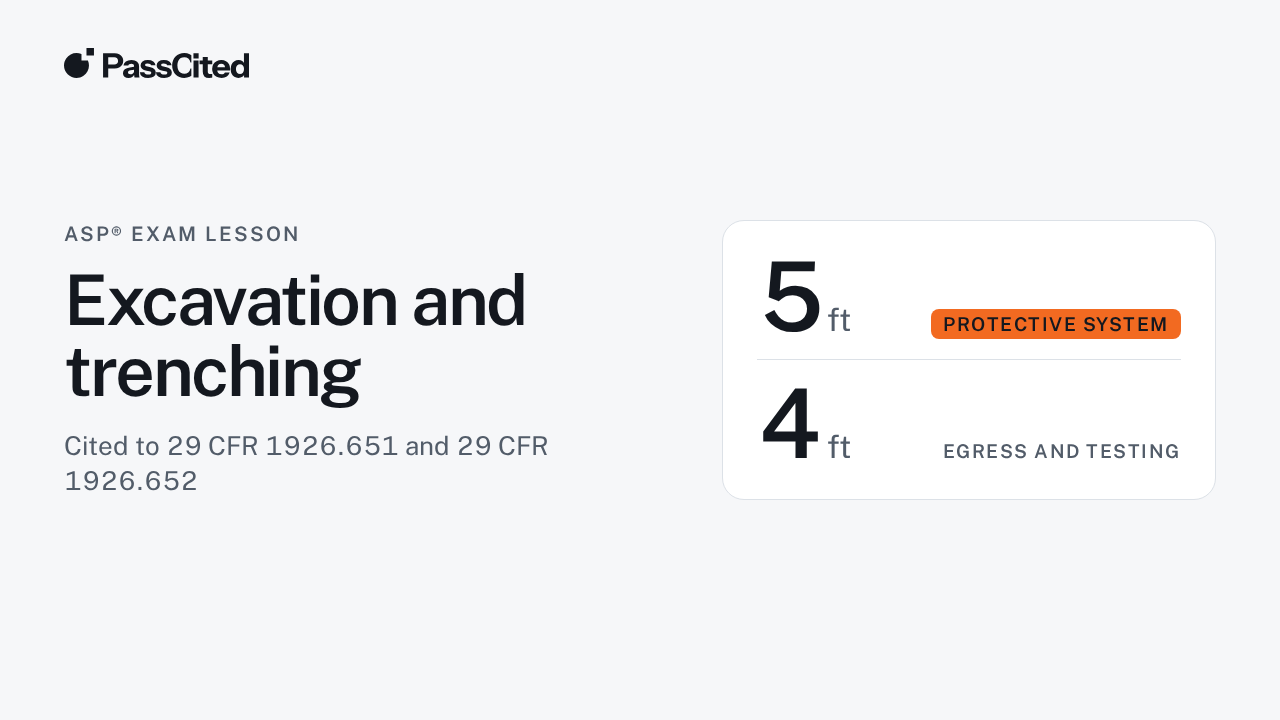 Excavation and trenchingASP lesson, 6:52ASP exam review of 29 CFR 1926 Subpart P: the 5-foot and 4-foot thresholds, utility locates, daily inspections, soil types, maximum allowable slopes, and who does what.
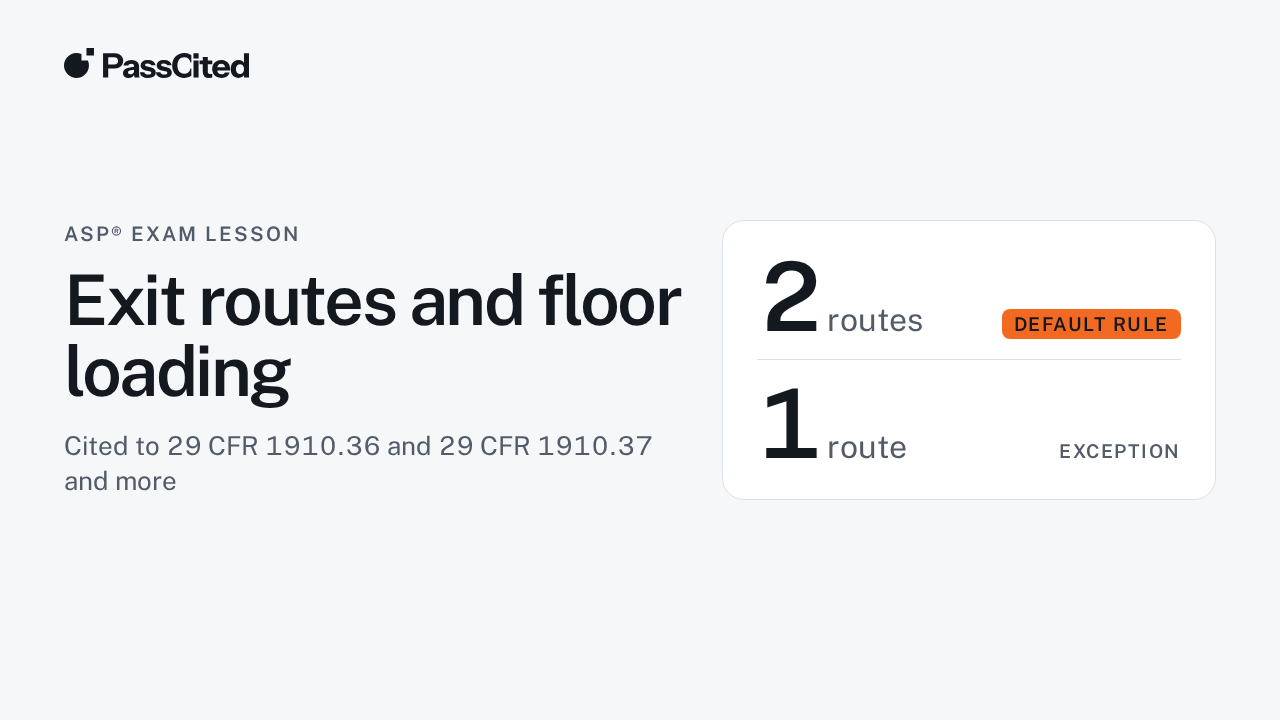 Exit routes and floor loadingASP lesson, 5:55The ASP-tested rules for exit routes under 29 CFR 1910.36 and 1910.37, plus the walking-working surface load and repair rules in 1910.22: counts, dimensions, doors, signs and who repairs.
See where you stand on the ASP
25 questions, free, no card. You get a readiness score for each ASP domain.
ASP®, CSP® and CHST® are registered marks of BCSP. PassCited is not affiliated with or endorsed by BCSP.