Safety math: rates, dose, slopes and TWA
ASP video lesson, 6:34. ASP Domain 1: Mathematical Calculations
Worked ASP exam math: incidence and DART rates, noise dose and TWA, simple-slope excavation width, and the 8-hour TWA of an air contaminant, each with its source formula.
Included with every ASP pass, with captions, chapters and the full transcript. Every rule and number is cited on screen to its primary source.
What this lesson covers
In this lesson, you'll learn to: compute an incidence rate and a serious-case rate, calculate a noise dose and its TWA, size a simple-slope excavation, and find an 8-hour TWA for an air contaminant. Start with incidence rates. The standard formula multiplies cases by 200,000, then divides by employee hours worked. Why 200,000? It equals 100 employees working 40 hours a week, 50 weeks a year.
- Intro
- Learning objectives
- Incidence rate
- Worked example
- Noise math
- Worked example
- Excavation slopes
- Worked example
- Air contaminants
- Worked example
- On the job
- Common exam traps
- Recap quiz
The video, captions and full transcript are included with every ASP pass. See passes
More ASP lessons
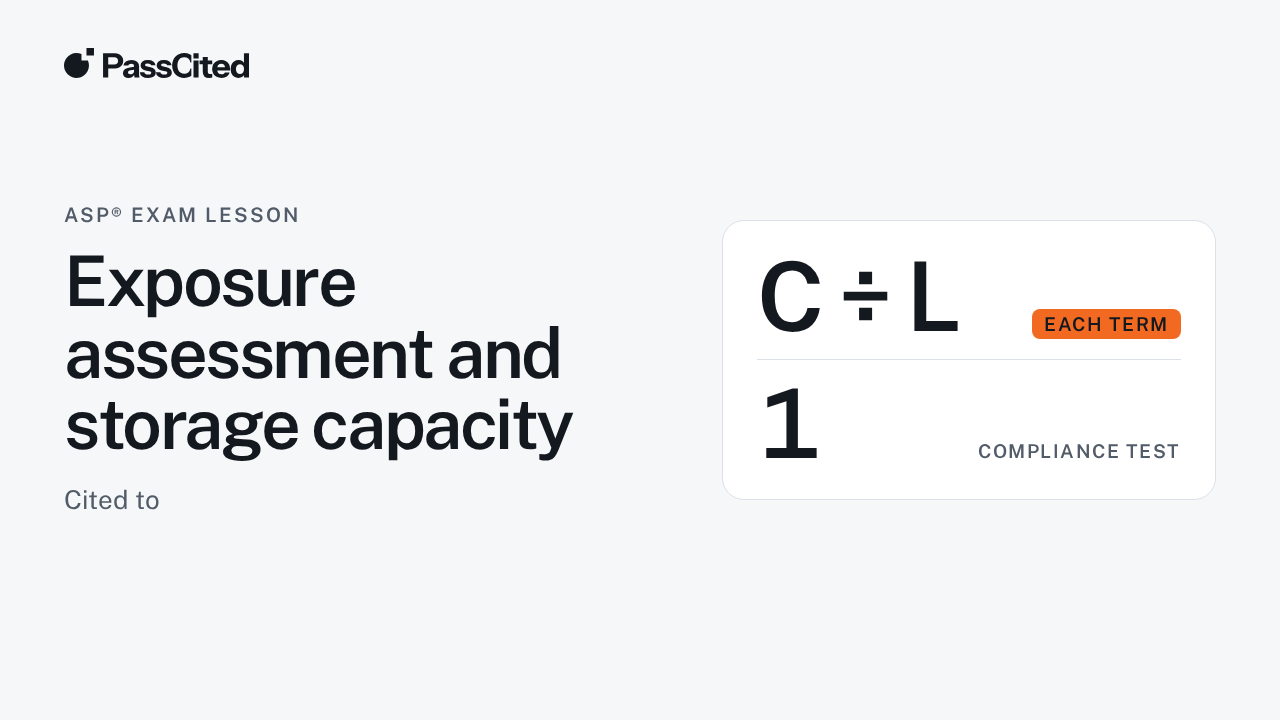 Exposure assessment and storage capacityASP lesson, 6:12Compute an 8-hour TWA from sampling periods, check a mixture's Em against unity, and size secondary containment at 10% of total volume or the largest container, whichever is greater.
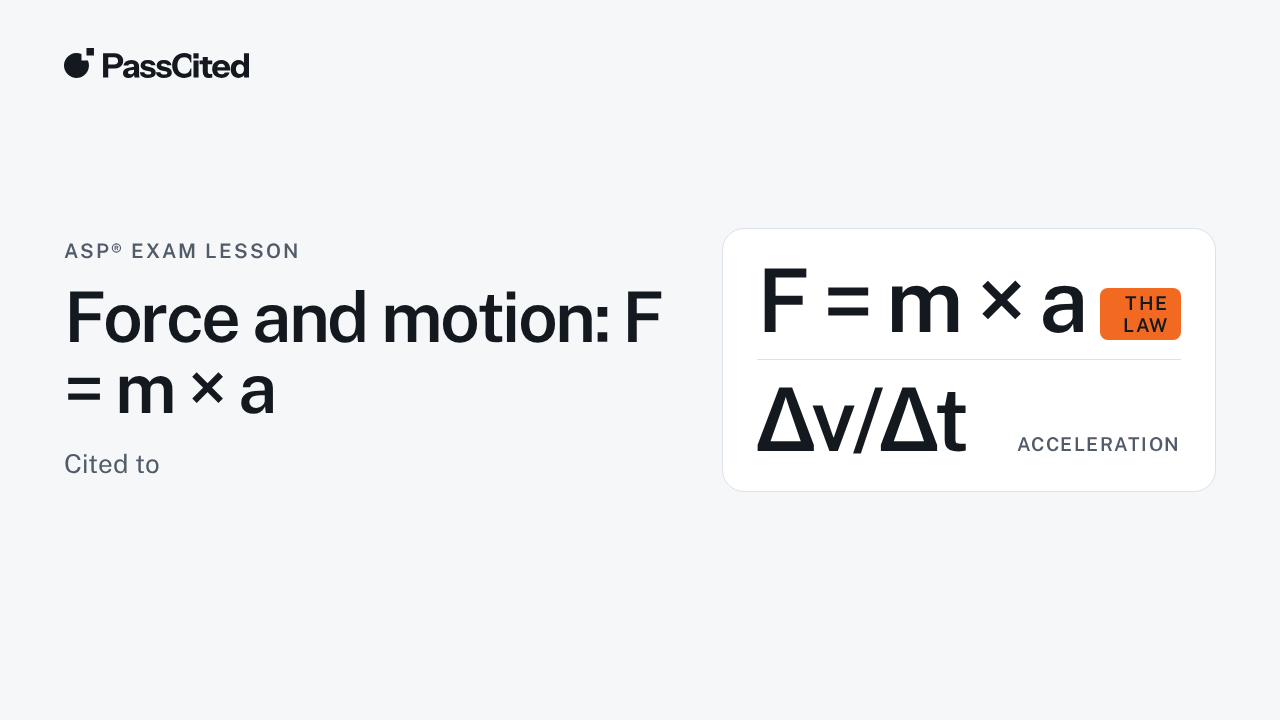 Force and motion: F = m × aASP lesson, 5:58Newton's second law for the ASP exam: F = m × a, units, the velocity-change form, and a worked deceleration-force example, with every formula quoted from its source.
 Heat index, WBGT and wind chillASP lesson, 6:55Calculate indoor and outdoor WBGT, the NWS heat index regression and wind chill, with worked examples, the formulas as published, and the traps that show up on the ASP exam.
See where you stand on the ASP
25 questions, free, no card. You get a readiness score for each ASP domain.
ASP®, CSP® and CHST® are registered marks of BCSP. PassCited is not affiliated with or endorsed by BCSP.