Safety and health programs, leadership and leading indicators
ASP video lesson, 6:19. ASP Domain 2: Safety Programs and Concepts
OSHA's recommended practices for safety and health programs: management leadership, worker participation, annual evaluation, and how leading and lagging indicators and SMART goals work. ASP exam focus.
Watch the first 1:27 free. The full lesson, with captions and the full transcript, is included with every ASP pass. Every rule and number is cited on screen to its primary source.
Transcript of the preview
0:00 Intro
Safety and health programs, leadership and leading indicators, for the ASP exam. Every rule and number here is cited to its primary source, on screen.
0:11 Learning objectives
In this lesson, you'll learn to: explain the proactive approach and the core program elements, describe what management leadership and worker participation look like, tell leading from lagging indicators and apply the SMART criteria, and state when to evaluate the program and read advisory wording correctly.
0:33 Proactive program basics
This guidance recommends a proactive approach to safety and health programs. It is guidance, not a regulation. Traditional approaches are often reactive: action comes only after an injury or illness, a new standard, or an outside inspection finding. Finding and fixing hazards before they cause injury or illness is the far more effective approach, and continuous improvement is central. Action items are specific, but not prescriptive.
1:05 Management leadership
Tailor the process to the needs of each workplace. Management leadership is the first core element. Top management demonstrates commitment to continuous improvement and communicates it to workers. A written policy, signed by top management, states the commitment to safety and health. Goals should be realistic and measurable, and emphasize prevention rather than injury and illness rates.
Also in the full lesson
- Worker participation
- Leading vs lagging
- Leading indicator examples
- SMART criteria
- Program evaluation
- On the job
- Common exam traps
- Recap quiz
The full transcript is included with every ASP pass. See passes
More ASP lessons
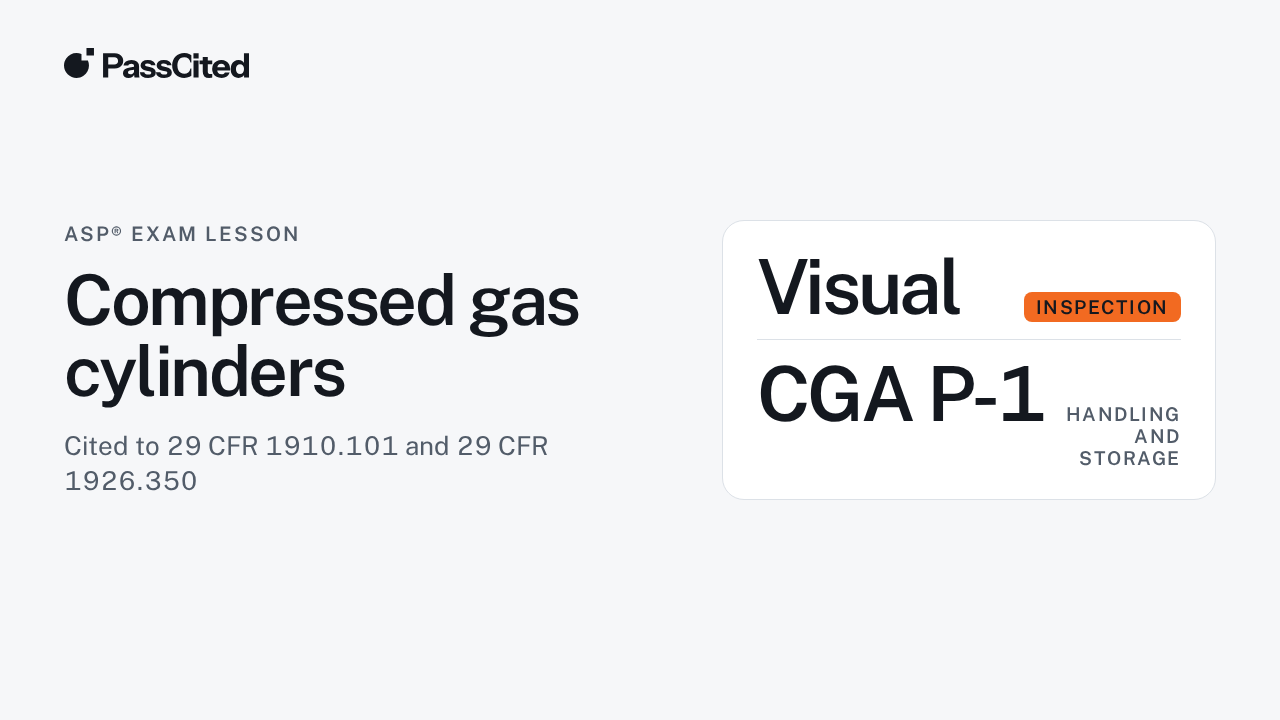 Compressed gas cylindersASP lesson, 6:17The testable rules for compressed gas cylinders: handling, storage distances, fuel gas use, leaks, hose and manifolds, under 29 CFR 1910.101 and 1926.350, for the ASP exam.
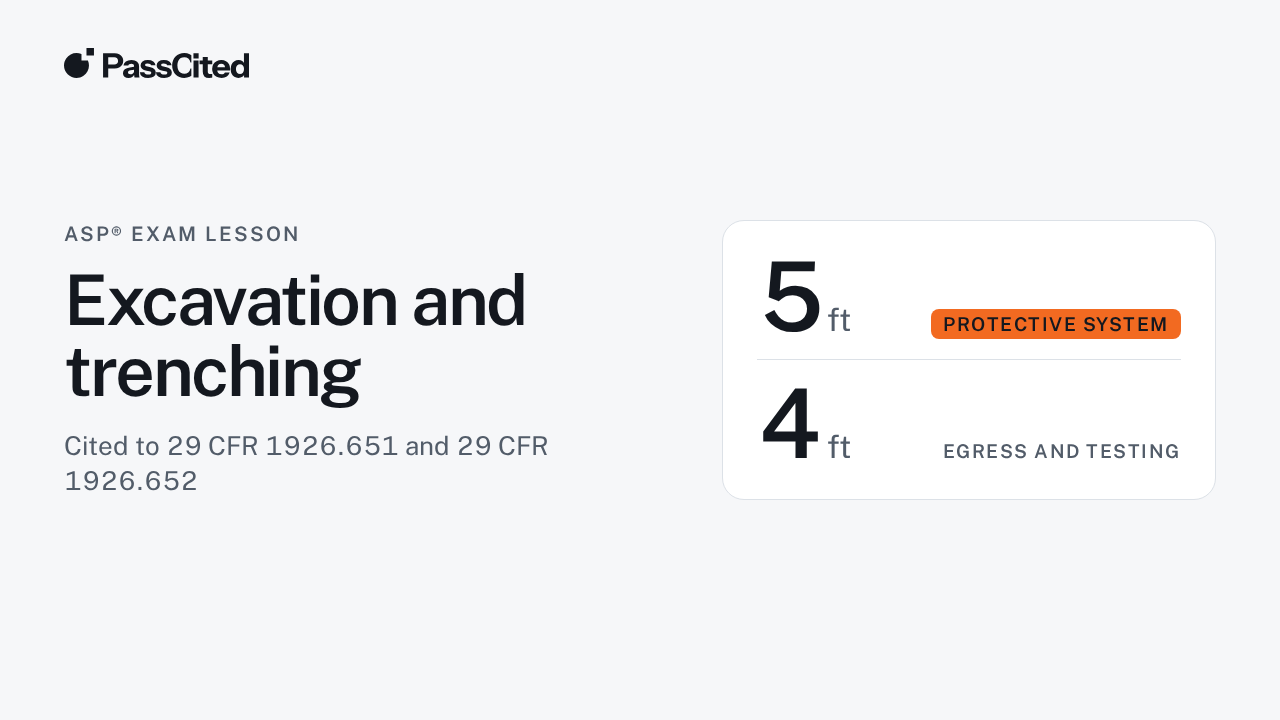 Excavation and trenchingASP lesson, 6:52ASP exam review of 29 CFR 1926 Subpart P: the 5-foot and 4-foot thresholds, utility locates, daily inspections, soil types, maximum allowable slopes, and who does what.
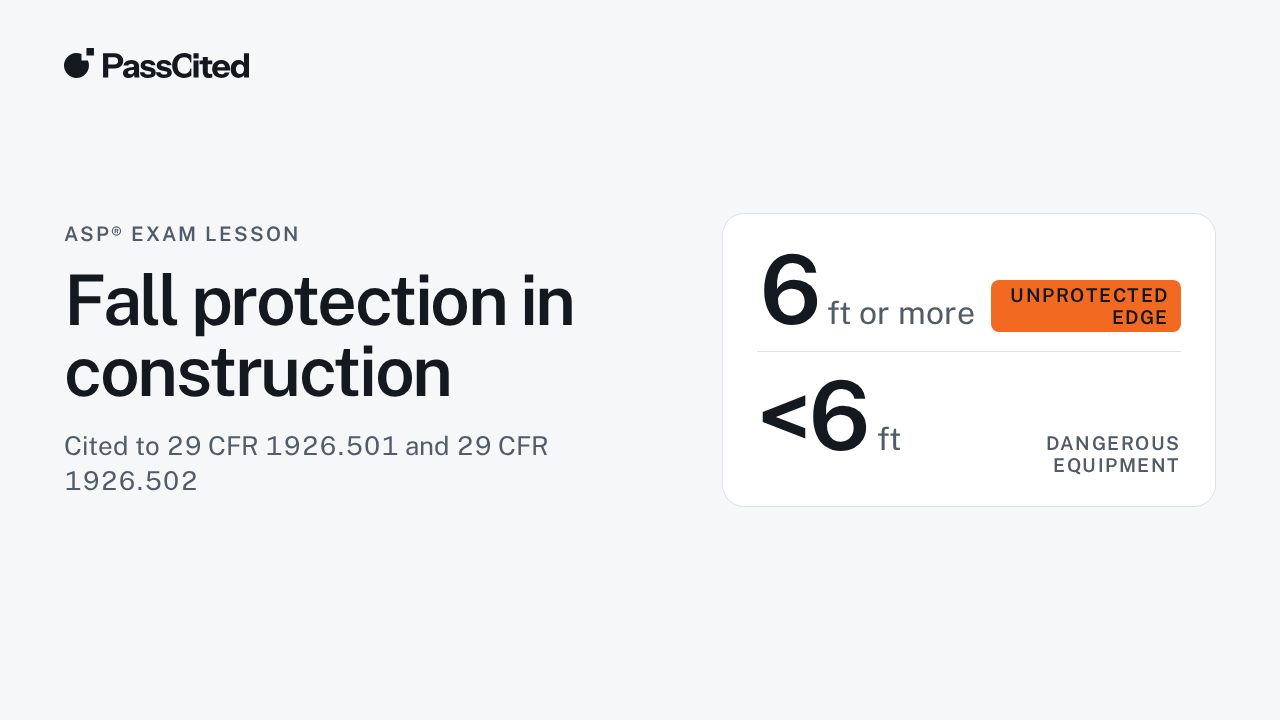 Fall protection in constructionASP lesson, 6:49Construction fall protection under 1926.501 and 1926.502: the 6-foot trigger, system criteria, guardrail, net, arrest and warning line numbers, and who must prepare and supervise.
See where you stand on the ASP
25 questions, free, no card. You get a readiness score for each ASP domain.
ASP®, CSP® and CHST® are registered marks of BCSP. PassCited is not affiliated with or endorsed by BCSP.