Scaffolding requirements
ASP video lesson, 7:35. ASP Domain 2: Safety Programs and Concepts
ASP exam review of 29 CFR 1926.451: capacity safety factors, platform rules, supported and suspension scaffolds, access, fall protection heights, guardrails and competent-person duties.
Included with every pass, and free to watch with captions. Every rule and number is cited on screen to its primary source.
Transcript
0:00 Intro
451, for the ASP exam. Every rule and number here is cited to its primary source, on screen. In this lesson, you'll learn to: state the capacity safety factors, apply the platform and tie-in rules, match fall protection to the scaffold type, and know who must inspect and supervise.
0:12 Learning objectives
Each scaffold and component must carry its own weight plus at least 4 times the maximum intended load.
0:28 Capacity
Suspension ropes need at least 6 times; adjustable: at the hoist's rated load or 2 times stall load, whichever is greater. A qualified person designs the scaffold. 5 times at stall load, whichever is greater. Working platforms are fully planked, with gaps of 1 inch or less; if wider is demonstrably necessary, 9 1/2 inches max to uprights.
1:02 Platform construction
Walkway-only or erector platforms need only necessary planking. Platforms and walkways are at least 18 inches wide; if demonstrably too narrow, as wide as feasible, with guardrails or PFAS. Ladder jack, top plate bracket and pump jack scaffolds: 12 inches. Front edge within 14 inches of the work face, unless front-edge guardrails or PFAS are used. Outrigger scaffolds: 3 inches. Unless cleated or hooked, ends extend at least 6 inches past the support centerline.
1:56 Supported scaffolds
Height to base width over 4 to 1 requires guying, tying or bracing. Start at the closest horizontal member to the 4:1 height, or per the manufacturer. Repeat vertically every 20 feet or less if 3 feet wide or less, 26 or less if wider. Ties go at each end, at horizontal intervals of 30 feet or less. Legs bear on base plates and mud sills or other firm foundation.
2:29 Suspension scaffolds
Suspension scaffolds add rope rules. A competent person inspects ropes before each workshift and after any integrity-affecting occurrence. Replace for six randomly distributed broken wires in one rope lay, or three in one strand in one rope lay. Wire rope clips: at least 3, at least 6 rope diameters apart. Counterweights are non-flowable and purpose-designed: no sand, gravel, masonry units or roofing felt.
3:12 Access
Tiebacks go perpendicular, or use opposing angles. Single angled tiebacks are prohibited. Platforms more than 2 feet above or below an access point need proper access. Use ladders, stair towers, ramps or integral access.
3:31 Fall protection
Never crossbraces. Direct access: within 14 inches horizontally and 24 inches vertically. Each employee on a scaffold more than 10 feet above a lower level must be protected from falling. Boatswains' chair, catenary, float, needle beam, ladder jack: a personal fall arrest system. Single-point or two-point adjustable suspension scaffolds: both a PFAS and a guardrail system.
4:03 Guardrail systems
Scaffolds not otherwise specified in (g)(1)(i) through (vi): PFAS or guardrails. Guardrail rules depend on scaffold type and date. Supported scaffolds made or placed in service after January 1, 2000: toprail 38 to 45 inches.
4:31 Use and supervision
Earlier ones, and suspended needing both: 36 to 45. Toprail strength: 100 pounds on single- and two-point adjustable suspension scaffolds; 200 pounds on all others. Use rules assign duties to the competent person. A competent person inspects before each work shift and after any occurrence that could affect structural integrity. Erecting, moving, dismantling or altering happens under a competent person's supervision. Power lines: insulated, under 300 volts: 3 feet.
5:19 Common exam traps
300 volts to 50 kV: 10 feet. Storms or high winds stop work unless a competent person finds it safe and employees have PFAS or wind screens; screens only if the scaffold is secured against the wind. Platforms must not deflect more than 1/60 of the span when loaded.
5:46 Recap quiz
Now, five traps that catch people on exam day. One: ropes are 6 times, not 4. Two: above 10 feet, not 6; ramps and walkways need guardrails at 6. Three: crossbraces are never a means of access. Four: inspect each work shift, not weekly. Five: sand and gravel are not allowed as counterweights. Question 1. A supported scaffold is 3 feet wide, height to base width over 4 to 1. How often are ties repeated vertically? A: 20 feet or less. B: 26 or less. C: 30 or less. D: 40 or less. A. Scaffolds 3 feet wide or less repeat every 20 feet or less. Wider ones use 26. Question 2. Protection required on a two-point adjustable suspension scaffold 30 feet up? A: Guardrail only. B: PFAS only. C: Both. D: Safety net only. C. Two-point adjustable suspension scaffolds need both a PFAS and a guardrail system. Question 3. A platform is 30 inches above the landing. May employees climb the crossbraces? A: Yes, if under 3 feet. B: Yes, with approval. C: No, proper access is needed. D: Yes, if 12 inches wide. C. Crossbraces shall not be used as a means of access. Want to see where you stand on every ASP domain? com.
More ASP lessons
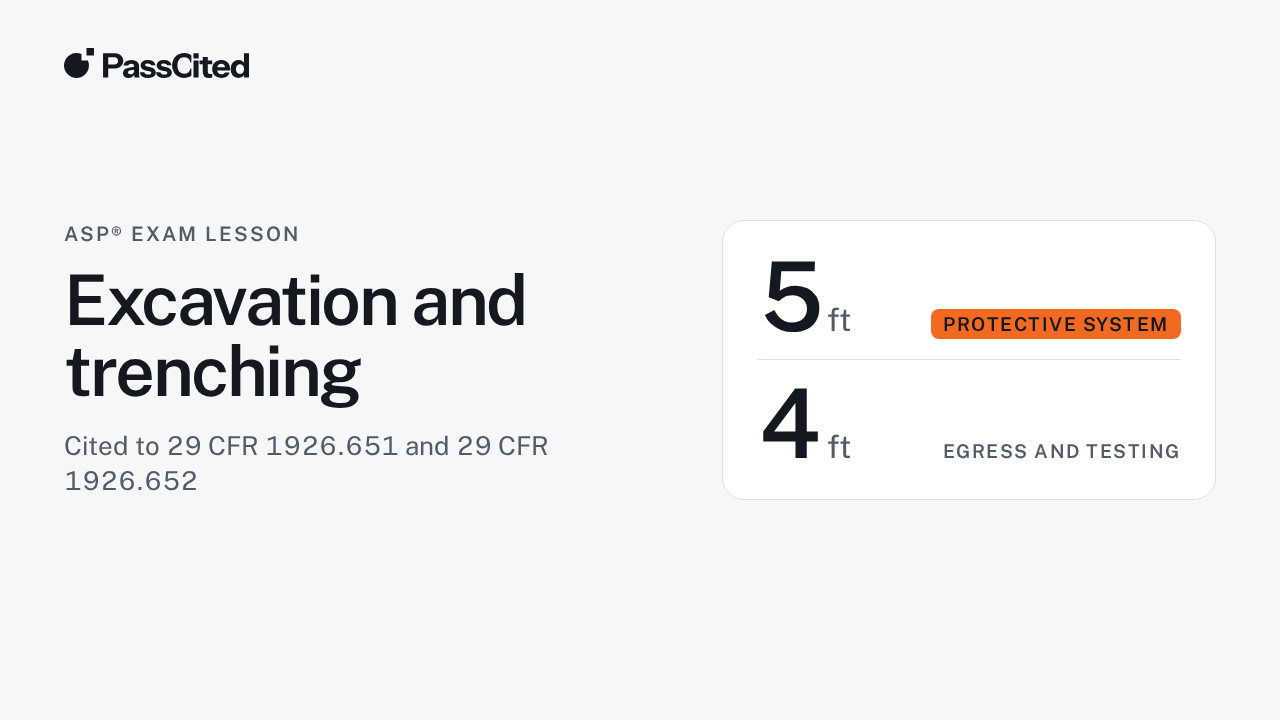 Excavation and trenchingASP lesson, 7:06ASP exam review of 29 CFR 1926 Subpart P: the 5-foot and 4-foot thresholds, utility locates, daily inspections, soil types, maximum allowable slopes, and who does what.
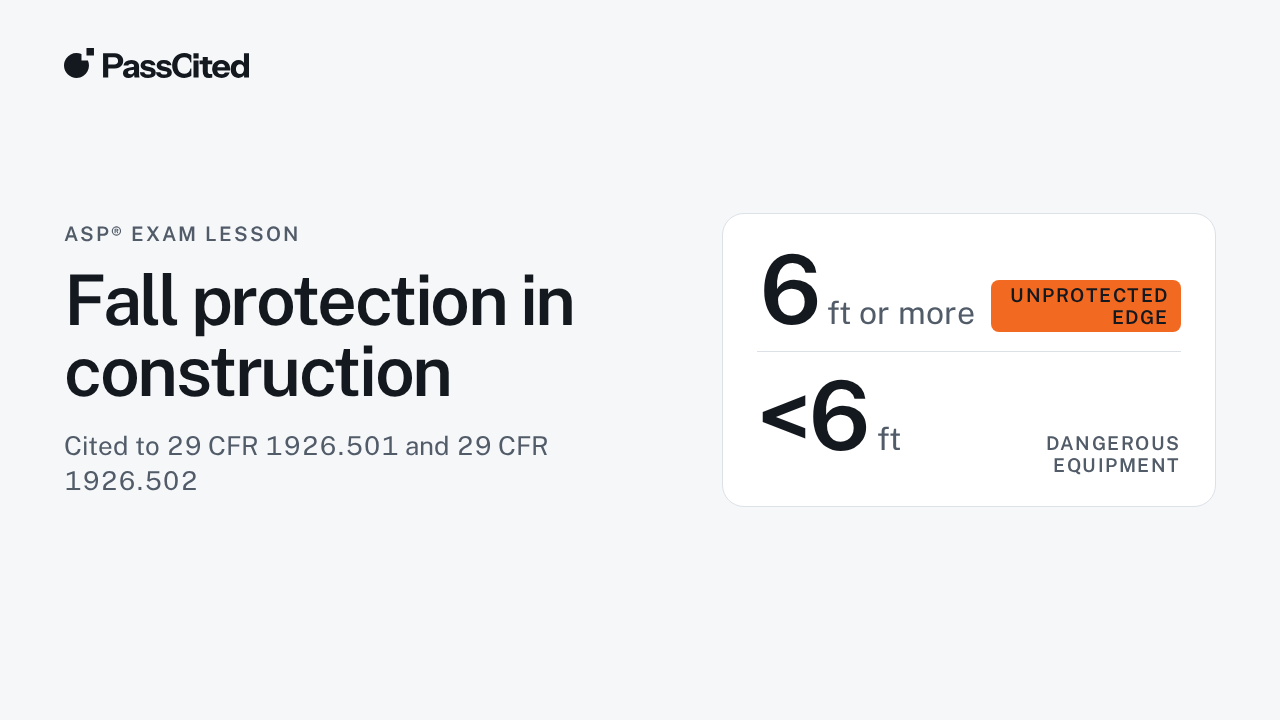 Fall protection in constructionASP lesson, 7:07Construction fall protection under 1926.501 and 1926.502: the 6-foot trigger, system criteria, guardrail, net, arrest and warning line numbers, and who must prepare and supervise.
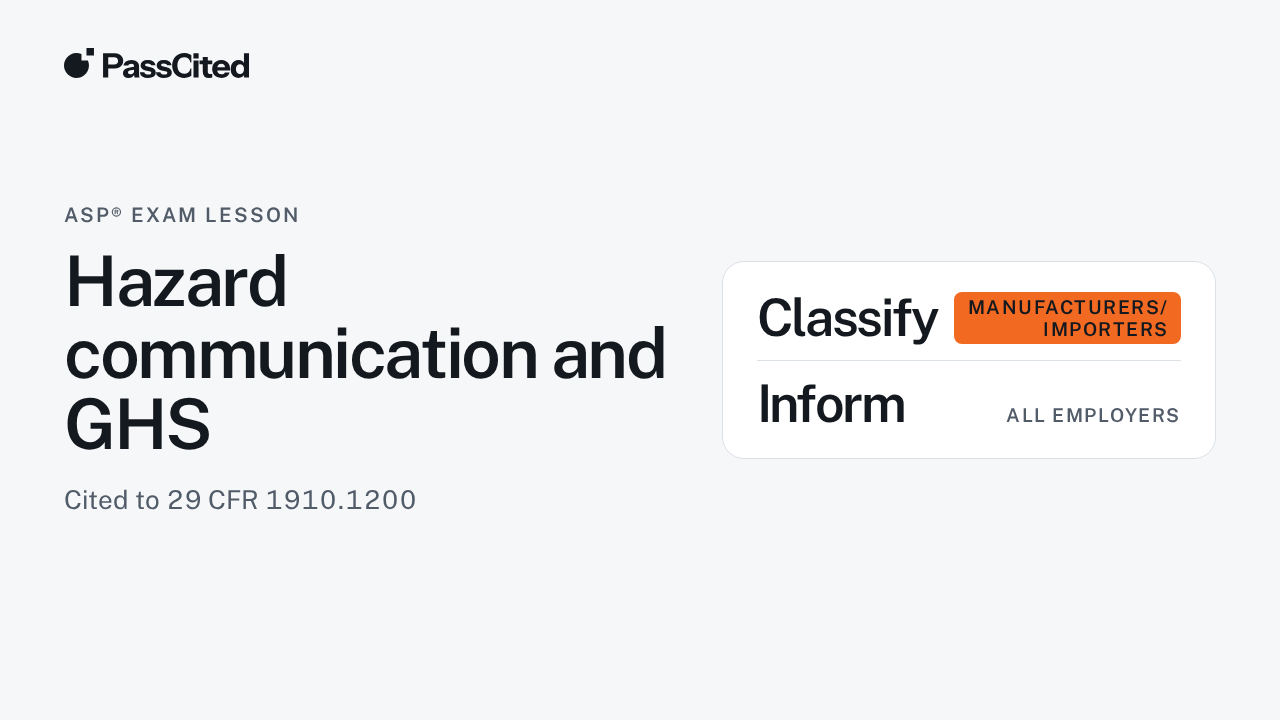 Hazard communication and GHSASP lesson, 7:29ASP exam review of OSHA 1910.1200: who classifies chemicals, the six label elements, SDS timing and 16 sections, the written program, training, trade secrets and 2026-2028 dates.
See where you stand on the ASP
25 questions, free, no card. You get a readiness score for each ASP domain.
ASP®, CSP® and CHST® are registered marks of BCSP. PassCited is not affiliated with or endorsed by BCSP.