Cranes, hoisting and rigging
CHST video lesson, 7:22. CHST Domain 1: Hazard and Risk Identification and Control
CHST review of crane power line clearances, operator duties, rated capacity checks, sling inspection and removal criteria, plus a worked sling tension example, cited to 29 CFR 1926.
Included with every pass, and free to watch with captions. Every rule and number is cited on screen to its primary source.
Transcript
0:00 Intro
Cranes, hoisting and rigging, for the CHST exam. Every rule and number here is cited to its primary source, on screen.
0:11 Learning objectives
In this lesson, you'll learn to: apply the power line clearance rules and Table A, verify a load against rated capacity, know who inspects slings, and when to remove them, and calculate sling leg tension at an angle.
0:30 Power lines: the three options
If any part of the equipment, load line or load could get closer than 20 feet to a power line, pick an option. Option 1: the utility confirms the line is deenergized and visibly grounded at the worksite. Option 2: keep everything at least 20 feet away, using the encroachment measures. Option 3: keep the Table A distance. Assume all lines are energized unless the utility confirms they have been and continue to be deenergized and visibly grounded at the worksite.
1:07 Table A
Table A ties clearance to nominal voltage. Up to 50 kilovolts: 10 feet. Over 50 to 200: 15. Over 200 to 350: 20. Over 350 to 500: 25 feet. The value after "to" is included.
1:33 Preventing encroachment
For Option 3, the utility must provide the voltage within 2 working days. Under Option 2, or Option 3 inside the Table A distance, these apply. Hold a planning meeting. Tag lines, if used, must be non-conductive. Erect a marked warning line, barricade, or signs at 20 feet, or the Table A distance. If the operator can't see it, add a dedicated spotter plus another measure.
2:05 Below power lines
Otherwise, one measure. Subpart V work is exempt from these measures. No part of the equipment, load line or load may be below a power line unless the employer confirmed it is deenergized and visibly grounded at the worksite. Exception, non-extensible boom: uppermost part, boom at true vertical, more than 20 feet or the Table A distance below the line.
2:40 Rated capacity
Articulating or extensible booms: test fully extended. 1410, is also excepted. Never operate beyond rated capacity. The operator verifies load weight from a recognized source or calculation, or other equally reliable means. Or begin hoisting and use a load weighing device or load moment indicator. Over 75 percent of maximum rated capacity at the longest radius used?
3:15 Operator duties
Verify weight first. At 90 percent or more of maximum line pull, lift a few inches and apply the brakes. Keep two full wraps. If manufacturer procedures are unavailable, a qualified person develops the operational-control procedures. Capacity procedures must be developed and signed by a registered professional engineer familiar with the equipment.
3:46 Sling and rigging inspection
The competent person handles storm warnings, wind, ice and snow. Leaving a suspended load requires every condition, including barricades keeping all employees out of the fall zone. Rigging is inspected before use on each shift, and as necessary during use.
4:18 Worked example: sling angle
Each day before use, a designated competent person inspects the sling, fastenings and attachments. Alloy steel chain slings also get a thorough periodic inspection, at least every 12 months. Remove damaged slings immediately. Wire rope is out if broken wires in 8 diameters exceed 10 percent of total wires. A 1,000 pound load hangs from a two-legged bridle at 45 degrees to horizontal.
4:52 Common exam traps
Two legs carry the load: 500 pounds each in a vertical lift. 414. 414. Tension is 707 pounds per leg, so each leg needs a rating of at least 707. Under 30 degrees, slings should not be used. Now, six traps that catch people on exam day. One: presume every line energized unless the utility confirms it is deenergized and visibly grounded. Two: Table A distance depends on voltage, and the value after "to" is included. Three: capacity procedures need a registered professional engineer.
5:39 Recap quiz
Four: the trigger is 75 percent of maximum rated capacity at the longest radius used. Five: a designated competent person does the daily sling inspection. Six: tension rises as the angle flattens: 500 pounds becomes 707 at 45 degrees. Question 1. A crane could get closer than 15 feet to a 150 kilovolt line, Option 3. Required? A: ignore it. B: 15 feet, with encroachment measures. C: 20 feet only. D: tag lines suffice. B. Over 50 to 200 kilovolts is 15 feet, and the paragraph (b) encroachment measures apply. Question 2. Who develops and signs capacity procedures when the manufacturer's are unavailable? A: operator. B: competent person. C: registered professional engineer. D: safety officer. C. Capacity procedures must be developed and signed by a registered professional engineer. Question 3. A 1,000 pound load, two-leg bridle, 45 degrees. Minimum capacity per leg? A: 500. B: 600. C: 1,000. D: 707. D. 414 is 707 pounds per leg. Want to see where you stand on every CHST domain? com.
More CHST lessons
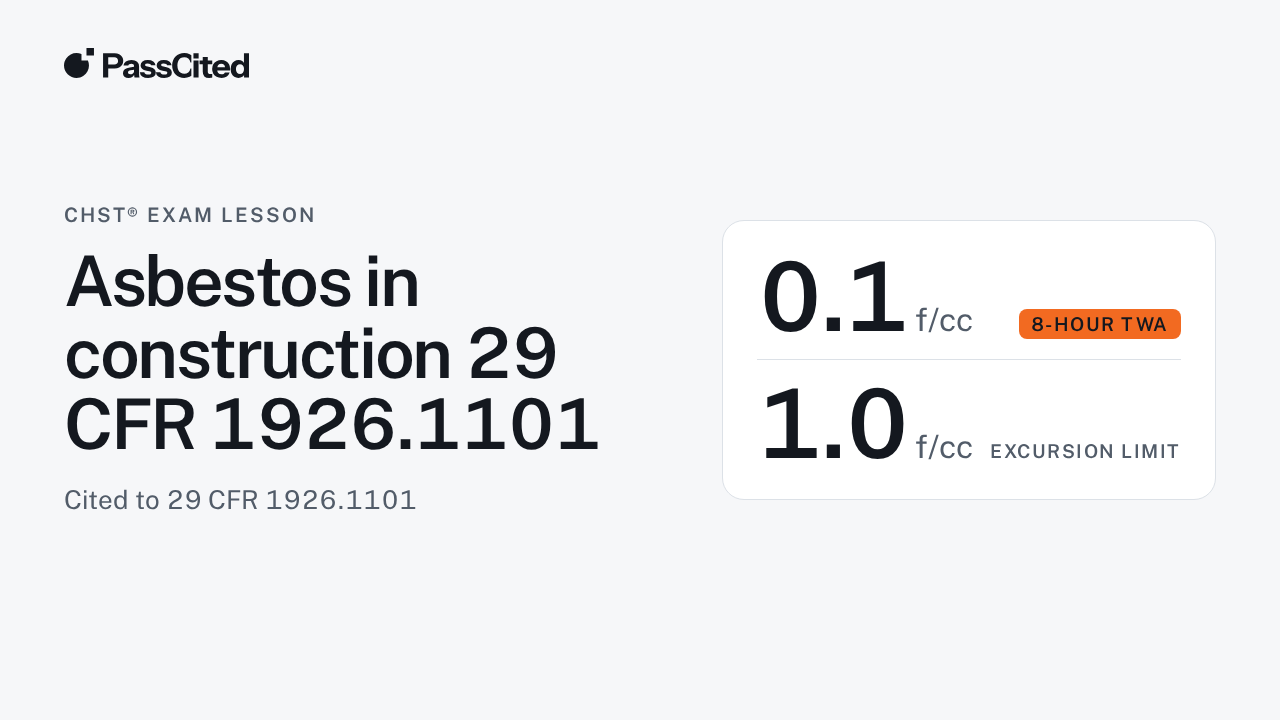 Asbestos in construction 29 CFR 1926.1101CHST lesson, 7:27Asbestos in construction under 29 CFR 1926.1101 for the CHST exam: PELs, work classes, competent person duties, regulated areas, monitoring, training hours and notification deadlines.
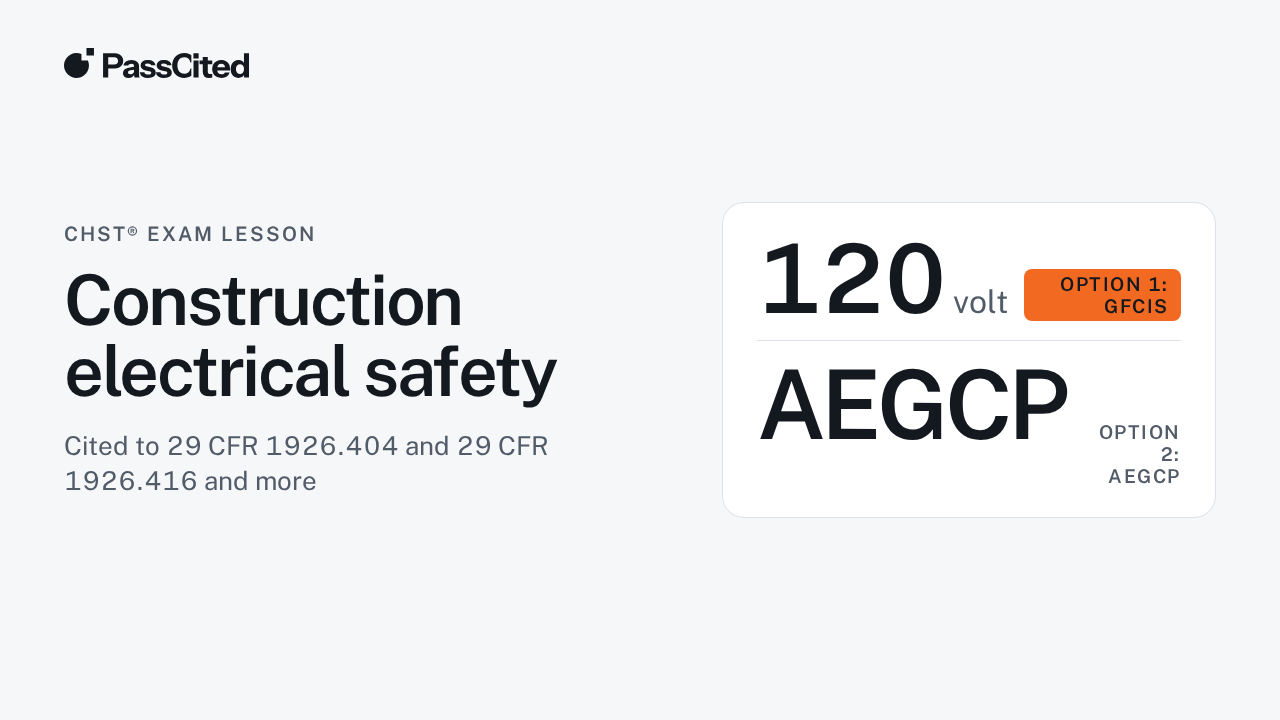 Construction electrical safetyCHST lesson, 7:05Construction electrical safety for the CHST exam: GFCI versus the assured grounding program, test intervals, overhead clearances, grounding distances, and lockout tagging under 1926 Subpart K.
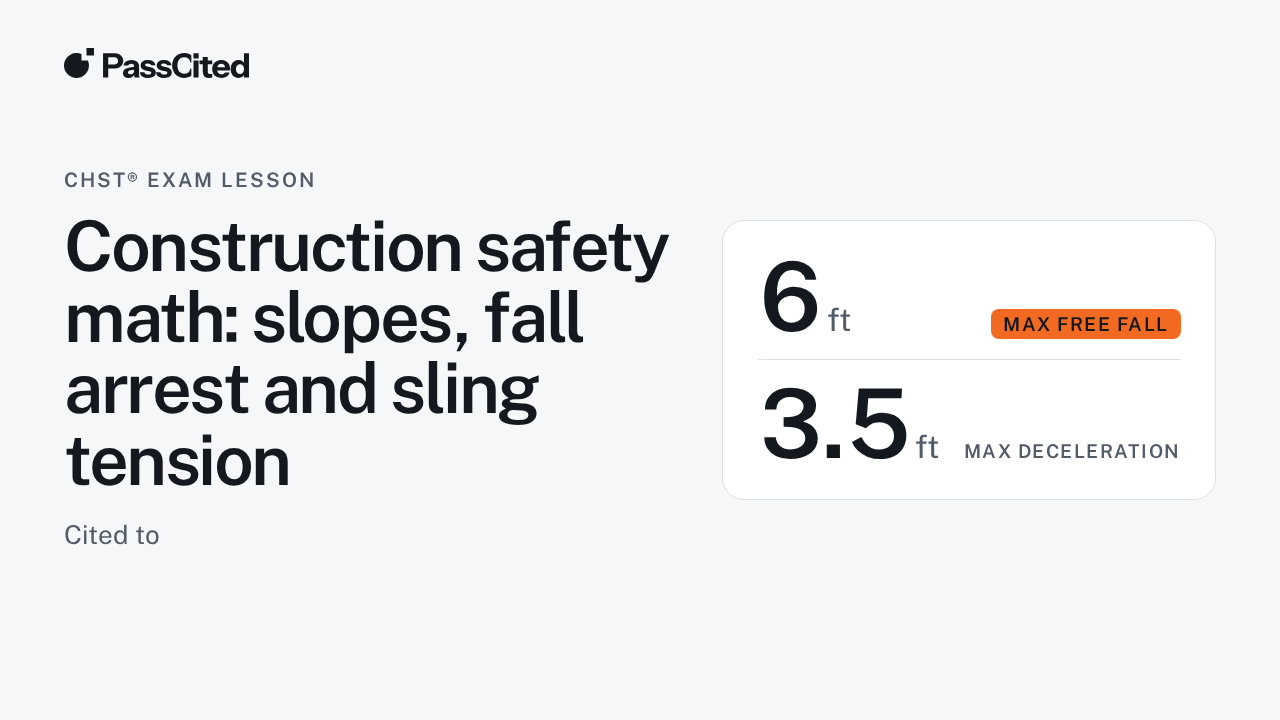 Construction safety math: slopes, fall arrest and sling tensionCHST lesson, 6:17Worked CHST calculations: excavation slope geometry, the 6-foot free fall and 3.5-foot deceleration limits, and sling tension at a 45-degree angle, each tied to its primary source.
See where you stand on the CHST
25 questions, free, no card. You get a readiness score for each CHST domain.
ASP®, CSP® and CHST® are registered marks of BCSP. PassCited is not affiliated with or endorsed by BCSP.