Excavation and trenching
CHST video lesson, 5:51. CHST Domain 1: Hazard and Risk Identification and Control
CHST exam review of 29 CFR 1926 Subpart P: the 5-foot and 4-foot thresholds, utility locates, daily inspections, soil types, maximum allowable slopes, and who does what.
Included with every pass, and free to watch with captions. Every rule and number is cited on screen to its primary source.
Transcript
0:00 Intro
Excavation and trenching, for the CHST exam. Every rule and number here is cited to its primary source, on screen.
0:09 Learning objectives
In this lesson, you'll learn to: state the depth thresholds that trigger each rule, explain the competent person's inspection duties, classify soil and match it to a maximum slope, and apply slope math to size a cut.
0:25 Two depths to memorize
Two depth thresholds drive most exam questions here. Protection is required, except entirely in stable rock, or under 5 feet with no sign of cave-in per a competent person. At 4 feet or more, trench egress is within 25 feet of lateral travel.
0:48 Underground installations
Test first if deeper than 4 feet and a hazardous atmosphere could be expected. Underground utilities come in three stages. Before opening, estimate locations and contact owners. No reply in 24 hours (unless law requires longer), or no exact location? Proceed with caution, using detection equipment or other acceptable means.
1:16 Competent person duties
Approaching them, determine the exact location by safe and acceptable means. While open, protect, support or remove them as necessary. The competent person carries the inspection duty. Inspect daily: before work starts and as needed throughout the shift. Also inspect after every rainstorm or hazard-increasing occurrence.
1:44 Appendix A soil classification
All these inspections apply when exposure can be reasonably anticipated. If hazards are found, remove exposed employees until precautions are taken. The competent person also monitors water removal equipment. A competent person classifies each deposit, using at least one visual and one manual analysis. 5 tsf or greater, but never if fissured, vibrated, previously disturbed, or in certain layered or other less-stable conditions. 5 tsf, or granular soil like angular gravel and silt.
2:31 Table B-1
5 tsf or less, sand or gravel, or submerged or freely seeping soil. A layered system takes its weakest layer, unless a more stable layer lies under a less stable one. Default: no steeper than 1½ to 1. Otherwise Table B-1 gives the steepest slope under 20 feet deep. Stable rock may be vertical. Type A is three-quarters to one, Type B one to one, Type C one and a half to one.
3:01 Worked example: slope
Short-term, open 24 hours or less, Type A at 12 feet or less may be one-half to one. Over 20 feet, a registered professional engineer designs it. Run equals depth times the horizontal part of the slope.
3:19 On the job
Type B is 1 to 1, so run equals depth times 1. 8 feet times 1 is 8 feet per side. 5 is 12 feet. Weaker soil means a flatter slope. You're the CHST on a utility job. Overnight rain hit an open trench over 5 feet deep. First, the competent person inspects after the rainstorm, before work starts.
3:47 Common exam traps
If a hazard is found, exposed employees are removed until precautions are taken. Over 5 feet, and not entirely in stable rock, the exemption is gone: a protective system, plus egress within 25 feet of lateral travel. Now, six traps that catch people on exam day. One: under 5 feet is exempt only with no sign of cave-in. Two: trench egress starts at 4 feet, within 25 feet of lateral travel.
4:23 Recap quiz
Three: inspect before work, as needed, and after every rainstorm. Four: a competent person classifies soil. Five: short-term Type A, 12 feet or less deep, may be one-half to one. Six: with distress, cut back at least one-half to one flatter. Question 1. Maximum simple slope, Type C under 20 feet deep? A: three-quarters to one. B: one to one. C: one and a half to one. D: one-half to one. C. Type C is one and a half to one, 34 degrees. Question 2. A 6-foot trench in sound soil, not stable rock. A: protection required. B: exempt if no cave-in sign. C: exempt, under 8 feet. D: no egress. A. The exception covers only excavations under 5 feet, or stable rock. Question 3. Owners cannot locate lines in 24 hours; law requires no longer. A: wait indefinitely. B: proceed with caution, detection equipment. C: dig unprotected. D: skip the request. B. Proceed with caution, using detection equipment or other acceptable means. Want to see where you stand on every CHST domain? com.
More CHST lessons
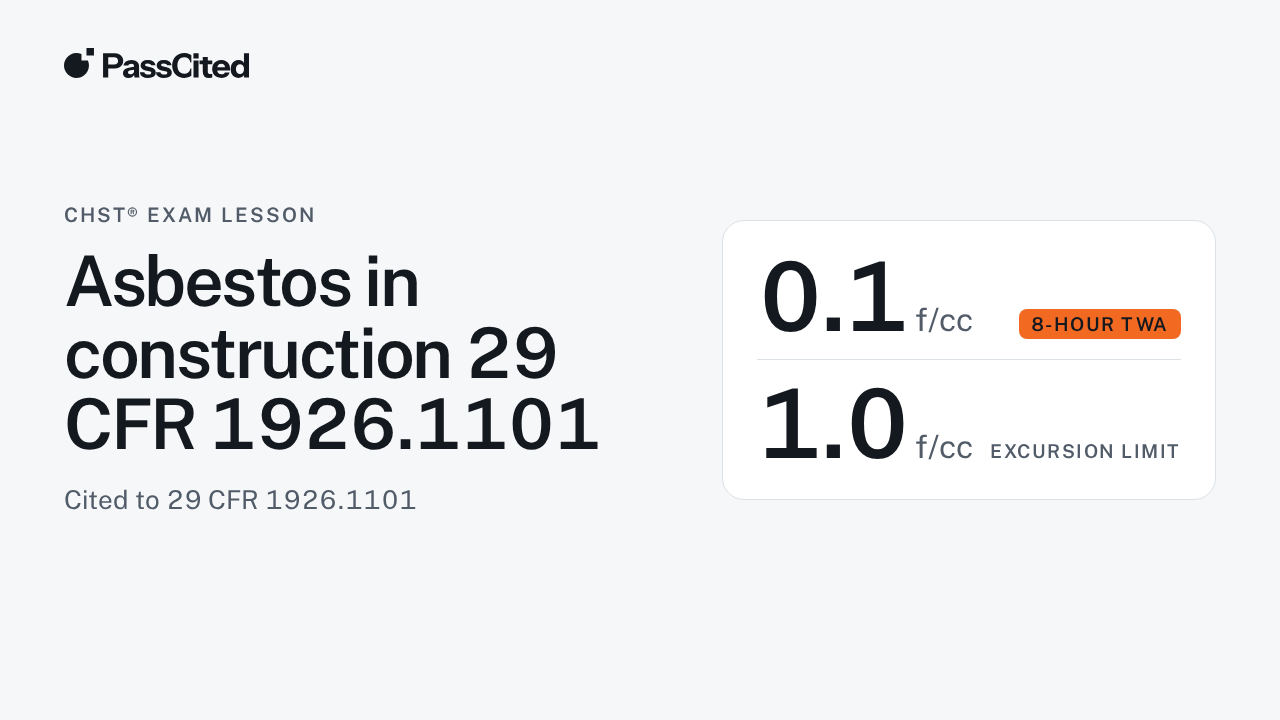 Asbestos in construction 29 CFR 1926.1101CHST lesson, 7:12Asbestos in construction under 29 CFR 1926.1101 for the CHST exam: PELs, work classes, competent person duties, regulated areas, monitoring, training hours and notification deadlines.
 Construction electrical safetyCHST lesson, 6:54Construction electrical safety for the CHST exam: GFCI versus the assured grounding program, test intervals, overhead clearances, grounding distances, and lockout tagging under 1926 Subpart K.
 Construction noise, radiation and lasersCHST lesson, 6:57CHST exam lesson on construction noise (Table D-2, the Fe formula, hearing protection), ionizing radiation, and laser and microwave limits under 29 CFR 1926.52, .53, .54 and .101.
See where you stand on the CHST
25 questions, free, no card. You get a readiness score for each CHST domain.
ASP®, CSP® and CHST® are registered marks of BCSP. PassCited is not affiliated with or endorsed by BCSP.