Scaffolding requirements
CHST video lesson, 6:50. CHST Domain 1: Hazard and Risk Identification and Control
CHST exam review of 29 CFR 1926.451: capacity safety factors, platform rules, supported and suspension scaffolds, access, fall protection heights, guardrails and competent-person duties.
Included with every pass, and free to watch with captions. Every rule and number is cited on screen to its primary source.
Transcript
0:00 Intro
451, for the CHST exam. Every rule and number here is cited to its primary source, on screen. In this lesson, you'll learn to: state the capacity safety factors, apply the platform and tie-in rules, match fall protection to the scaffold type, and know who must inspect and supervise.
0:12 Learning objectives
Each scaffold and component must carry its own weight plus at least 4 times the maximum intended load.
0:26 Capacity
Suspension ropes need at least 6 times. Adjustable: at the hoist's rated load or 2 times stall load, whichever is greater. A qualified person designs the scaffold. 5 times at stall load, whichever is greater. Working platforms are fully planked, gaps 1 inch or less; if wider is demonstrably necessary, 9 1/2 inches max to uprights.
0:54 Platform construction
Walkway-only or erector platforms need only necessary planking. Platforms and walkways are at least 18 inches wide; if demonstrably too narrow, as wide as feasible with guardrails or PFAS. Ladder jack, top plate bracket and pump jack: 12. Front edge within 14 inches of the work face unless front-edge guardrails or PFAS are used. Outrigger: 3 inches. Unless cleated or hooked, ends extend at least 6 inches past the support centerline.
1:36 Supported scaffolds
Height to base width over 4 to 1 requires guying, tying or bracing. Start at the closest horizontal member to the 4:1 height, or per the manufacturer. Repeat every 20 feet or less if 3 feet wide or less, 26 if wider. Ties at each end, at horizontal intervals of 30 feet or less.
2:03 Suspension scaffolds
Legs bear on base plates and mud sills or other firm foundation. Suspension scaffolds add rope rules. A competent person inspects ropes before each workshift and after integrity-affecting occurrences. Replace at six random broken wires in one rope lay, or three in one strand in one lay. Wire rope clips: at least 3, 6 rope diameters apart. Counterweights are non-flowable and purpose-designed: no sand, gravel, masonry units or roofing felt.
2:36 Access
Tiebacks go perpendicular, or use opposing angles. Single angled tiebacks are prohibited. Platforms more than 2 feet above or below an access point need proper access.
2:54 Fall protection
Use ladders, stair towers, ramps or integral access. Never crossbraces. Direct access: within 14 inches horizontally and 24 inches vertically. Each employee on a scaffold more than 10 feet above a lower level must be protected from falling. Boatswains' chair, catenary, float, needle beam, ladder jack: PFAS.
3:21 Guardrail systems
Single-point or two-point adjustable suspension: both a PFAS and a guardrail system. Scaffolds not otherwise specified: PFAS or guardrails. Guardrail rules depend on type and date. Supported scaffolds made or placed in service after January 1, 2000: toprail 38 to 45 inches.
3:45 Use and supervision
Earlier ones, and suspended needing both: 36 to 45. Toprail strength: 100 pounds on single- and two-point adjustable suspension; 200 on all others. Use rules assign duties to the competent person. A competent person inspects before each work shift and after any occurrence that could affect structural integrity. Erecting, moving, dismantling or altering happens under a competent person's supervision. Insulated power lines: under 300 volts, 3 feet; 300 volts to 50 kV, 10 feet.
4:25 On the job
Storms or high winds stop work unless a competent person finds it safe and employees have PFAS or wind screens, with the scaffold secured against wind. Platforms must not deflect more than 1/60 of the span when loaded. You're the competent person. A frame scaffold is 3 feet wide, over 4 to 1; a mason climbs crossbraces to a platform 30 inches up.
4:53 Common exam traps
First, stop the climbing: crossbraces are never access. Provide a ladder or stair tower. Then check the ties: over 4 to 1 needs restraint, repeated every 20 feet or less. Finally, inspect before each work shift and after anything affecting integrity.
5:18 Recap quiz
Now, five traps that catch people on exam day. One: ropes are 6 times, not 4. Two: above 10 feet, not 6. Three: crossbraces are never a means of access. Four: inspect each work shift, not weekly. Five: sand and gravel are not allowed as counterweights. Question 1. A supported scaffold is 3 feet wide, over 4 to 1. How often are ties repeated vertically? A: 20 feet or less. B: 26. C: 30. D: 40. A. Scaffolds 3 feet wide or less repeat every 20 feet or less. Wider ones use 26. Question 2. Protection on a two-point adjustable suspension scaffold 30 feet up? A: Guardrail only. B: PFAS only. C: Both. D: Safety net only. C. Two-point adjustable suspension scaffolds need both a PFAS and a guardrail system. Question 3. A platform is 30 inches above the landing. May employees climb the crossbraces? A: Yes, if under 3 feet. B: Yes, with approval. C: No. D: Yes, if 12 inches wide. C. Crossbraces shall not be used as a means of access. Want to see where you stand on every CHST domain? com.
More CHST lessons
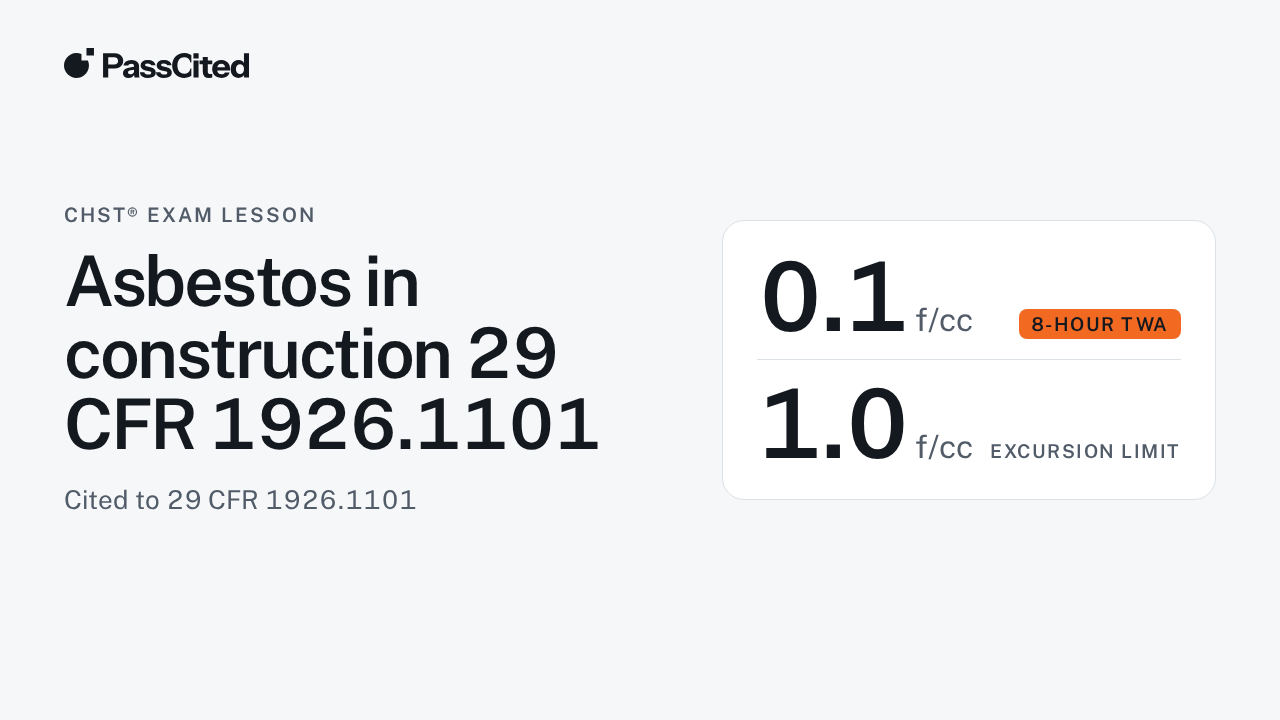 Asbestos in construction 29 CFR 1926.1101CHST lesson, 7:12Asbestos in construction under 29 CFR 1926.1101 for the CHST exam: PELs, work classes, competent person duties, regulated areas, monitoring, training hours and notification deadlines.
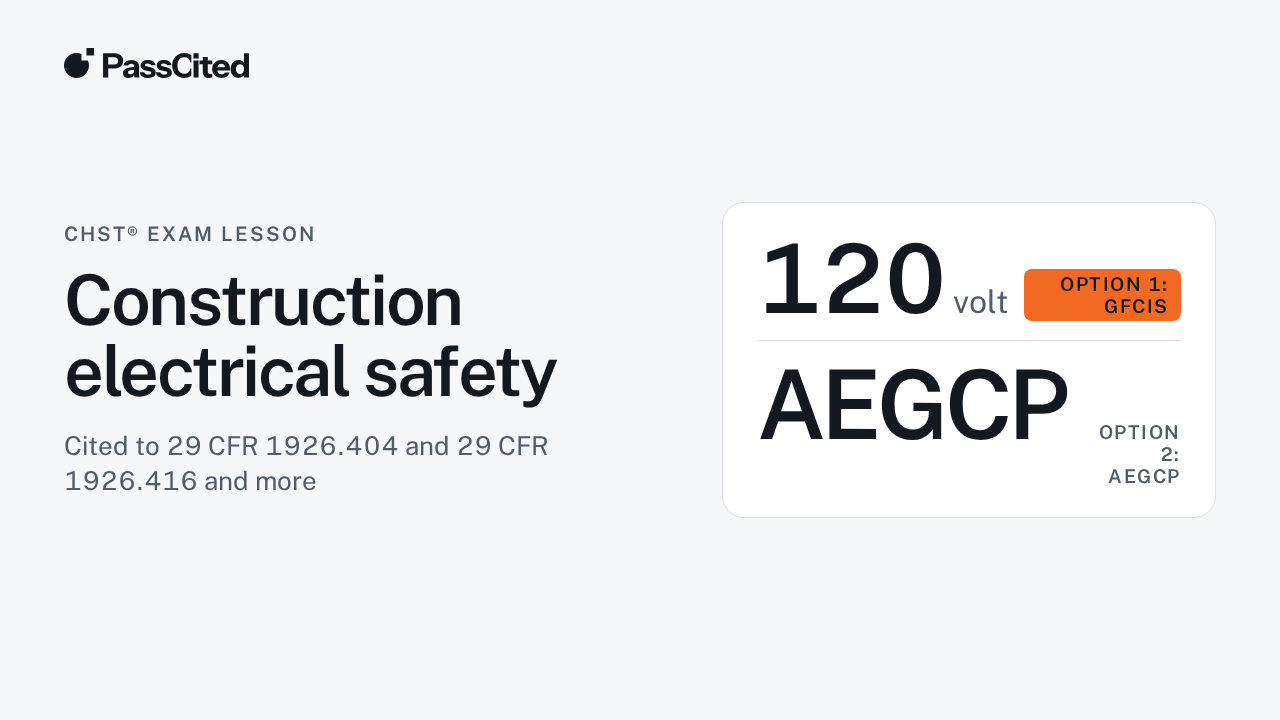 Construction electrical safetyCHST lesson, 6:54Construction electrical safety for the CHST exam: GFCI versus the assured grounding program, test intervals, overhead clearances, grounding distances, and lockout tagging under 1926 Subpart K.
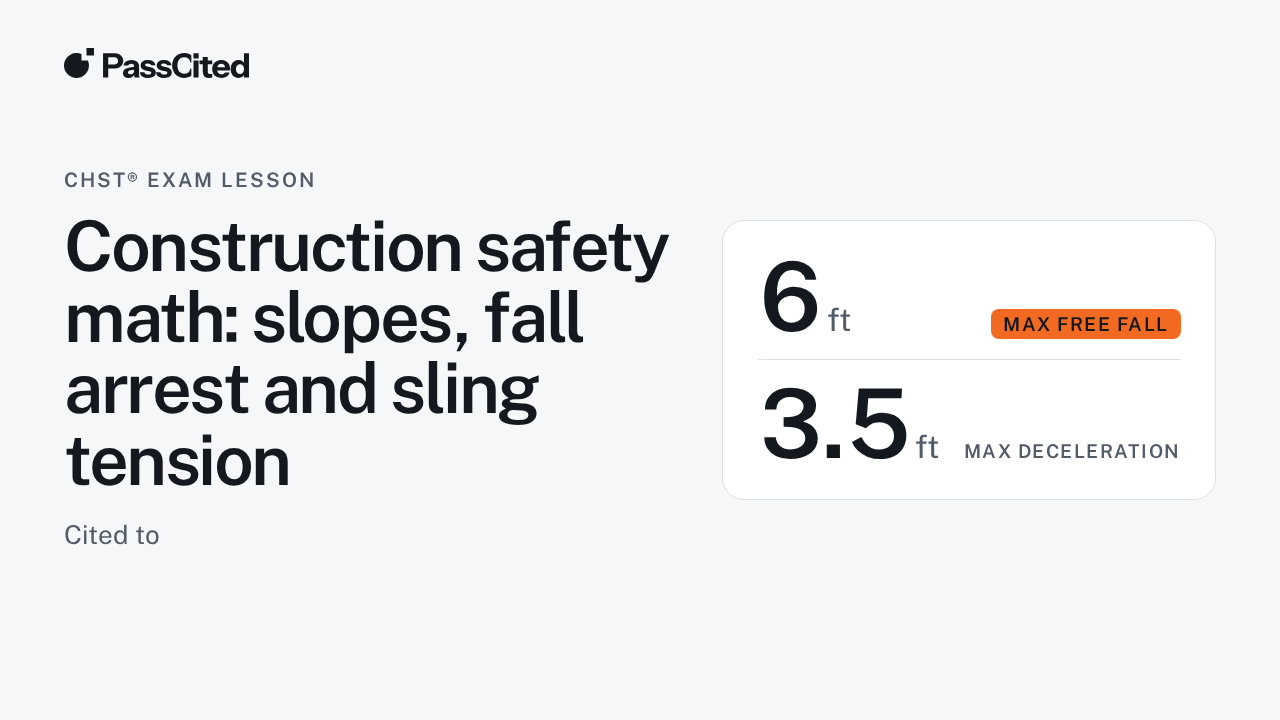 Construction safety math: slopes, fall arrest and sling tensionCHST lesson, 6:17Worked CHST calculations: excavation slope geometry, the 6-foot free fall and 3.5-foot deceleration limits, and sling tension at a 45-degree angle, each tied to its primary source.
See where you stand on the CHST
25 questions, free, no card. You get a readiness score for each CHST domain.
ASP®, CSP® and CHST® are registered marks of BCSP. PassCited is not affiliated with or endorsed by BCSP.