Rigging and fall clearance calculations
CSP video lesson, 6:32. CSP Domain 1: Advanced Application of Safety Principles
Work sling tension with the load angle factor, apply the two-leg rule and the 30-degree limit, and add up the free fall and deceleration limits used for fall clearance on the CSP exam.
Included with every pass, and free to watch with captions. Every rule and number is cited on screen to its primary source.
Transcript
0:00 Intro
Rigging and fall clearance calculations, for the CSP exam. Every rule and number here is cited to its primary source, on screen.
0:10 Learning objectives
In this lesson, you'll learn to: find sling leg tension from the load angle factor, apply the leg-count and sling-angle limits, state the free fall and deceleration limits, and add up fall clearance for a lanyard.
0:25 Why angle matters
A sling's rating means nothing until you know its angle. Take a 1,000 pound load on a 2-legged bridle. Each leg would lift 500 pounds in a vertical lift. But with a 45 degree sling angle involved, that 500 pound share is multiplied by the load angle factor from the chart.
0:55 Worked example
414. At lower angles it gets larger, so what a leg must carry depends on the angle, not just the load. Here's the DOE example, step by step. Load: 1,000 pounds. Two-legged bridle. Angle with horizontal: 45 degrees. First, the vertical share: 1,000 divided by 2 legs is 500 pounds.
1:24 The relationship
414 is 707 pounds. Each leg must be rated for at least 707 pounds, more than the 500 pound share. Here is the working formula. Leg tension is the vertical share, times the load angle factor. The vertical share is the load divided by the legs carrying it.
1:51 How many legs count
Standard geometry gives the factor: leg length over vertical height. 414, matching the DOE chart. Lower angles raise the factor. At 30 degrees it is 2. Before you divide the load, decide how many legs actually carry it. Two legs should be considered to carry the load, because in normal lifting practice it won't be uniformly distributed on all legs. If rigging techniques, verified by a qualified rigger, ensure even distribution, full use of three legs is allowed.
2:33 Personal fall arrest limits
Four or more legs need special rigging techniques, verified by a member of a qualified engineering organization, to prove even distribution.
2:53 Worked example
OSHA's guidance on synthetic rope sling hitches says slings with horizontal angles less than 30 degrees should not be used. Legs 5 degrees or less from vertical may be considered vertical. 502. The system must be rigged so an employee can't free fall more than 6 feet, nor contact any lower level. 5 feet. Exam problems often combine both. Now total the clearance. The lower level must be farther away than the whole fall. 5 feet of deceleration. Assume also a 1 foot harness stretch and a 5 foot D-ring to feet distance, plus a 3 foot safety margin.
3:39 On the job
5 feet. 5 feet with the actual distance to the lower level. If the lower level is closer, clearance is not met. 502 values. You're the safety manager on a steel job. A 1,000 pound load goes on a two-legged synthetic rope bridle at 45 degrees. First, check the angle. OSHA's guidance on synthetic rope slings says horizontal angles below 30 degrees should not be used; 45 is not below that.
4:18 Common exam traps
Next, by the DOE rigging method, count two legs: 500 pounds each. 414 and each leg sees 707 pounds of tension. The legs are rated only for the 500 pound vertical share. Stop the lift: each leg needs at least 707 pounds. Now, five traps that catch people on exam day. One: each leg doesn't just carry half. At 45 degrees, 500 pounds becomes 707. Two: count two legs, unless rigging techniques verified by a qualified rigger ensure an even load; then three may count.
5:02 Recap quiz
Three: four or more legs need verification by a member of a qualified engineering organization. Four: OSHA's guidance for synthetic rope slings says horizontal angles below 30 degrees should not be used. Five: 6 feet is only free fall. 5 feet more. Question 1. A 2,000 pound load, 2-legged bridle, 30 degrees, load angle factor 2. Tension per leg? A: 1,000. B: 1,414. C: 2,000. D: 4,000. C. 2,000 divided by 2 is 1,000, times 2 is 2,000 pounds. Question 2. A 3-leg sling, no verification. How many legs count? A: one. B: two. C: three. D: four. B. Two legs, unless rigging techniques verified by a qualified rigger ensure even distribution. Question 3. 5 feet. Maximum combined distance? A: 6. 5. 5. D: 12. B. 5 feet, before other allowances. Want to see where you stand on every CSP domain? com.
More CSP lessons
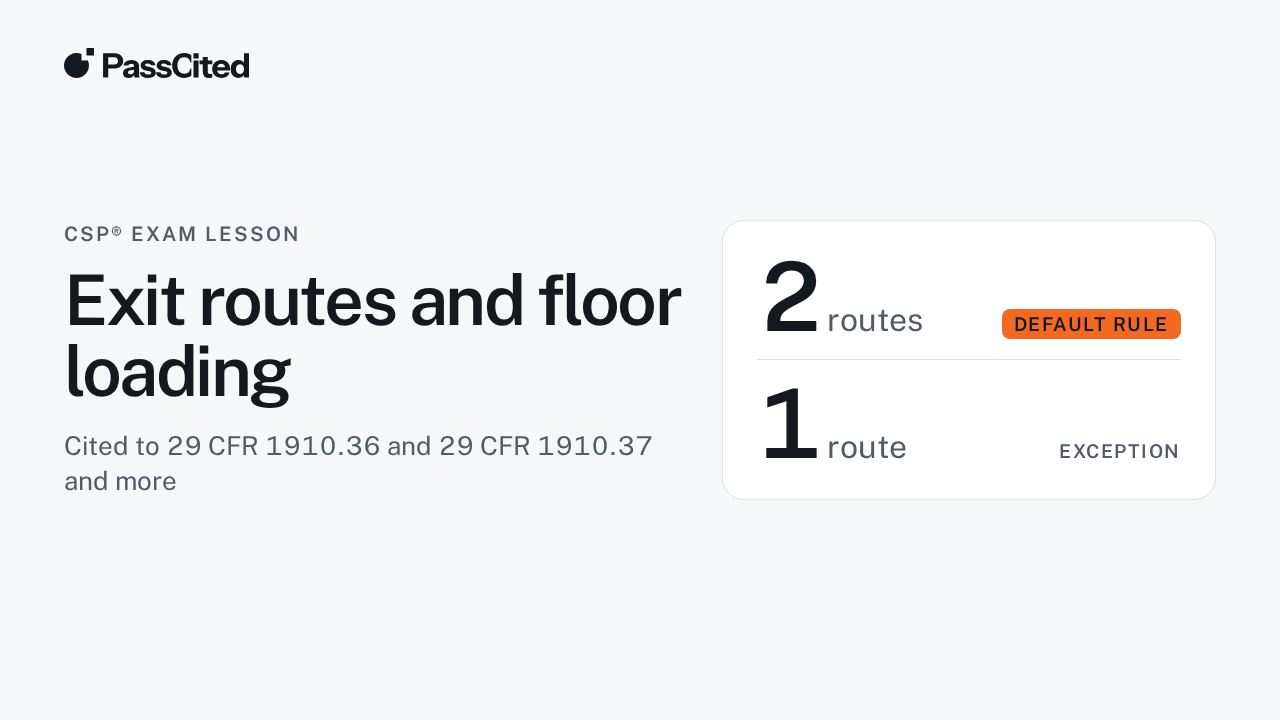 Exit routes and floor loadingCSP lesson, 6:41The CSP-tested rules for exit routes under 29 CFR 1910.36 and 1910.37, plus the walking-working surface load and repair rules in 1910.22: counts, dimensions, doors, signs and who repairs.
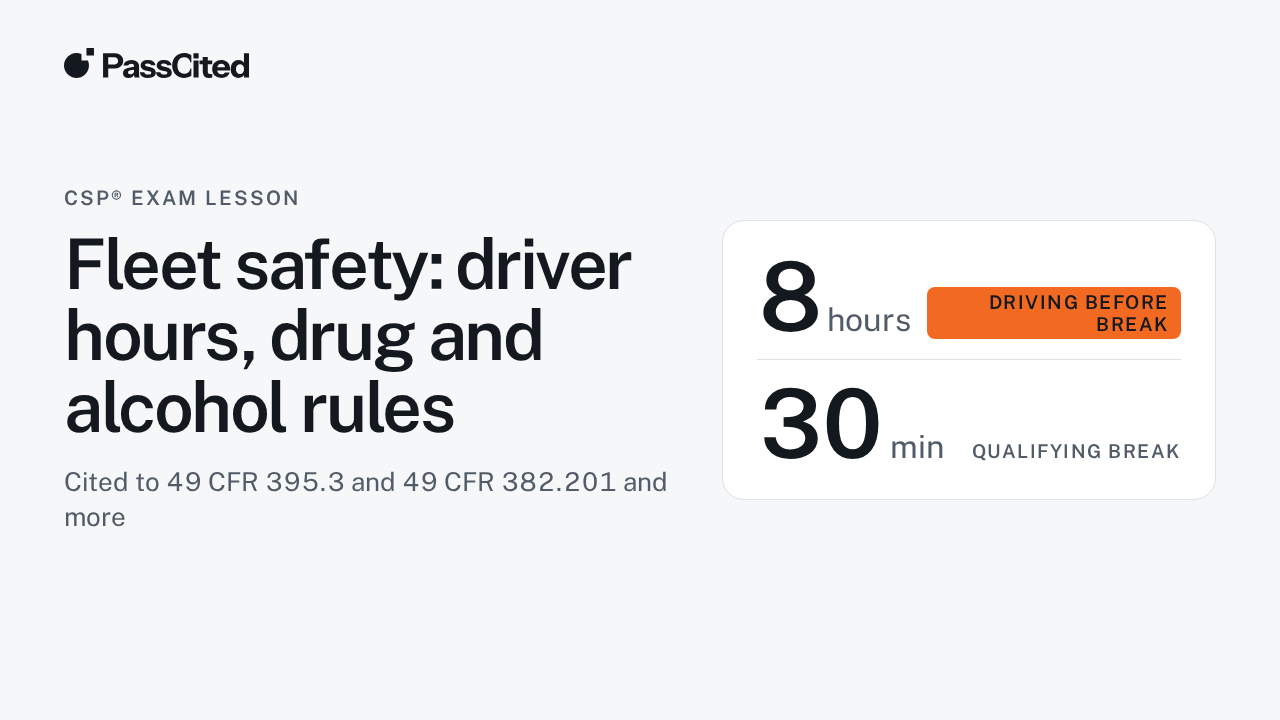 Fleet safety: driver hours, drug and alcohol rulesCSP lesson, 6:39Driver hours-of-service limits for property-carrying CMVs and DOT alcohol and drug rules: the 0.04 alcohol level, pre-employment testing, and the numbers the CSP exam tests.
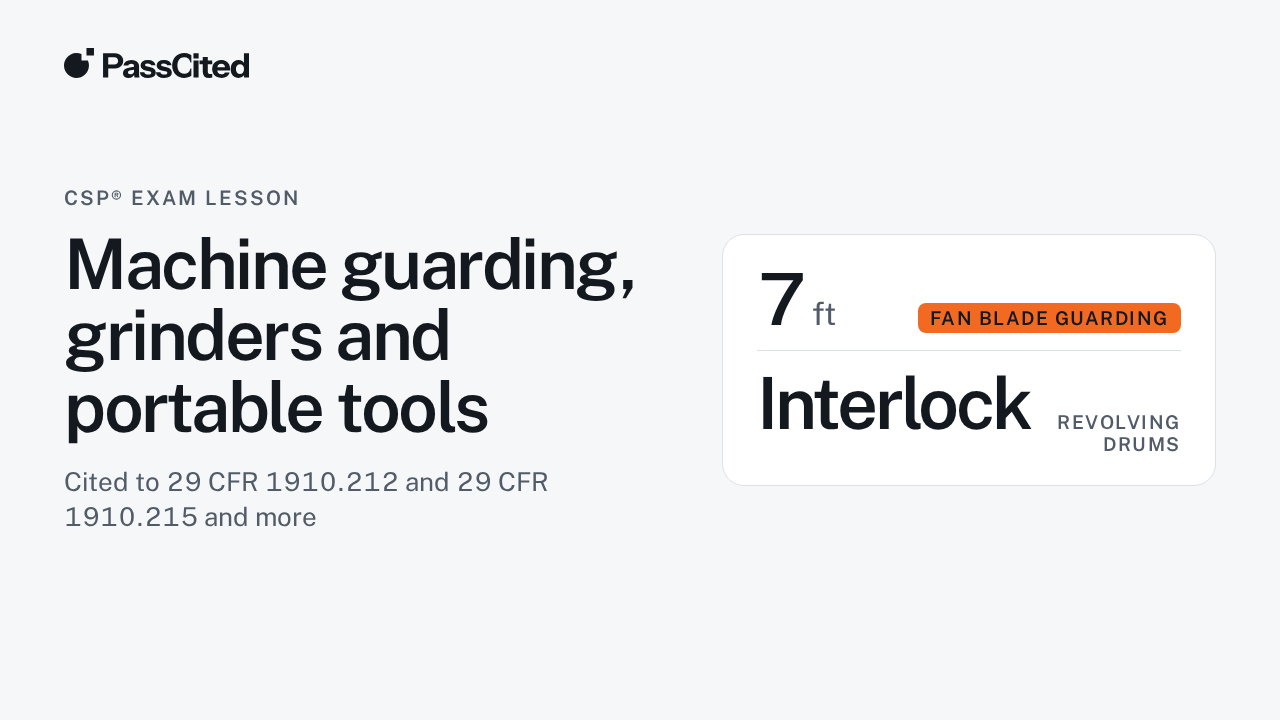 Machine guarding, grinders and portable toolsCSP lesson, 6:37CSP exam review of OSHA machine guarding, abrasive wheel guard exposure angles, work rests, flanges, the ring test, fan blade guards and compressed air limits under 1910.212, .215 and .242.
See where you stand on the CSP
25 questions, free, no card. You get a readiness score for each CSP domain.
ASP®, CSP® and CHST® are registered marks of BCSP. PassCited is not affiliated with or endorsed by BCSP.