Fleet safety: driver hours, drug and alcohol rules
CSP video lesson, 6:48. CSP Domain 1: Advanced Application of Safety Principles
Driver hours-of-service limits for property-carrying CMVs and DOT alcohol and drug rules: the 0.04 alcohol level, pre-employment testing, and the numbers the CSP exam tests.
Included with every pass, and free to watch with captions. Every rule and number is cited on screen to its primary source.
Transcript
0:00 Intro
Fleet safety: driver hours, drug and alcohol rules, for the CSP exam. Every rule and number here is cited to its primary source, on screen.
0:13 Learning objectives
04 alcohol prohibition, and describe pre-employment drug and alcohol testing. 1 exceptions, three daily limits control a property-carrying driver. First, the driver must take 10 consecutive hours off duty before driving.
0:33 Daily limits
Second, no driving after 14 consecutive hours following coming on duty after 10 consecutive hours off duty. Third, a total of 11 hours of driving is allowed within that 14-hour period. Except for short-haul exception drivers, driving is not permitted once more than 8 hours of driving time pass without a break.
1:06 30-minute break
The break must be a consecutive 30-minute interruption in driving status. It can be off-duty, sleeper berth, or on-duty not driving time, or a combination. Weekly limits bar driving after a set number of on-duty hours, and they depend on how the carrier operates.
1:26 Weekly limits
If the carrier does not operate vehicles every day of the week, no driving after 60 hours on duty in any 7 consecutive days. If it operates every day of the week, no driving after 70 hours on duty in any 8 consecutive days.
1:53 34-hour restart
The weekly periods can be reset with an off-duty period. Any 7-day period may end with the start of an off-duty period of 34 or more consecutive hours. The same is true of any 8-day period.
2:14 Alcohol
So the reset is 34 or more consecutive hours off duty, not 10. 04. 04 or greater. 04 or greater may not let the driver perform or continue safety-sensitive functions. Before a driver first performs safety-sensitive functions, a controlled substances test is required, with a verified negative result from the MRO or C/TPA.
2:38 Pre-employment drug test
An exception applies only if all three conditions are met. First, the driver was in a compliant program within the previous 30 days. Second, in that program, tested within 6 months of applying, or in random testing for the 12 months before applying. Third, the employer ensures no known prior employer has records of a violation of this part or another DOT agency's drug rule, within the previous six months. The employer must contact the testing program and obtain and retain specified information, including participation, last test date and results.
3:35 Drug vs. alcohol
If it can't verify participation, it must test. Pre-employment testing differs for drugs and alcohol. Drug testing is required before first safety-sensitive work, unless the exception applies. Pre-employment alcohol testing is optional, but if used, it must treat all safety-sensitive employees the same.
4:05 Common exam traps
It follows a contingent offer of employment or transfer and comes before first safety-sensitive duty. 04. Now, six traps that catch people on exam day. One: the 14 hours is a window after coming on duty, with 11 hours of driving inside it. Two: ten hours is the daily rest. Ending a 7 or 8-day period takes 34 consecutive hours or more. Three: the 30-minute break need not be off duty. On-duty not driving counts. 04 or greater, not only above it.
4:55 Recap quiz
Five: pre-employment alcohol testing is optional. The drug test is required, unless the exception applies. Six: if you choose pre-employment alcohol testing, you must treat all safety-sensitive employees the same. Question 1. A driver has driven 8 hours with no break and wants to keep driving. Which satisfies the break requirement? A: 15 minutes off duty. B: 30 consecutive minutes on-duty not driving. C: a 10-minute stop. D: two separate 10-minute breaks. B. The consecutive 30-minute interruption can be on-duty not driving time. Question 2. A carrier operates every day of the week. A driver reaches 70 hours on duty in 8 consecutive days. What ends the 8-day period? A: a 10-hour rest. B: a 30-minute break. C: 34 or more consecutive hours off duty. D: 11 more hours. C. An 8-day period may end with the beginning of 34 or more consecutive off-duty hours. Question 3. 04. What must it do? 05. B: allow short trips. C: not permit safety-sensitive functions. D: wait for a random test. C. 04 or greater, the employer may not permit safety-sensitive functions. Want to see where you stand on every CSP domain? com.
More CSP lessons
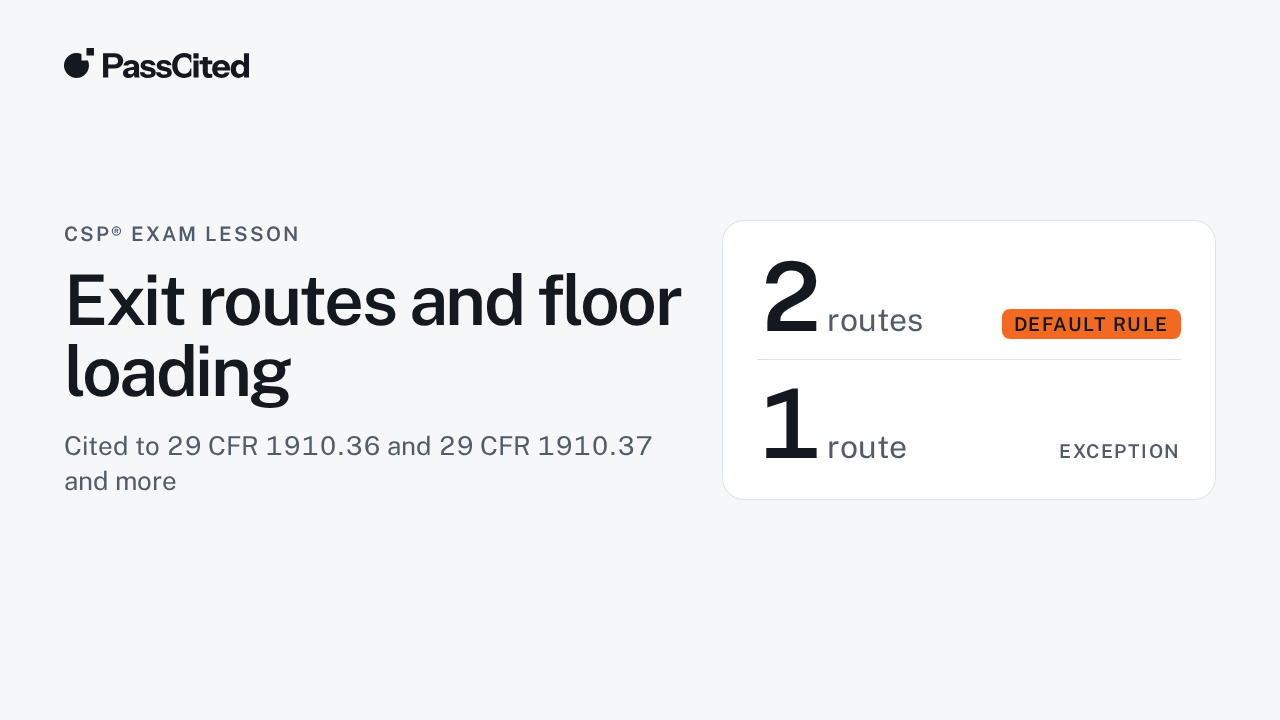 Exit routes and floor loadingCSP lesson, 6:43The CSP-tested rules for exit routes under 29 CFR 1910.36 and 1910.37, plus the walking-working surface load and repair rules in 1910.22: counts, dimensions, doors, signs and who repairs.
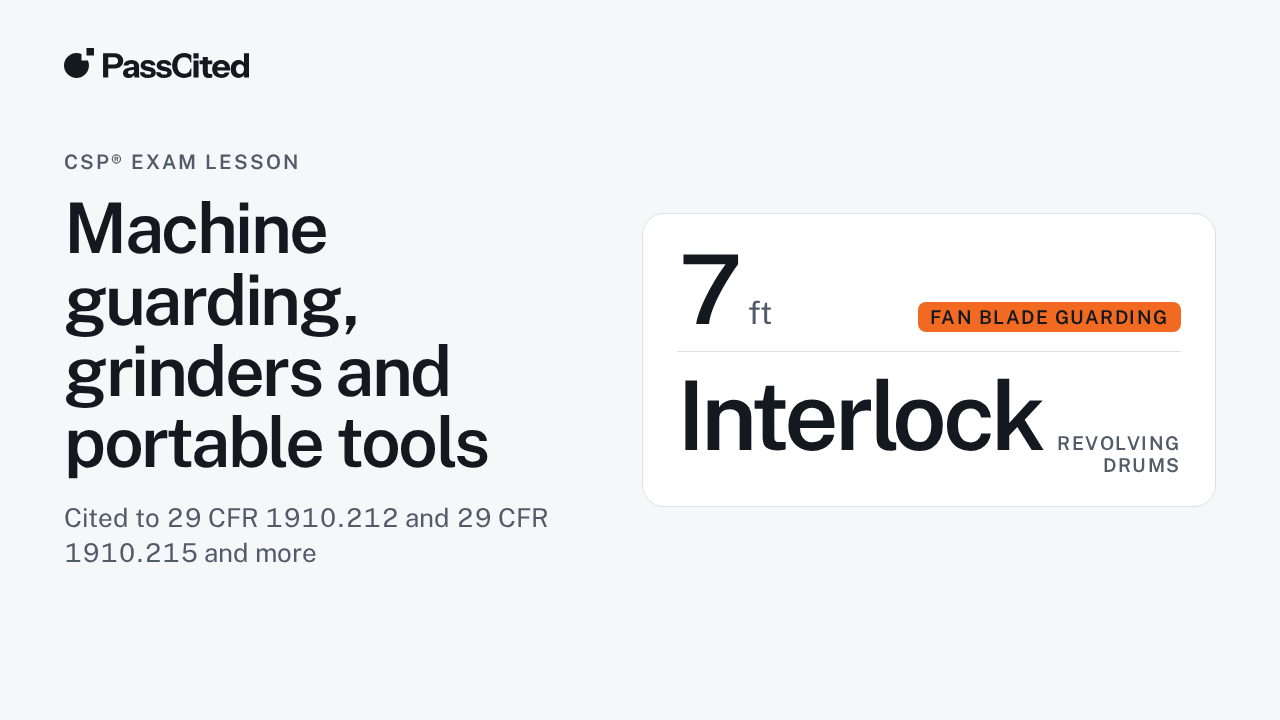 Machine guarding, grinders and portable toolsCSP lesson, 6:53CSP exam review of OSHA machine guarding, abrasive wheel guard exposure angles, work rests, flanges, the ring test, fan blade guards and compressed air limits under 1910.212, .215 and .242.
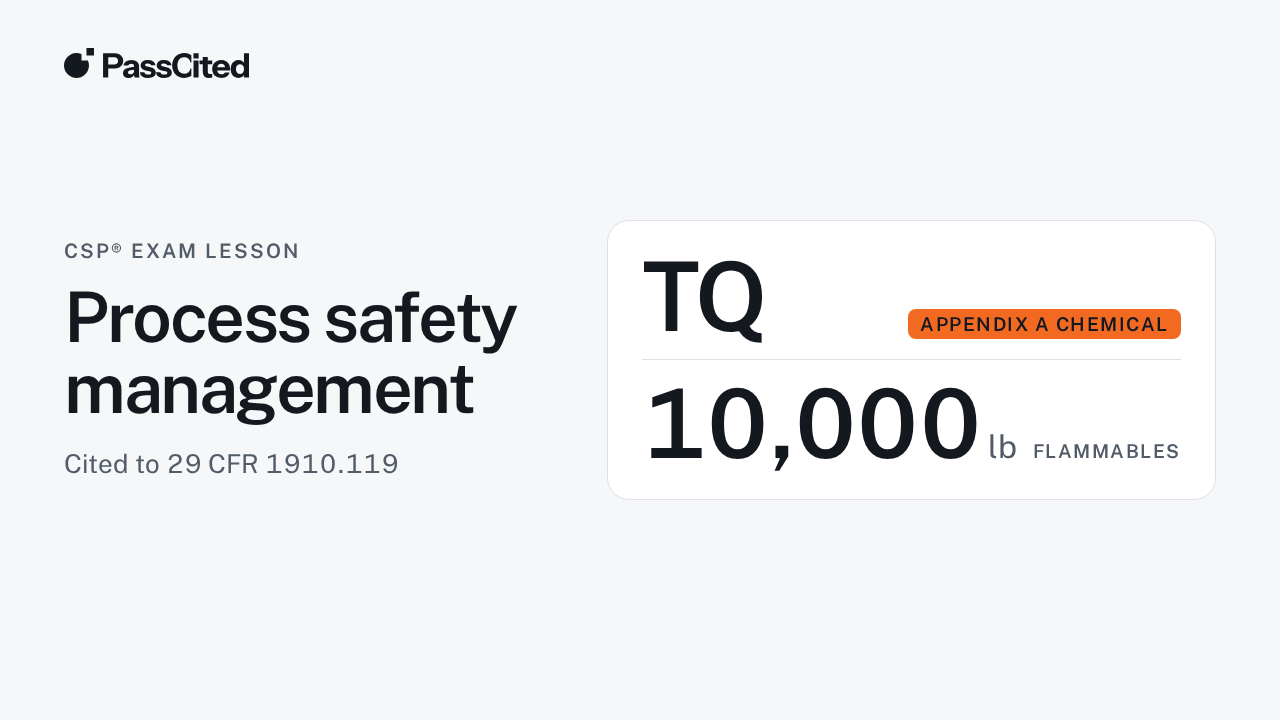 Process safety managementCSP lesson, 7:20PSM under 29 CFR 1910.119 for the CSP exam: coverage thresholds, process safety information, PHA, management of change, pre-startup review, audits and the key time limits.
See where you stand on the CSP
25 questions, free, no card. You get a readiness score for each CSP domain.
ASP®, CSP® and CHST® are registered marks of BCSP. PassCited is not affiliated with or endorsed by BCSP.