Incident investigation and management of change
CSP video lesson, 6:34. CSP Domain 2: Program Management
CSP exam review of OSHA PSM 1910.119: the 48-hour investigation start, team makeup, report contents, five-year retention, management of change rules, and compliance audits.
Included with every pass, and free to watch with captions. Every rule and number is cited on screen to its primary source.
Transcript
0:00 Intro
Incident investigation and management of change, for the CSP exam. Every rule and number here is cited to its primary source, on screen. In this lesson, you'll learn to: state the investigation start deadline and the report contents, identify who must serve on the investigation team, apply the management of change considerations and training rule, and separate report retention from compliance audit intervals.
0:33 When you must investigate
Under PSM, the employer must investigate each incident that resulted in, or could reasonably have resulted in, a catastrophic release of highly hazardous chemical in the workplace. That covers actual releases and near misses that could reasonably have caused a catastrophic release. Start the investigation as promptly as possible, but not later than 48 hours after the incident.
1:01 Investigation team
The employer must establish an investigation team. The standard sets a minimum makeup, not a fixed size. It needs at least one person knowledgeable in the process involved. If the incident involved a contractor's work, a contract employee must be included. Add other people with the knowledge and experience to thoroughly investigate and analyze the incident.
1:26 The report
A report is prepared at the conclusion of the investigation, and the standard lists what it includes at a minimum. It must include two dates: the date of the incident and the date the investigation began. It must also include a description of the incident and the factors that contributed to it.
1:51 After the report
And any recommendations resulting from the investigation. Three duties follow the report: resolve, review and retain. First, a system to promptly address and resolve findings and recommendations. Resolutions and corrective actions must be documented. Second, review the report with all affected personnel whose job tasks are relevant, including contract employees where applicable.
2:22 Management of change
Third, retain incident investigation reports for five years. The employer must establish and implement written procedures to manage changes. They cover changes to process chemicals, technology, equipment, and procedures, and to facilities that affect a covered process.
2:46 Before any change
Replacements in kind are excluded from the written MOC procedures, so a like-for-like swap does not trigger them. The procedures must assure five considerations are addressed prior to any change. The technical basis for the change, and its impact on safety and health.
3:08 Before start-up
Modifications to operating procedures. The necessary time period for the change, and the authorization requirements. Affected employees must be informed of, and trained in, the change. That includes employees involved in operating the process, plus maintenance and contract employees whose job tasks will be affected.
3:34 Don't confuse the intervals
It must happen prior to start-up of the process or affected part. If the change alters process safety information or operating procedures, update them accordingly. Compliance audits are a separate requirement with their own numbers. Don't mix them with investigation numbers. Let's take audits first. Employers must certify they evaluated compliance at least every three years, to verify procedures and practices are adequate and are being followed.
4:14 Common exam traps
At least one person knowledgeable in the process conducts it. Findings are reported, each promptly gets a documented response, corrected deficiencies are documented, and the two most recent reports are retained. Incident investigation reports are different: they are retained for five years. Now, six traps that catch people on exam day. One: the deadline is 48 hours after the incident, not whenever the team is ready.
4:46 Recap quiz
Two: near misses that could reasonably have caused a catastrophic release count. Three: five years for reports, every three years for audits. Four: keep the two most recent audit reports. Five: change training comes before start-up. Six: replacements in kind are excepted. Question 1. After a PSM incident, what is the latest point by which the investigation must be initiated? A: Within one shift. B: Not later than 48 hours. C: Within three weeks. D: Whenever the audit is due. B. Not later than 48 hours following the incident, and as promptly as possible. Question 2. A contractor's work contributed to an incident. Which team satisfies the standard? A: Only the plant manager. B: Employer staff only. C: A process-knowledgeable person, a contract employee, and others with knowledge. D: A consultant alone. C. Include a process-knowledgeable person, a contract employee, and others with appropriate knowledge and experience. Question 3. A change alters operating procedures. When must affected employees be trained? A: Within a month after start-up. B: At the next annual refresher. C: After the first audit. D: Prior to start-up. D. Training happens prior to start-up of the process or affected part of the process. Want to see where you stand on every CSP domain? com.
More CSP lessons
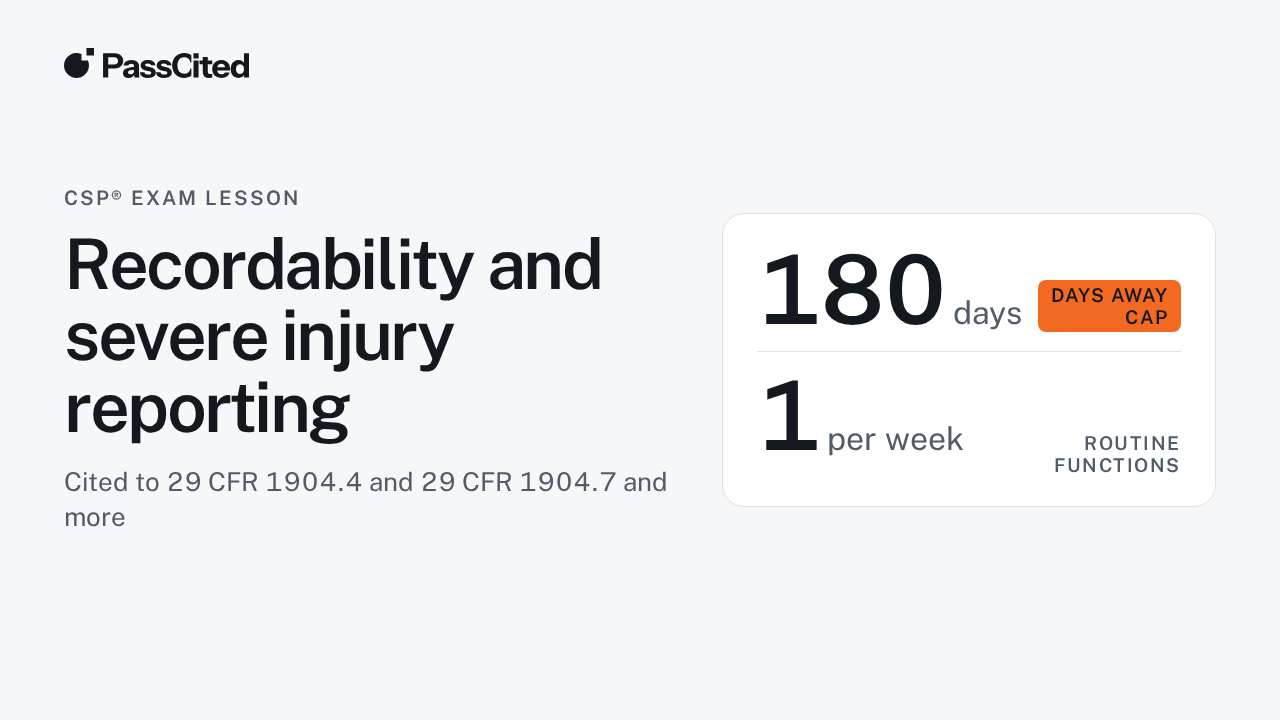 Recordability and severe injury reportingCSP lesson, 7:10CSP exam review of OSHA recordkeeping: the general recording criteria, first aid versus medical treatment, restricted work, the 8-hour and 24-hour reporting deadlines, and the incidence rate formula.
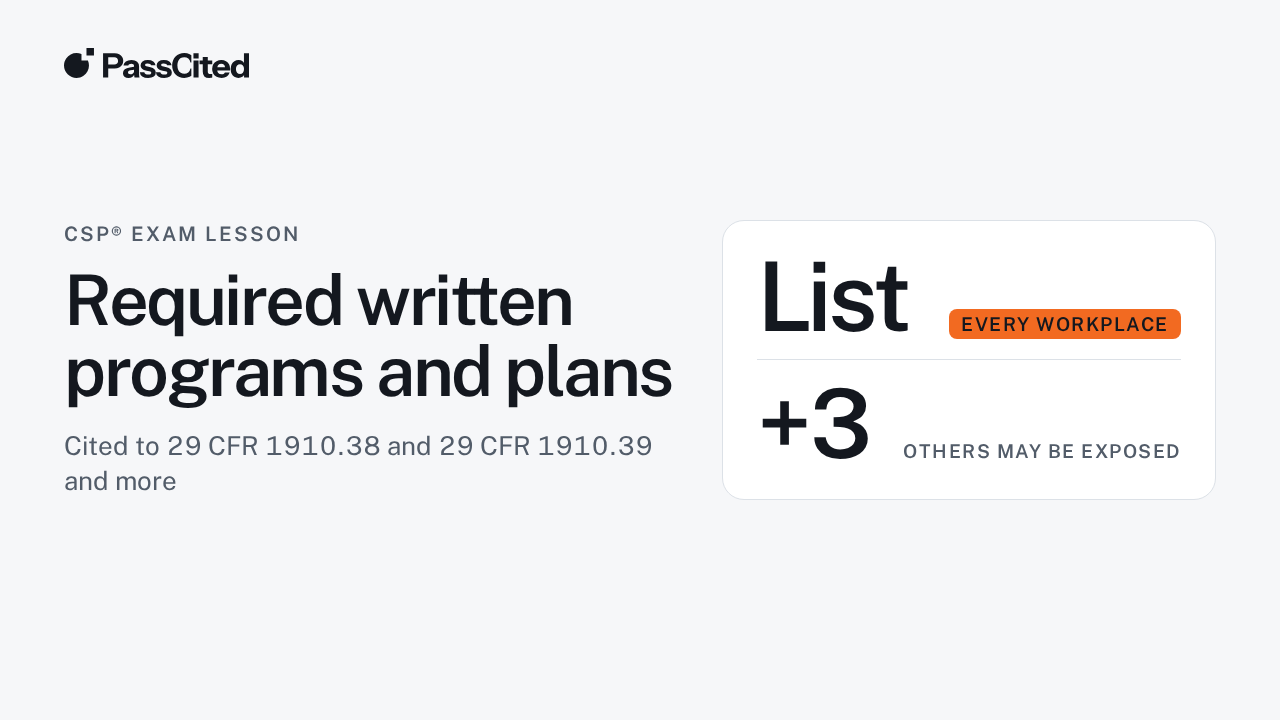 Required written programs and plansCSP lesson, 7:19What OSHA requires in writing: emergency action plans, fire prevention plans, hazard communication and respiratory protection programs, including minimum elements, the 10-employee oral exception and who administers.
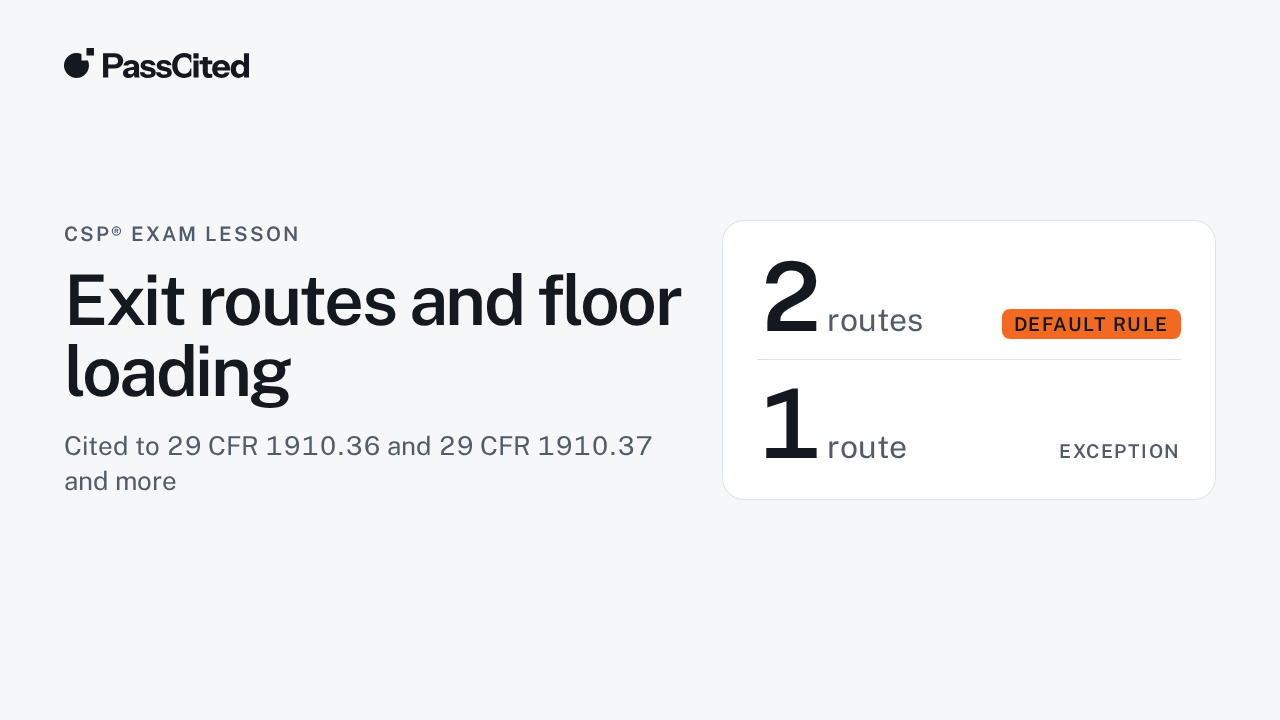 Exit routes and floor loadingCSP lesson, 6:43The CSP-tested rules for exit routes under 29 CFR 1910.36 and 1910.37, plus the walking-working surface load and repair rules in 1910.22: counts, dimensions, doors, signs and who repairs.
See where you stand on the CSP
25 questions, free, no card. You get a readiness score for each CSP domain.
ASP®, CSP® and CHST® are registered marks of BCSP. PassCited is not affiliated with or endorsed by BCSP.