Process hazard analysis under PSM
CSP video lesson, 6:46. CSP Domain 3: Risk Management
What OSHA's PSM standard requires in a process hazard analysis: methodologies, required topics, team makeup, findings, five-year revalidation and records, for the CSP exam.
Included with every pass, and free to watch with captions. Every rule and number is cited on screen to its primary source.
Transcript
0:00 Intro
Process hazard analysis, for the CSP exam. Every rule and number here is cited to its primary source, on screen. In this lesson, you'll learn to: name the methodologies OSHA lists for a PHA, list what every PHA must address, describe the team and findings duties, and apply the five-year revalidation and retention rules.
0:10 Learning objectives
Paragraph (e)(1) requires an initial process hazard analysis on covered processes.
0:29 Initial analysis
It must fit the complexity of the process, and identify, evaluate, and control the hazards. The employer must determine and document a priority order, based on a rationale. Considerations include extent of the process hazards, number of potentially affected employees, age of the process, and operating history. The deadline is separate: as soon as possible, but not later than this schedule. At least 25 percent completed by May 26, 1994, at least 50 percent by 1995, at least 75 percent by 1996, and all by May 26, 1997. Paragraph (e)(2) lists the methodologies.
1:22 Methodologies
The employer uses one or more that are appropriate. What-If, Checklist, or the combined What-If/Checklist. HAZOP or FMEA. Or Fault Tree Analysis. Or an appropriate equivalent methodology. The employer must use one or more appropriate methods, but no single method is mandated. Paragraph (e)(3) lists what every PHA must address.
1:49 Required content
The hazards of the process, and any previous incident with likely potential for catastrophic consequences. Engineering and administrative controls applicable to the hazards and their interrelationships, such as detection methods for early warning of releases, and the consequences if those controls fail. Facility siting, human factors, and a qualitative evaluation of a range of possible safety and health effects of control failure on employees in the workplace. Detection that gives early warning of releases might include process monitoring and control instrumentation with alarms, or hardware such as hydrocarbon sensors.
2:39 The team
Paragraph (e)(4): the PHA must be performed by a team. The team needs expertise in engineering and process operations, plus at least one employee with experience and knowledge specific to the process. Also, one member must know the specific PHA methodology being used.
3:07 Findings
That is its own requirement, even for a team strong in engineering and operations. Paragraph (e)(5) requires a system to promptly address the team's findings and recommendations. Recommendations must be resolved in a timely manner, and the resolution documented. Document what actions are to be taken, complete them as soon as possible, and develop a written schedule. Then communicate the actions to operating, maintenance, and other employees whose work assignments are in the process and who may be affected.
3:48 Revalidation and records
On the exam, remember the elements: address, resolve and document, document actions, complete as soon as possible on a written schedule, and communicate. Start with timing. A PHA completed after May 26, 1987 that meets the requirements is acceptable as an initial PHA. It is then updated and revalidated, based on its completion date, under paragraph (e)(6).
4:22 Common exam traps
At least every five years after the initial PHA, it must be updated and revalidated by a team meeting the (e)(4) requirements. Retain PHAs, updates, revalidations, and documented resolutions for the life of the process. Now, five traps that catch people on exam day. One: the cycle is at least every five years after the initial PHA, not three. Two: records are kept for the life of the process, not five years. Three: no single method is mandated.
5:01 Recap quiz
Use one or more appropriate ones, and equivalents count. Four: it takes a team, including a process-experienced employee and a member knowledgeable in the methodology being used. Five: the revalidation team must meet the same team requirements. Question 1. How often must a PHA be updated and revalidated? A: at least every 3 years. B: at least every 5 years. C: at least every 10 years. D: only when the process changes. B. At least every five years after the initial PHA is completed. Question 2. A team has engineering and operations expertise and a process-experienced employee. What is still required? A: a member knowledgeable in the methodology. B: an outside OSHA consultant. C: a certified safety professional. D: a union representative. A. One member must know the specific methodology being used. Question 3. A team recommends a change. What must the employer do? A: keep it 5 years, then discard it. B: document actions and set a written schedule. C: wait for the next revalidation. D: tell only the process engineer. B. Document actions, complete them as soon as possible with a written schedule, and tell affected employees. Want to see where you stand on every CSP domain? com.
More CSP lessons
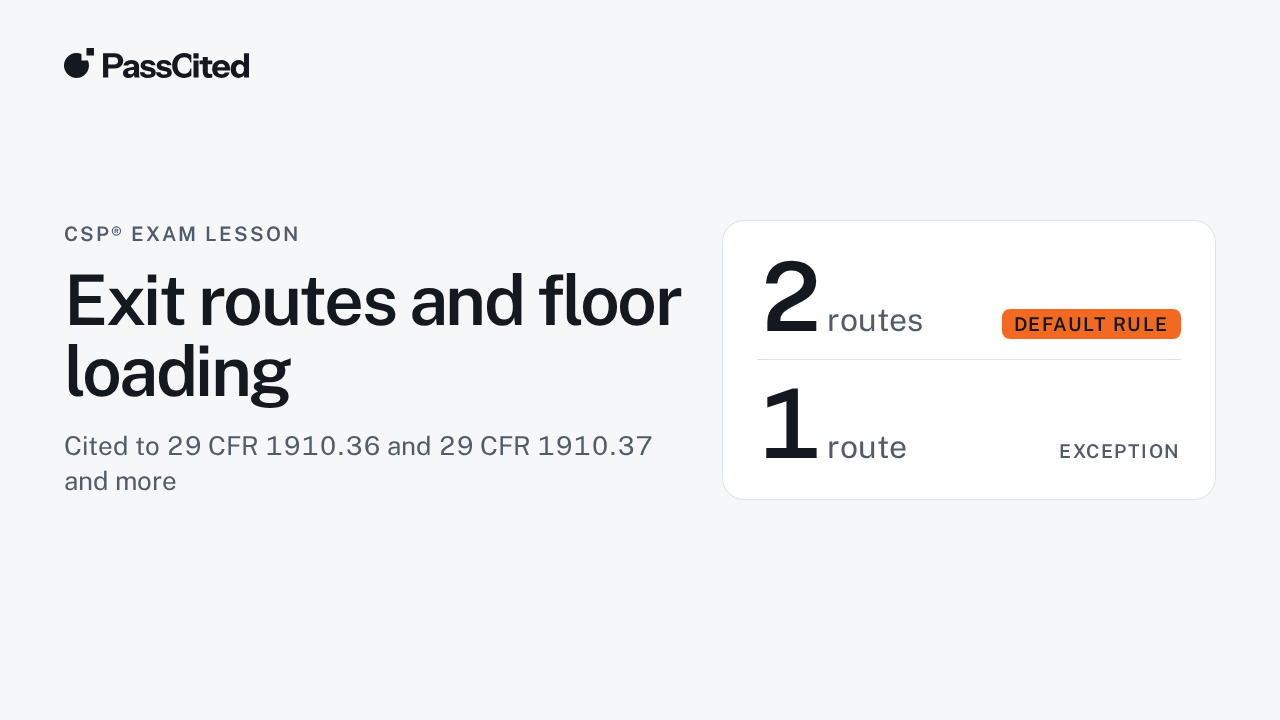 Exit routes and floor loadingCSP lesson, 6:43The CSP-tested rules for exit routes under 29 CFR 1910.36 and 1910.37, plus the walking-working surface load and repair rules in 1910.22: counts, dimensions, doors, signs and who repairs.
 Fleet safety: driver hours, drug and alcohol rulesCSP lesson, 6:48Driver hours-of-service limits for property-carrying CMVs and DOT alcohol and drug rules: the 0.04 alcohol level, pre-employment testing, and the numbers the CSP exam tests.
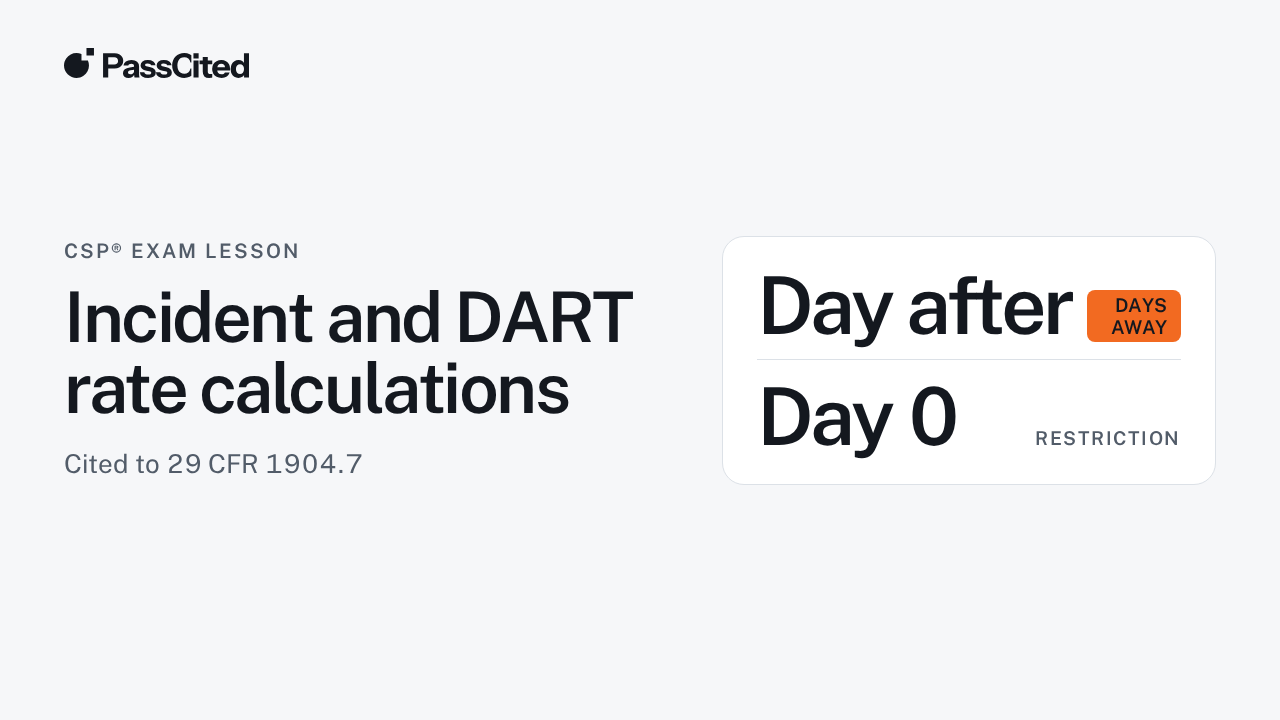 Incident and DART rate calculationsCSP lesson, 6:21Calculate TRIR and DART as cases per 100 full-time workers using the 200,000-hour base. Learn what counts in each numerator, work through examples, and avoid the common CSP exam traps.
See where you stand on the CSP
25 questions, free, no card. You get a readiness score for each CSP domain.
ASP®, CSP® and CHST® are registered marks of BCSP. PassCited is not affiliated with or endorsed by BCSP.