System safety process
ASP video lesson, 6:38. ASP Domain 2: Safety Programs and Concepts
MIL-STD-882E system safety for the ASP exam: the eight-element process, severity and probability risk assessment, the design order of precedence, risk acceptance and the user representative.
Watch the first 1:26 free. The full lesson, with captions and the full transcript, is included with every ASP pass. Every rule and number is cited on screen to its primary source.
Transcript of the preview
0:00 Intro
The DoD system safety process, for the ASP exam. Every rule and number here is cited to its primary source, on screen.
0:08 Learning objectives
In this lesson, you'll learn to: name the eight elements of the system safety process, rank the design order of precedence from most to least effective, explain how severity, probability and risk assessment codes are used, and state who accepts risk, and who must concur.
0:28 Core definitions
This DoD standard practice opens with definitions. Start with two. System safety applies engineering and management principles to achieve acceptable risk across all life-cycle phases. Target risk is the projected level the program manager plans to reach, using the design order of precedence.
0:47 The process
The system safety process has eight elements, and iteration between steps may be required. First, document the approach. Second, identify and document hazards. Third, assess and document risk. Fourth, identify and document mitigation measures. Fifth, reduce risk. Sixth, verify, validate and document the reduction. Seventh, accept risk and document.
1:20 Hazards and the HTS
Eighth, manage life-cycle risk. Hazards come from systematic analysis, and each is documented in a closed-loop Hazard Tracking System. The analysis covers hardware, software, interfaces including human interfaces, intended use and operational environment. It must consider the entire life-cycle and impacts to personnel, infrastructure, defense systems, the public and the environment.
Also in the full lesson
- Assess risk
- Design order of precedence
- Risk acceptance
- After fielding
- On the job
- Common exam traps
- Recap quiz
The full transcript is included with every ASP pass. See passes
More ASP lessons
 Compressed gas cylindersASP lesson, 6:17The testable rules for compressed gas cylinders: handling, storage distances, fuel gas use, leaks, hose and manifolds, under 29 CFR 1910.101 and 1926.350, for the ASP exam.
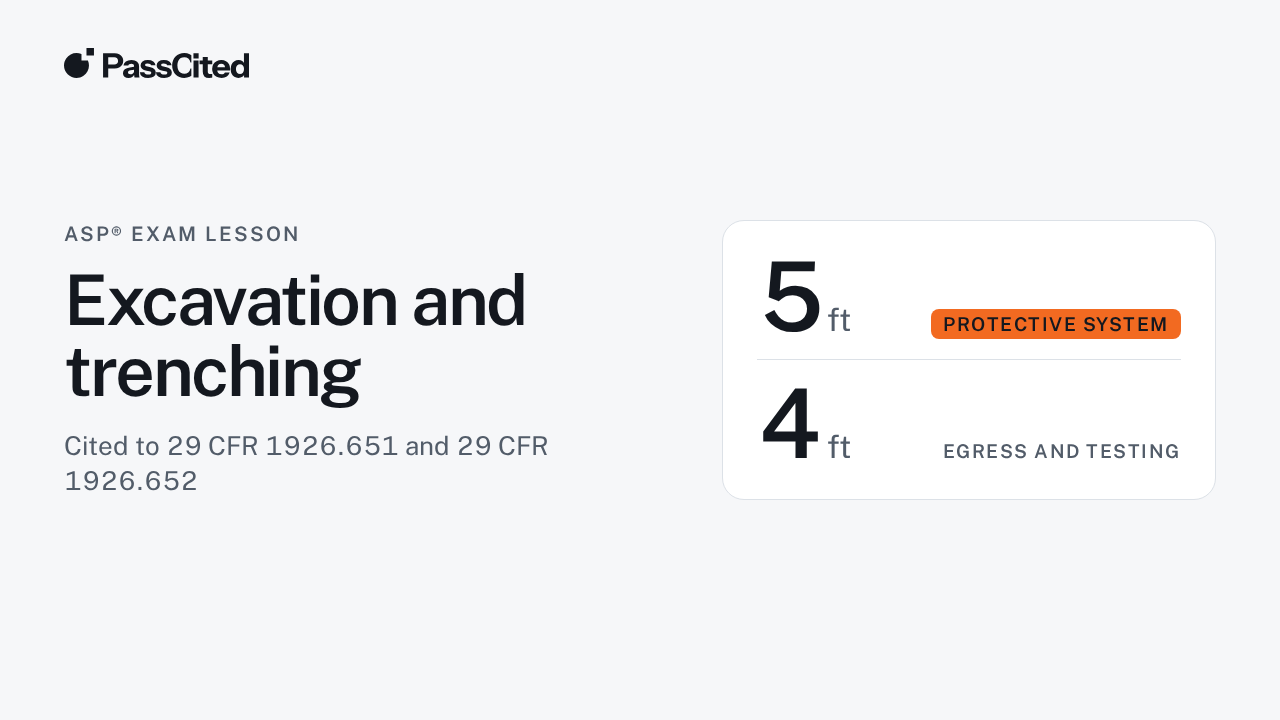 Excavation and trenchingASP lesson, 6:52ASP exam review of 29 CFR 1926 Subpart P: the 5-foot and 4-foot thresholds, utility locates, daily inspections, soil types, maximum allowable slopes, and who does what.
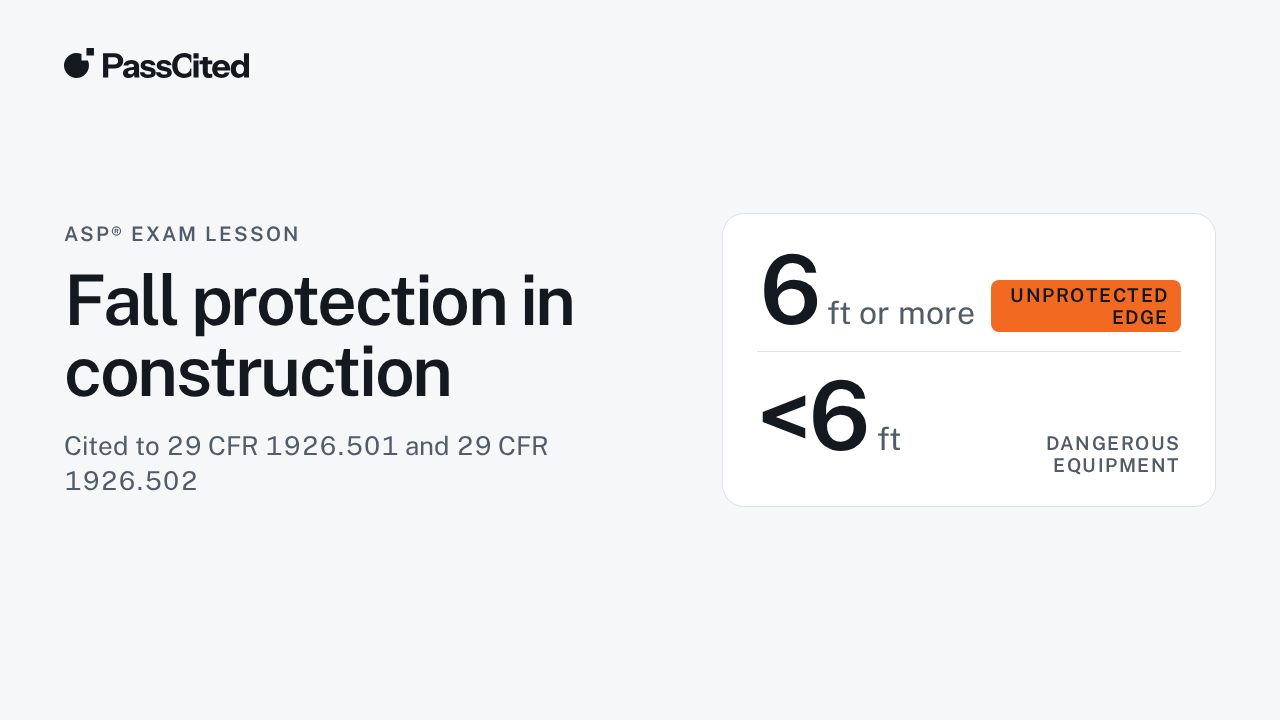 Fall protection in constructionASP lesson, 6:49Construction fall protection under 1926.501 and 1926.502: the 6-foot trigger, system criteria, guardrail, net, arrest and warning line numbers, and who must prepare and supervise.
See where you stand on the ASP
25 questions, free, no card. You get a readiness score for each ASP domain.
ASP®, CSP® and CHST® are registered marks of BCSP. PassCited is not affiliated with or endorsed by BCSP.