OSHA inspections and citations
ASP video lesson, 6:35. ASP Domain 9: Legal
What a compliance officer may do on site, how citations are issued and posted, and the abatement deadlines an employer must meet under 29 CFR part 1903. Built for the ASP exam.
Included with every pass, and free to watch with captions. Every rule and number is cited on screen to its primary source.
Transcript
0:00 Intro
OSHA inspections and citations, for the ASP exam. Every rule and number here is cited to its primary source, on screen. In this lesson, you'll learn to: describe how an inspection is conducted, state the citation time limit and posting rules, apply the rescue citation policy, and meet abatement certification deadlines.
0:10 Learning objectives
An inspection opens with credentials, then the officer explains the purpose and scope.
0:25 Conduct of inspections
The officer may take samples and photographs, and question privately any employer, owner, operator, agent or employee. Officers must follow your safety rules and wear appropriate protective equipment. At the end, a closing conference covers apparent violations, and you can add pertinent information.
0:50 Issuing a citation
The Area Director reviews the report and, believing a violation occurred, issues a citation, or a de minimis notice for violations with no direct or immediate relationship to safety or health. Time is limited: no citation may issue after 6 months from the alleged violation. A citation describes the violation with particularity, citing the provision, fixes a reasonable abatement time, and states that issuance is no finding unless uncontested or, if contested, affirmed.
1:22 Common confusion
Two confusions. First, fixing a hazard on the spot does not stop a citation. A citation or notice is still issued even if you abate immediately, or initiate steps to abate. Second, a citation is not a finding of violation unless uncontested, or if contested, affirmed by the Review Commission.
1:45 Rescue activities
No citation may issue for an employee's rescue of someone in imminent danger, unless one of three exceptions applies. One: the employee was designated for rescue and you failed to provide protection, including training and equipment. Two: you directed the employee to perform rescue as part of the job, with the same failure.
2:18 Posting citations
Three: an undesignated employee volunteers where life-threatening accidents are foreseeable, and you failed to instruct on rescue arrangements, not attempting rescue, and its hazards. On receipt, post the citation immediately and unedited at or near each place the alleged violation occurred. If that is impractical, use a prominent place readily observable by all affected employees.
2:46 Abatement verification
It stays up until the violation is abated or 3 working days, whichever is later. Contesting does not end posting unless the Review Commission issues a final order vacating it. De minimis notices need not be posted. Abatement verification runs on fixed deadlines. First, certify within 10 calendar days after the abatement date. Not required if the officer, on site, saw abatement within 24 hours after identifying the violation and noted it. Next, a plan: OSHA may require one, if the citation says so, for any violation except other-than-serious when abatement time exceeds 90 calendar days.
3:26 Final order date
Due within 25 calendar days of final order. Then progress reports, if the citation requires them. The first is due no sooner than 30 calendar days after the plan.
3:41 Employee notification
The final order date drives the plan deadline. Uncontested: the fifteenth working day after you receive the citation. Contested: generally the thirtieth day after the judge's decision is docketed with the Commission. Employees must be informed of abatement activities by posting each document, or a summary, near the violation.
4:08 On the job
Within 3 working days of notice of submission, employees may request to examine and copy; you comply within 5 working days. Documents stay posted 3 working days after submission. For movable equipment cited as serious, repeat or willful, attach a warning tag or citation copy. You're the safety manager at a fabrication shop.
4:35 Common exam traps
A citation arrives, and you plan to contest it. First, post it immediately, unedited, near each place the violation occurred. Filing a contest does not end posting unless the Review Commission issues a final order vacating it. If it stands, certify within 10 calendar days after the abatement date, and answer employee copy requests within 5 working days. Now, six traps that catch people on exam day. One: a citation or de minimis notice is still issued even if you abate immediately.
5:12 Recap quiz
Two: no citation may be issued more than 6 months after the alleged violation. Three: contesting does not end posting unless a final order vacates the citation. Four: the 10 days run from the abatement date, not the citation. Five: the 25 days run from the final order date. Six: uncontested is the fifteenth working day, not 30 days. Question 1. After the abatement date, within how many calendar days must an employer certify abatement? A: three. B: ten. C: fifteen. D: twenty-five. B. Ten calendar days after the abatement date. Question 2. Hazard abated by the second day. How long must the citation stay posted? A: until abated or three working days, whichever is later. B: only until abated. C: ten calendar days. D: six months. A. Whichever is later, abatement or three working days. Question 3. An uncontested citation is received. When is the final order date? A: tenth calendar day. B: twenty-fifth calendar day. C: thirtieth day. D: fifteenth working day. D. The fifteenth working day after receipt. Want to see where you stand on every ASP domain? com.
More ASP lessons
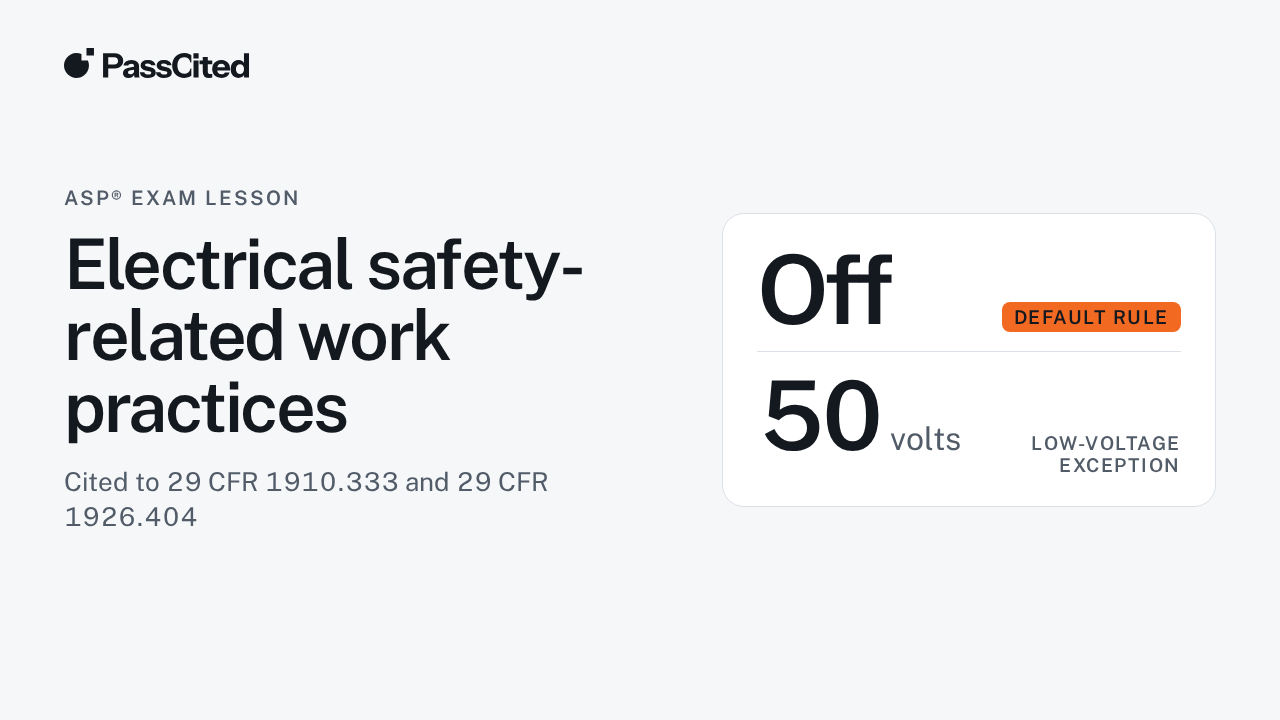 Electrical safety-related work practicesASP lesson, 7:11Deenergize first, lockout and tagging, qualified-person tests, overhead line distances, and construction GFCI and grounding rules from 1910.333 and 1926.404, for the ASP exam.
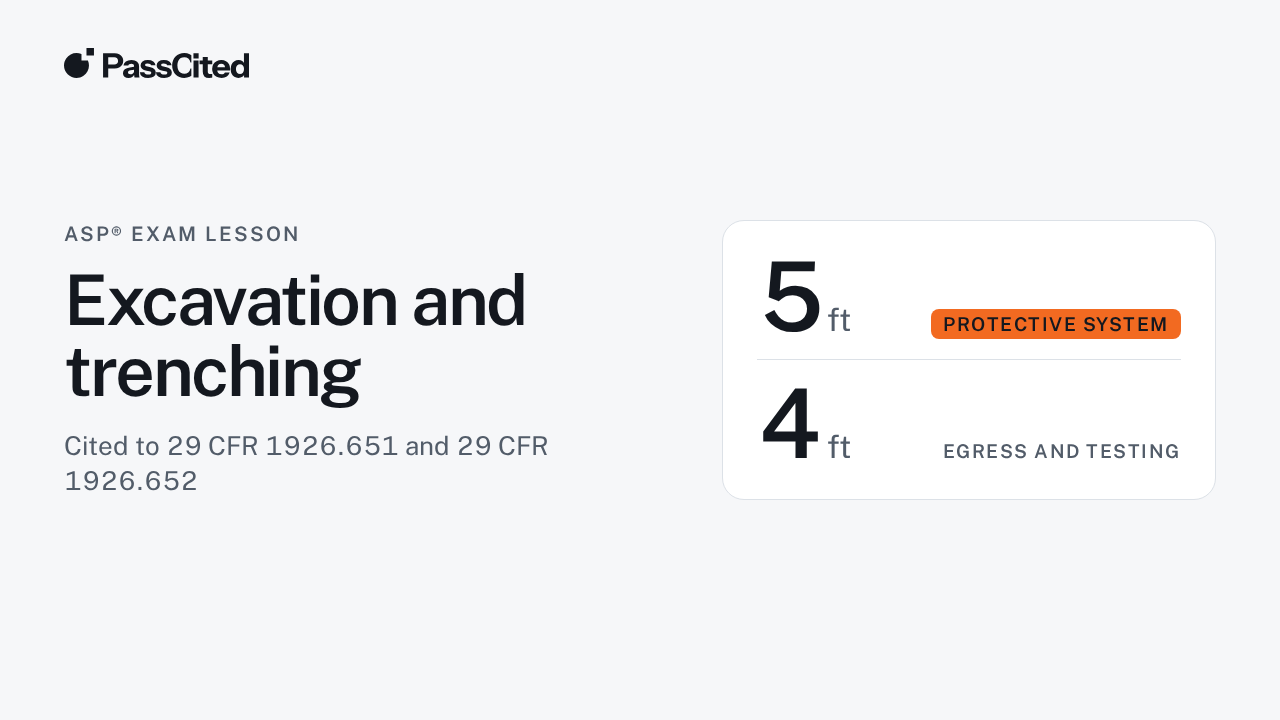 Excavation and trenchingASP lesson, 6:52ASP exam review of 29 CFR 1926 Subpart P: the 5-foot and 4-foot thresholds, utility locates, daily inspections, soil types, maximum allowable slopes, and who does what.
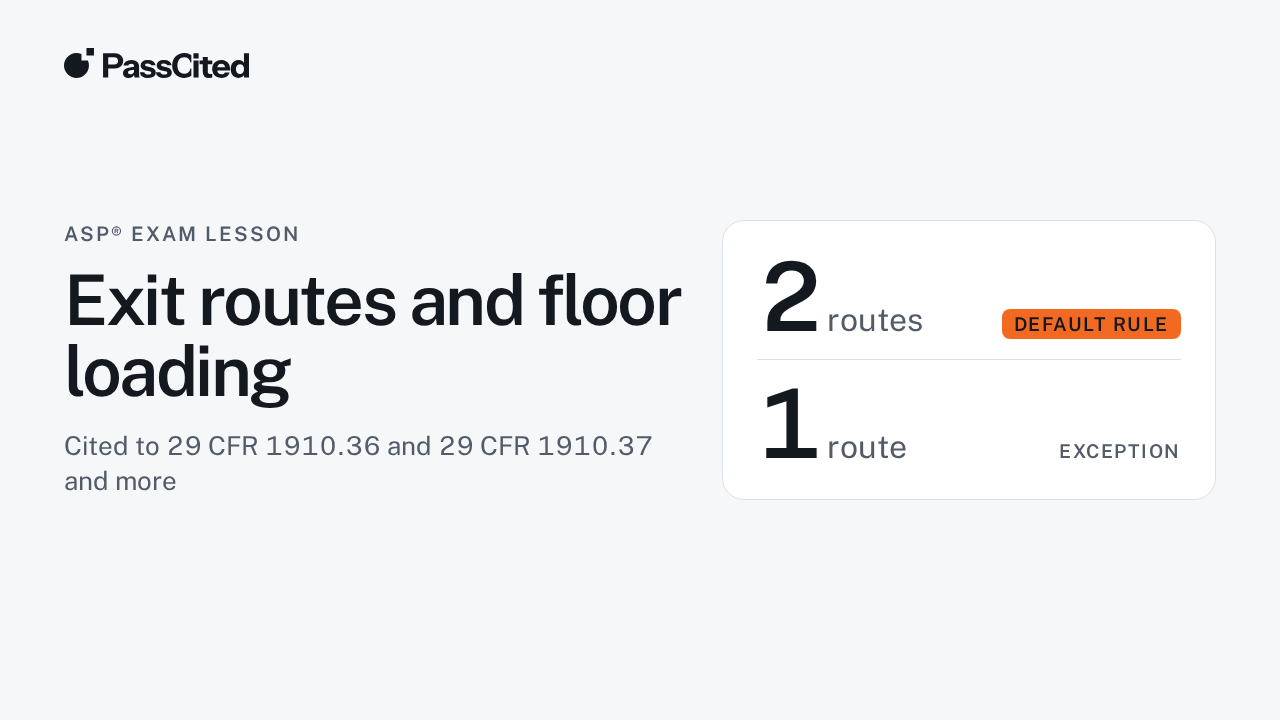 Exit routes and floor loadingASP lesson, 5:55The ASP-tested rules for exit routes under 29 CFR 1910.36 and 1910.37, plus the walking-working surface load and repair rules in 1910.22: counts, dimensions, doors, signs and who repairs.
See where you stand on the ASP
25 questions, free, no card. You get a readiness score for each ASP domain.
ASP®, CSP® and CHST® are registered marks of BCSP. PassCited is not affiliated with or endorsed by BCSP.