Incident and DART rate calculations
CSP video lesson, 6:21. CSP Domain 2: Program Management
Calculate TRIR and DART as cases per 100 full-time workers using the 200,000-hour base. Learn what counts in each numerator, work through examples, and avoid the common CSP exam traps.
Included with every pass, and free to watch with captions. Every rule and number is cited on screen to its primary source.
Transcript
0:00 Intro
Incident and DART rate calculations, for the CSP exam. Every rule and number here is cited to its primary source, on screen.
0:09 Learning objectives
In this lesson, you'll learn to: state the incidence rate formula and its 200,000-hour base, decide which cases count in the TRIR numerator, identify the days away, restricted or transferred cases that make up DART, and calculate a rate and read it as cases per 100 full-time workers.
0:32 The base formula
Every rate starts with one formula from BLS. Learn it once, and both TRIR and DART follow. Cases times 200,000, divided by employee hours worked, equals the incidence rate. The 200,000 hours equal 100 employees working 40 hours a week, 50 weeks a year. Both TRIR and DART use this same base, so only the numerator changes.
1:05 What counts in TRIR
0 means three cases per 100 full-time workers. TRIR counts recordable cases. 7, a case is recordable if it results in any of six outcomes. The numerator is the count of those cases. Death, days away from work, and restricted work or transfer.
1:34 What counts in DART
Medical treatment beyond first aid, and loss of consciousness. Also a significant injury or illness diagnosed by a physician or other licensed professional, even without the other outcomes.
1:50 Counting days
DART uses the same formula, with a narrower numerator. BLS defines it as cases with time off, or transfer or restricted duties. So medical treatment only, and loss of consciousness alone, fall outside it. Three counting rules explain many exam questions, because they decide how days are counted and whether a restriction is recorded at all.
2:16 Worked example: TRIR
You begin counting days away on the day after the injury occurred or the illness began. A restriction or transfer imposed only for the day of injury need not be recorded. Weekends and holidays still count as days away if the employee could not have worked them.
2:47 Worked example: DART
Example: a plant logs 6 recordable cases and 400,000 hours worked. We want the total recordable incident rate, TRIR. Multiply 6 cases by 200,000. Divide 1,200,000 by 400,000 hours. 0: three recordables per 100 full-time workers. Check: 400,000 hours is twice the base, so the rate is half the case count.
3:21 On the job
Same plant: of the 6 recordables, 2 involved days away and 1 involved restriction. The other 3 were medical treatment only, so DART cases total 3. Add days-away and restricted cases; leave treatment-only cases out. Multiply 3 by 200,000, then divide by 400,000 hours. 5, half the TRIR, because only half the recordable cases qualify. Same hours, same base, smaller numerator. You're the safety manager at a metal fabrication shop.
4:02 Common exam traps
Year-end: 5 recordables, 3 with days away or restriction, and 250,000 hours. Management wants both rates. 0. 4. Report both, read as cases per 100 full-time workers. TRIR uses all recordables; DART uses only the days-away, restricted, and transfer cases. Now, five traps that catch people on exam day. One: the base is 200,000 hours, not 100,000. Using 100,000 would double every rate. Two: DART is a subset of TRIR, not every recordable.
4:43 Recap quiz
It can never exceed TRIR. Three: count days away starting the day after the injury. Four: a restriction or transfer for only the day of injury need not be recorded as restricted work. Five: weekends and holidays count in days away if the injury kept the employee from working them. Question 1. Which recordable case is counted in TRIR but not in DART? A: one day away. B: restricted work. C: medical treatment only. D: job transfer. C. Treatment beyond first aid with no lost time or restriction is recordable, so it counts in TRIR, but it falls outside DART. Question 2. A site logs 4 recordables and 200,000 hours. What is the TRIR? 0. 0. 0. 5. 0. With 200,000 hours, the base cancels, so the rate equals the number of cases. Question 3. A company has 3 DART cases and 600,000 hours. What is the DART rate? 0. 5. 0. 5. 0. Three times 200,000 is 600,000, divided by 600,000 hours. Option D used the wrong hours. Want to see where you stand on every CSP domain? com.
More CSP lessons
 Incident investigation and management of changeCSP lesson, 6:31CSP exam review of OSHA PSM 1910.119: the 48-hour investigation start, team makeup, report contents, five-year retention, management of change rules, and compliance audits.
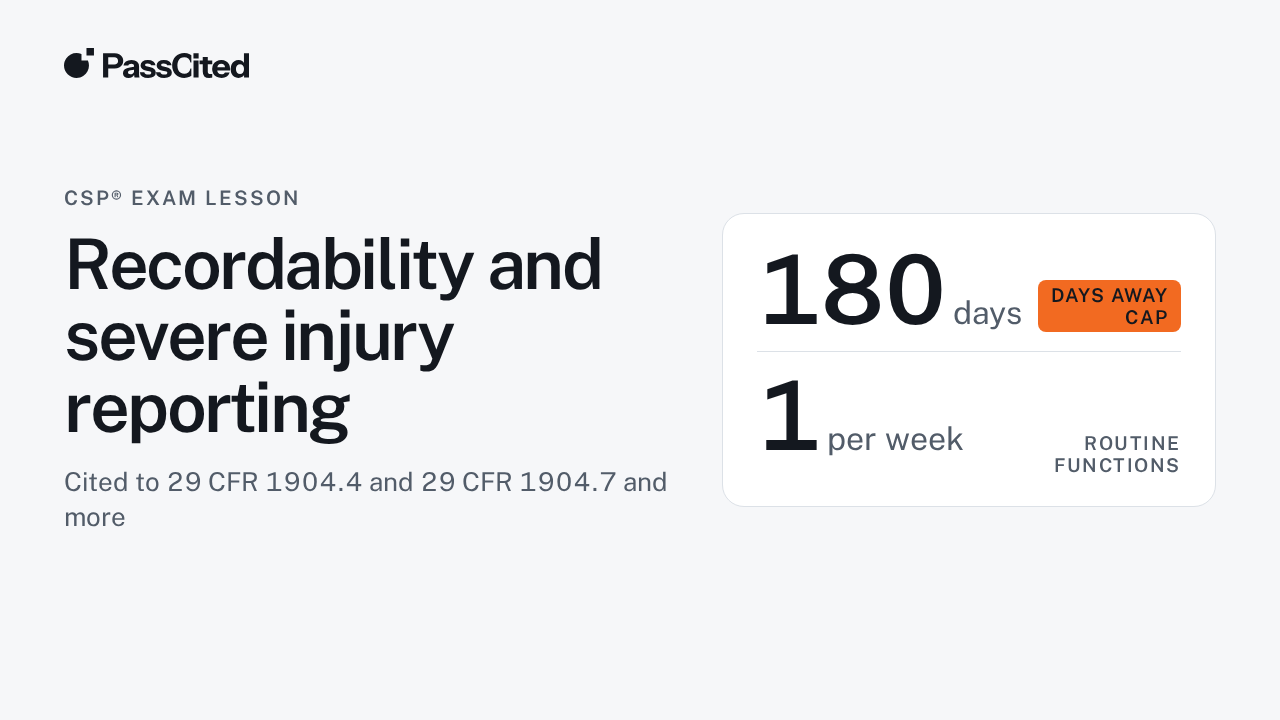 Recordability and severe injury reportingCSP lesson, 6:53CSP exam review of OSHA recordkeeping: the general recording criteria, first aid versus medical treatment, restricted work, the 8-hour and 24-hour reporting deadlines, and the incidence rate formula.
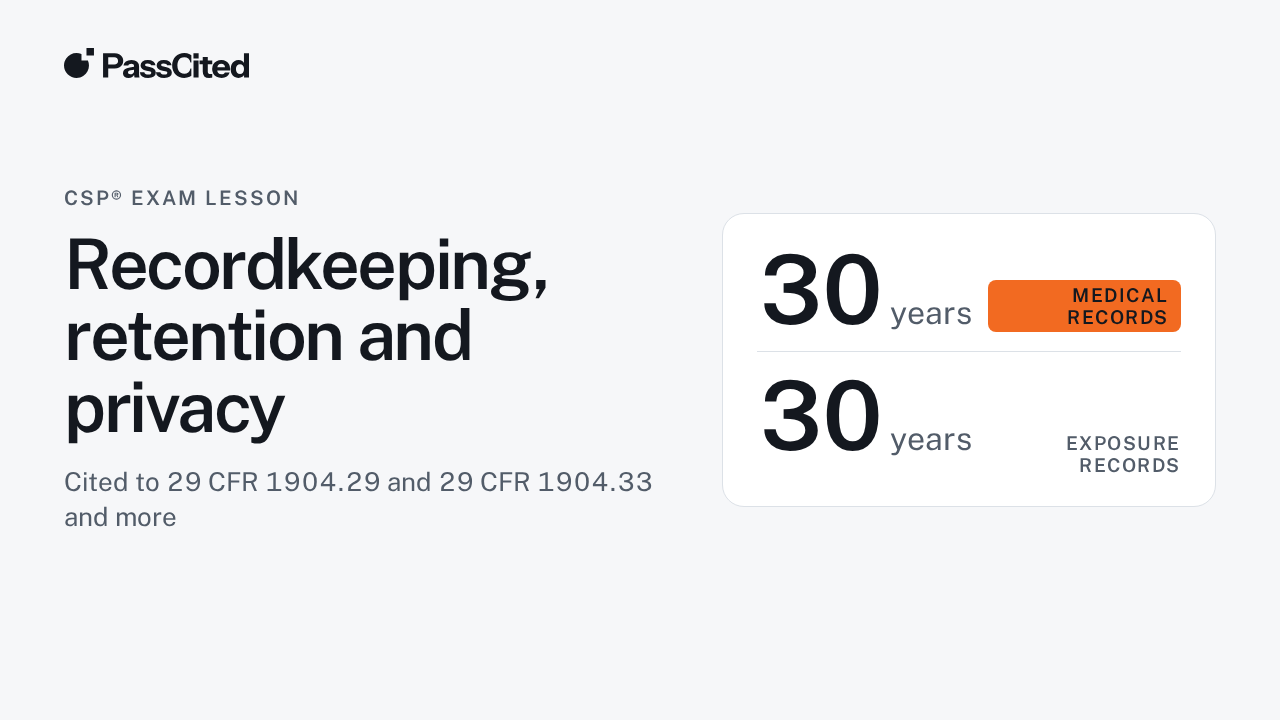 Recordkeeping, retention and privacyCSP lesson, 5:52OSHA 300, 300-A and 301 forms, five-year retention, privacy concern cases, and 1910.1020 exposure and medical record retention and access: the numbers and rules tested on the CSP exam.
See where you stand on the CSP
25 questions, free, no card. You get a readiness score for each CSP domain.
ASP®, CSP® and CHST® are registered marks of BCSP. PassCited is not affiliated with or endorsed by BCSP.