Machine guarding, grinders and portable tools
CSP video lesson, 6:53. CSP Domain 1: Advanced Application of Safety Principles
CSP exam review of OSHA machine guarding, abrasive wheel guard exposure angles, work rests, flanges, the ring test, fan blade guards and compressed air limits under 1910.212, .215 and .242.
Included with every pass, and free to watch with captions. Every rule and number is cited on screen to its primary source.
Transcript
0:00 Intro
Machine guarding, grinders and portable tools, for the CSP exam. Every rule and number here is cited to its primary source, on screen.
0:12 Learning objectives
In this lesson, you'll learn to: state the machine guarding and point of operation rules, apply the fan blade and compressed air limits, know the grinder work rest and guard exposure numbers, and explain flange sizing and the ring test.
0:31 1910.212 · General machines
212, guarding must protect the operator and others in the machine area. Hazards include point of operation, nip points, rotating parts, and flying chips and sparks. Guards are affixed to the machine where possible, secured elsewhere if not, and must not be a hazard themselves.
0:58 1910.212(a)(3) · Point of operation
Point of operation is where work is actually performed on the material. If the point of operation exposes an employee to injury, it shall be guarded. Absent a specific standard, it must prevent the operator having any part of his body in the danger zone during the operating cycle.
1:24 1910.212 · Fans and drums
Special handtools for placing and removing material only supplement guarding, never replace it. Portable power tools usually require point of operation guarding. Fan blades must be guarded when the blade periphery is less than 7 feet above the floor or working level.
1:46 1910.215 · Abrasive wheels
The guard openings can be no larger than one-half inch. Revolving drums, barrels and containers need an enclosure interlocked with the drive, so they cannot revolve unless it is in place. Abrasive wheels are used only on machines with safety guards, with narrow exceptions.
2:14 1910.215(b) · Guard exposure
One exception: mounted wheels in portable operations, 2 inches and smaller in diameter. On offhand grinders, the work rest opening is one-eighth inch maximum, so work can't jam and break the wheel. Never adjust the rest with the wheel in motion; clamp it securely after each adjustment. Each listed grinder type has a maximum angular exposure of the wheel periphery and sides. Bench and floor stands: should not exceed 90 degrees, beginning not more than 65 above the spindle plane. Contact below it allows 125. Cylindrical grinders: 180 degrees, beginning not more than 65 degrees above the spindle plane.
3:06 1910.215(c) · Flanges
Surface grinders using the periphery, and cutting-off machines: 150 degrees, beginning not less than 15 below the spindle plane. Swing frame and automatic snagging: 180 degrees, top half always enclosed. Top grinding, work above centerline: 60 degrees. Abrasive wheels are generally mounted between flanges not less than one-third the wheel diameter.
3:36 1910.215(d) · Mounting
Exceptions include Types 27 and 28. Type 1 cutting-off: at least one-fourth. Type 27A: under one-third, never under one-fourth. Both flanges normally match in diameter and bearing surface. Blotters spread flange pressure, with listed exceptions. Immediately before mounting, the user inspects and sounds every wheel: the ring test. Check that the spindle speed does not exceed the maximum operating speed marked on the wheel.
4:12 1910.242 · Hand and portable tools
Tap gently with a nonmetallic implement. A cracked wheel sounds dead and shall not be used. Wheels must be dry and free from sawdust.
4:32 Common exam traps
Tap 45 degrees each side of vertical, 1 or 2 inches from the periphery, then rotate 45 degrees and repeat. The employer is responsible for the safe condition of tools, including employee-furnished tools. i. Even then, it requires effective chip guarding and personal protective equipment. Now, five traps that catch people on exam day. One: special handtools only supplement guarding. Two: fan blades under 7 feet above the floor or working level are guarded, openings no larger than one-half inch.
5:15 Recap quiz
Three: the work rest gap is one-eighth inch maximum, not one-fourth. Never adjust it with the wheel moving. Four: flanges are generally one-third, but listed exceptions exist, such as Type 1 and Type 27A cutting-off wheels at one-fourth. , with chip guarding and PPE. Question 1. What is the maximum work rest opening on an offhand grinder? A: one-eighth inch. B: one-fourth inch. C: one-sixteenth inch. D: one-half inch. A. One-eighth inch prevents the work jamming between wheel and rest. Question 2. A fan's blade periphery is 6 feet above the floor. What is required? A: no guard. B: only if someone is nearby. C: openings no larger than 1 inch. D: openings no larger than half an inch. D. Under 7 feet, blades are guarded with openings no larger than one-half inch. Question 3. A bench grinder wheel must be touched below the spindle plane. Maximum guard exposure? A: 60 degrees. B: 90 degrees. C: 125 degrees. D: 180 degrees. C. Contact below the spindle plane allows up to 125 degrees. Want to see where you stand on every CSP domain? com.
More CSP lessons
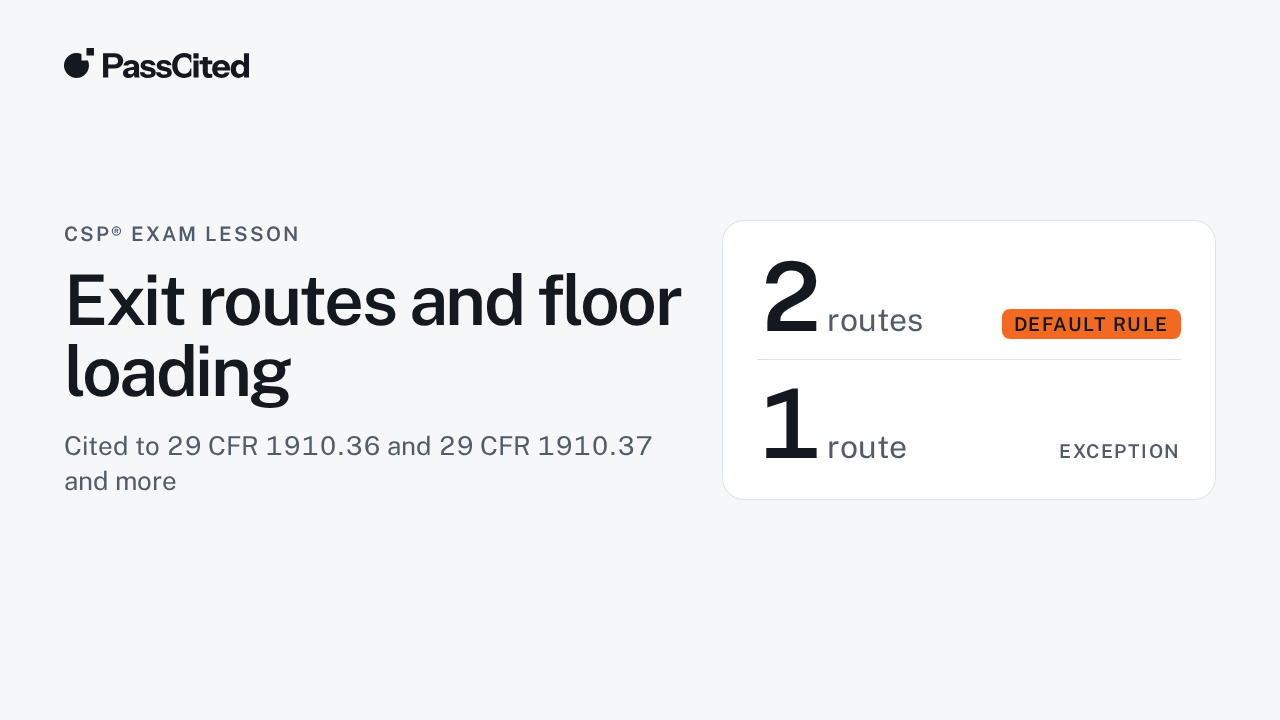 Exit routes and floor loadingCSP lesson, 6:43The CSP-tested rules for exit routes under 29 CFR 1910.36 and 1910.37, plus the walking-working surface load and repair rules in 1910.22: counts, dimensions, doors, signs and who repairs.
 Fleet safety: driver hours, drug and alcohol rulesCSP lesson, 6:48Driver hours-of-service limits for property-carrying CMVs and DOT alcohol and drug rules: the 0.04 alcohol level, pre-employment testing, and the numbers the CSP exam tests.
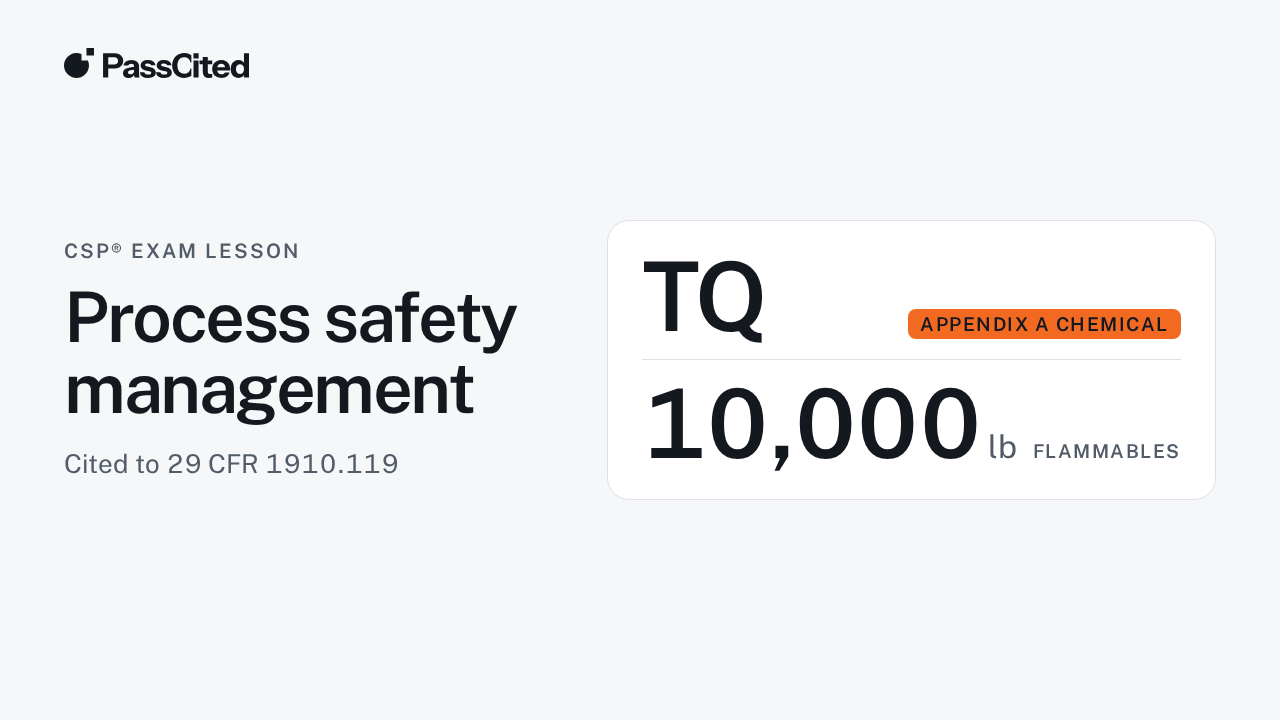 Process safety managementCSP lesson, 7:20PSM under 29 CFR 1910.119 for the CSP exam: coverage thresholds, process safety information, PHA, management of change, pre-startup review, audits and the key time limits.
See where you stand on the CSP
25 questions, free, no card. You get a readiness score for each CSP domain.
ASP®, CSP® and CHST® are registered marks of BCSP. PassCited is not affiliated with or endorsed by BCSP.