Recordability and severe injury reporting
CSP video lesson, 7:10. CSP Domain 2: Program Management
CSP exam review of OSHA recordkeeping: the general recording criteria, first aid versus medical treatment, restricted work, the 8-hour and 24-hour reporting deadlines, and the incidence rate formula.
Included with every pass, and free to watch with captions. Every rule and number is cited on screen to its primary source.
Transcript
0:00 Intro
Recordability and severe injury reporting, for the CSP exam. Every rule and number here is cited to its primary source, on screen.
0:11 Learning objectives
In this lesson, you'll learn to: apply the general recording criteria, separate first aid from medical treatment, state the OSHA reporting deadlines and exceptions, and calculate an incidence rate.
0:28 Recording criteria
A case is recorded when it passes three tests. One: it is work-related. Two: it is a new case. Three: it meets the general recording criteria, or the specific-case rules for needlestick, hearing loss and similar cases.
0:47 General criteria
7, a work-related case is recordable if it results in any of these. Death, days away from work, and restricted work or job transfer. Medical treatment beyond first aid, and loss of consciousness, regardless of how long. Also significant diagnosed cases, recorded at diagnosis: cancer, chronic irreversible disease, a fractured or cracked bone, or a punctured eardrum.
1:19 First aid vs. treatment
First aid is a complete list: nothing outside it counts as first aid. Observation-only visits and diagnostic tests such as x-rays are not medical treatment either. Non-prescription medication at non-prescription strength, tetanus shots, bandages and butterfly strips, and hot or cold therapy are first aid. Prescription strength, other vaccines, sutures and staples, and rigid-stay devices are medical treatment.
1:58 Counting days
Provider status does not matter: a listed treatment stays first aid even from a physician. Restricted days are counted like days away, except a permanent job change that eliminates the restricted routine functions can stop the count, after at least one day. Start counting the day after the injury. Count calendar days, including weekends and days off the employee could not have worked. You may cap the total at 180. Restricted work affects routine functions, done at least once per week, or the full shift.
2:37 Severe injury reporting
A restriction or transfer imposed only on the injury day does not have to be recorded as restricted work. Reporting to OSHA is separate from recording, with its own deadlines. A work-related fatality must be reported within 8 hours. An in-patient hospitalization, an amputation, or a loss of an eye must be reported within 24 hours.
3:09 Reporting details
Delayed events are reportable only within a window: a fatality within 30 days; the other three within 24 hours of the incident. They are still recorded. Report by phone or in person to the nearest Area Office, by the toll-free number, or online.
3:31 Definitions and exceptions
If the Area Office is closed, a message, fax or email does not work. Use the 800 number or the website. If you learn late, the clock starts when it is reported to you or any of your agents. Know these definitions and exceptions. In-patient hospitalization is a formal admission for care or treatment. Observation or diagnostic testing only is not reportable. Amputation is traumatic loss of a limb or external body part, including fingertips with or without bone loss.
4:08 Incidence rate
Avulsions and severed ears are excluded. Public-road crashes outside construction work zones, and commercial or public transportation incidents, are not reported, but are recorded if you are required to keep records. Incidence rate equals cases times 200,000, divided by employee hours worked. The 200,000 is 100 employees working 40 hours a week, 50 weeks a year.
4:45 Common exam traps
Example: 6 recordable cases over 380,000 hours. 6 times 200,000 is 1,200,000. 2. The same formula works for just the serious cases: days away, restriction, or transfer. Now, six traps that catch people on exam day. One: a listed first-aid treatment stays first aid even from a physician. Two: count calendar days away, including days off the employee could not have worked. Three: fatalities are 8 hours. Hospitalization, amputation and loss of an eye are 24 hours.
5:29 Recap quiz
Four: record the case even if the employee ignores the recommendation. Five: loss of consciousness is recordable regardless of how long it lasts. Six: a public-road crash outside a construction work zone is not reported, but is recorded if you are required to keep records. Question 1. A worker is admitted to a hospital for care after a work-related incident. Reporting deadline? A: Eight hours. B: Twenty-four hours. C: Seven days. D: Thirty days. B. Hospitalization is reported within 24 hours; eight is for fatalities. Question 2. Which treatment is medical treatment beyond first aid? A: Tetanus immunization. B: Hot or cold therapy. C: Sutures or staples. D: An adhesive bandage. C. Sutures and staples are wound closing devices: medical treatment. Question 3. After a work-related injury, a physician says stay home three weeks; the employee returns Monday. How is it recorded? A: Not recorded. B: First aid. C: Days away, recommended days. D: Restricted work only. C. Days away are recorded whether or not the employee follows the recommendation. Want to see where you stand on every CSP domain? com.
More CSP lessons
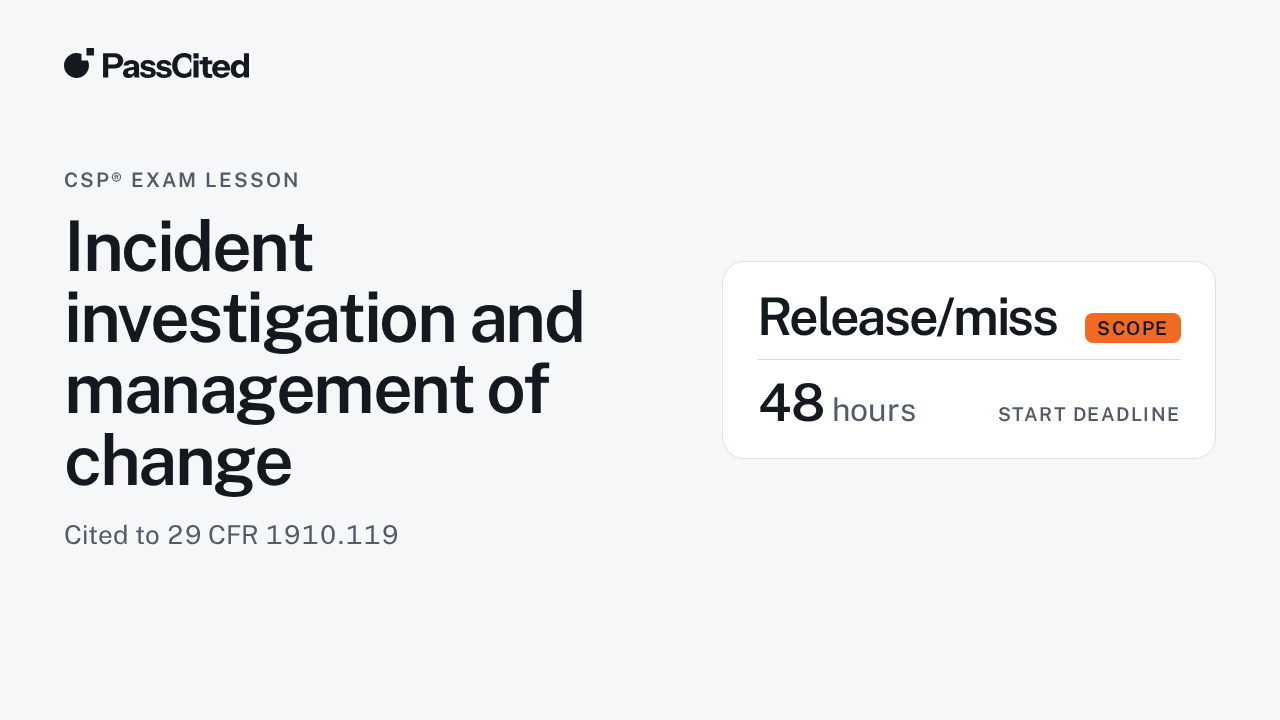 Incident investigation and management of changeCSP lesson, 6:34CSP exam review of OSHA PSM 1910.119: the 48-hour investigation start, team makeup, report contents, five-year retention, management of change rules, and compliance audits.
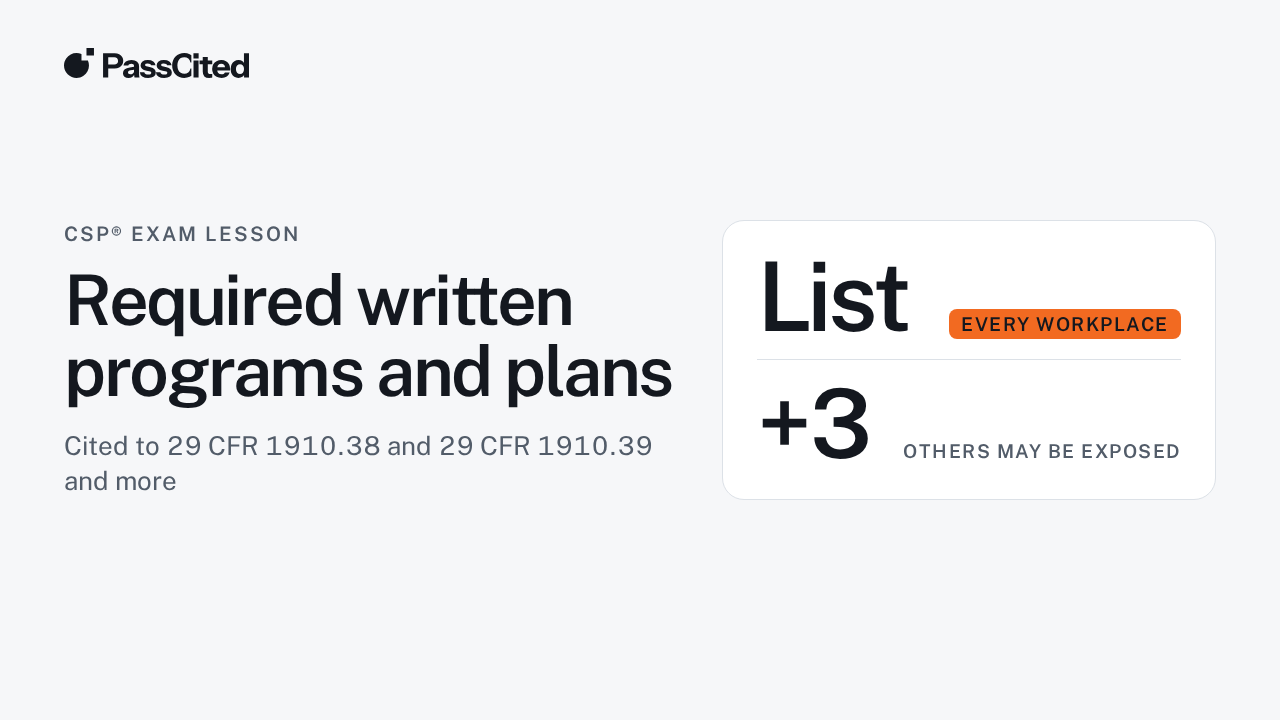 Required written programs and plansCSP lesson, 7:19What OSHA requires in writing: emergency action plans, fire prevention plans, hazard communication and respiratory protection programs, including minimum elements, the 10-employee oral exception and who administers.
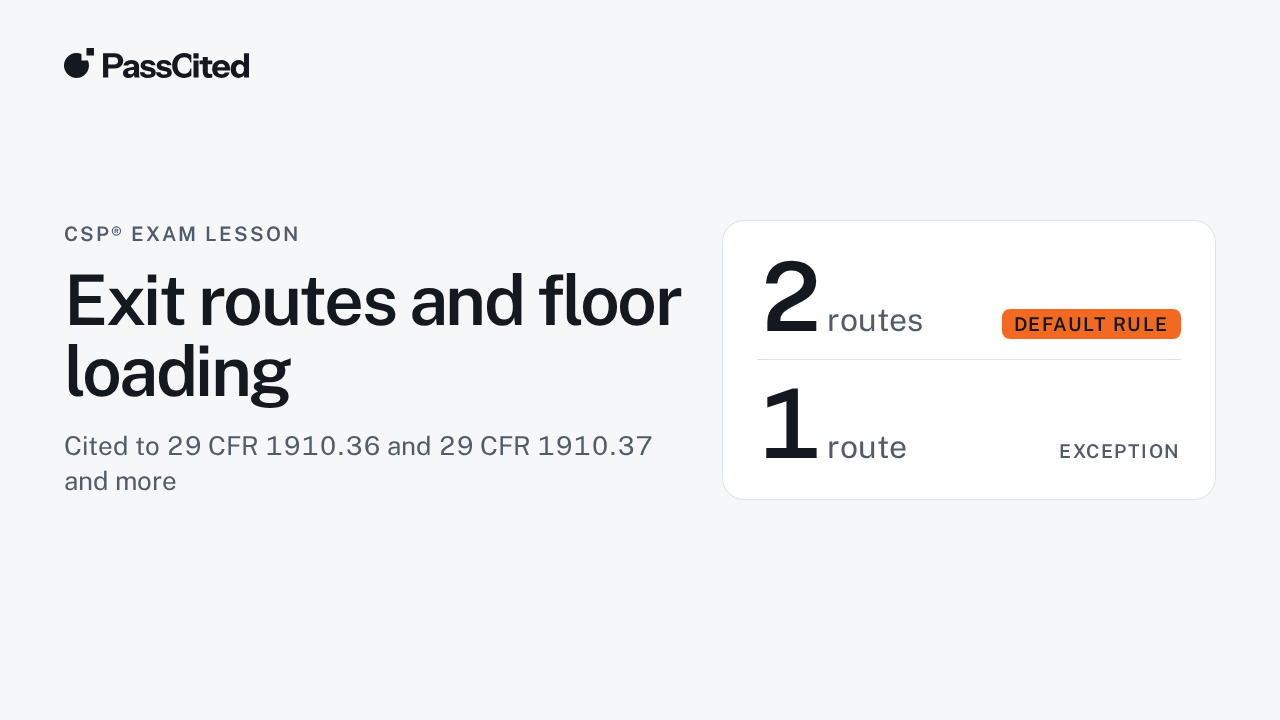 Exit routes and floor loadingCSP lesson, 6:43The CSP-tested rules for exit routes under 29 CFR 1910.36 and 1910.37, plus the walking-working surface load and repair rules in 1910.22: counts, dimensions, doors, signs and who repairs.
See where you stand on the CSP
25 questions, free, no card. You get a readiness score for each CSP domain.
ASP®, CSP® and CHST® are registered marks of BCSP. PassCited is not affiliated with or endorsed by BCSP.