Recordkeeping, retention and privacy
CSP video lesson, 5:52. CSP Domain 2: Program Management
OSHA 300, 300-A and 301 forms, five-year retention, privacy concern cases, and 1910.1020 exposure and medical record retention and access: the numbers and rules tested on the CSP exam.
Included with every pass, and free to watch with captions. Every rule and number is cited on screen to its primary source.
Transcript
0:00 Intro
Recordkeeping, retention and privacy, for the CSP exam. Every rule and number here is cited to its primary source, on screen.
0:09 Learning objectives
In this lesson, you'll learn to: name the injury forms and the seven-day recording deadline, list the privacy concern cases and how to protect names, state the five-year and thirty-year retention periods, and apply the access rules for exposure and medical records.
0:27 Part 1904 forms
Three forms. The 300 Log lists each recordable case in a line or two. The 300-A summarizes the year. The 301 Incident Report is completed for each case on the Log. Enter each case within seven calendar days of receiving information that it occurred.
0:45 Form flexibility
You must use OSHA forms or equivalent forms. An equivalent form has the same information, is as readable, and uses the same instructions.
0:59 Privacy concern cases
Records may be kept on a computer if it can produce equivalent forms when needed. Some cases are privacy concern cases. You must not enter the name on the Log. The list is complete. Intimate body parts or the reproductive system, sexual assault, and mental illnesses. Also HIV, hepatitis or tuberculosis, and needlesticks or sharps cuts contaminated with another person's blood or other potentially infectious material.
1:29 Protecting identity
Plus other illnesses if the employee voluntarily asks. No other cases may be added. On the Log, write “privacy case” instead of the name. Keep a separate, confidential list of case numbers and names. If the person may still be identified, you may use discretion in describing the case, but still identify cause and general severity.
1:57 Retention: injury records
Voluntary disclosure to others requires removing or hiding names and identifying information, with limited exceptions: a hired auditor or consultant, or as necessary for insurance claims. Save the 300 Log, the privacy case list, the annual summary and the 301 reports. Keep them five years following the end of the calendar year they cover.
2:18 1910.1020 retention
During storage, you must update the Log for newly discovered cases and classification changes. The summary and the 301 reports need not be updated. 1020 covers exposure and medical records. Retention is longer than for the Log.
2:39 Retention exceptions
Medical records: at least the duration of employment plus 30 years. Exposure records: at least 30 years. Lab background data needs only 1 year if results, methods and a background summary are kept 30. Some medical records need no specified retention period. Separate health insurance claims records, and minor one-time first aid records made on-site by a non-physician and kept separately from the medical program.
3:08 Access to records
Employees with under one year of service: records need not be kept beyond employment if given to the employee at termination. Analyses using exposure or medical records: 30 years. Chest X-ray films stay in their original state. Employees and designated representatives may request access.
3:31 On the job
Access must be provided in a reasonable time, place and manner. If access can't be provided within 15 working days, explain the reason and earliest date within those 15 days. The first copy must be free, or copying facilities provided free, or the record loaned. You're the safety manager at a plant.
3:55 Common exam traps
A worker reports a needlestick from a sharp contaminated with another person's blood. First, record it on the 300 Log and 301 within seven calendar days. It's a privacy concern case, so write “privacy case” for the name and keep a separate confidential list. Then retain the forms and the list for five years after the calendar year ends. Now, five traps that catch people on exam day. Employers may not add other privacy cases.
4:29 Recap quiz
The list is complete. Five years runs from the end of the calendar year, not the incident date. Only the Log must be updated. The summary and 301 are optional. 1020 run employment plus 30 years, not five. Records access: reasonable time, with a fifteen working day explanation point. Seven days is the Log entry deadline. Question 1. By when must a recordable case be entered on the 300 Log and 301? A: At the end of the shift. B: 7 calendar days of receiving information. C: Within 30 calendar days. D: End of the year. B. Within seven calendar days of receiving information that the case occurred. Question 2. Which case is NOT a privacy concern case? A: Mental illness. B: Contaminated needlestick. C: Broken wrist from a fall. D: Injury from a sexual assault. C. A broken wrist isn't listed, and the list is complete. Question 3. A worker's exposure monitoring results are on file. Minimum retention? A: 5 years. B: 1 year. C: 30 years. D: Duration of employment only. C. Exposure records are kept at least 30 years. Want to see where you stand on every CSP domain? com.
More CSP lessons
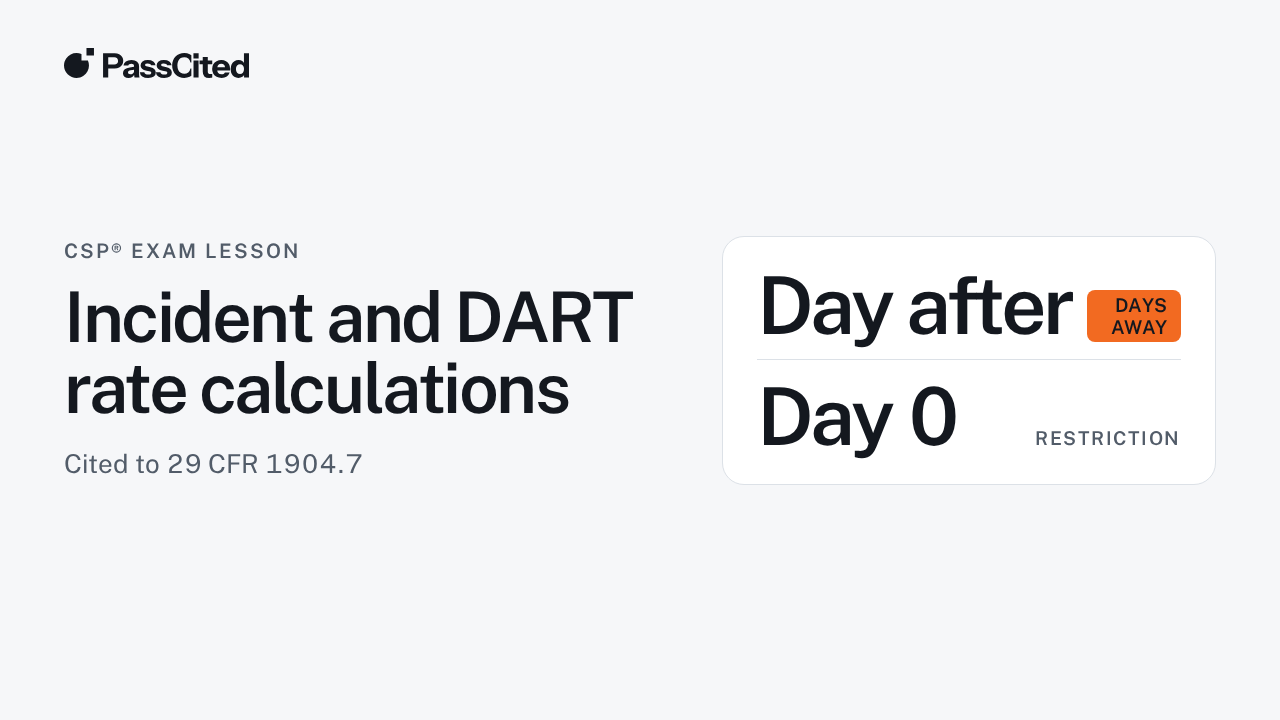 Incident and DART rate calculationsCSP lesson, 6:21Calculate TRIR and DART as cases per 100 full-time workers using the 200,000-hour base. Learn what counts in each numerator, work through examples, and avoid the common CSP exam traps.
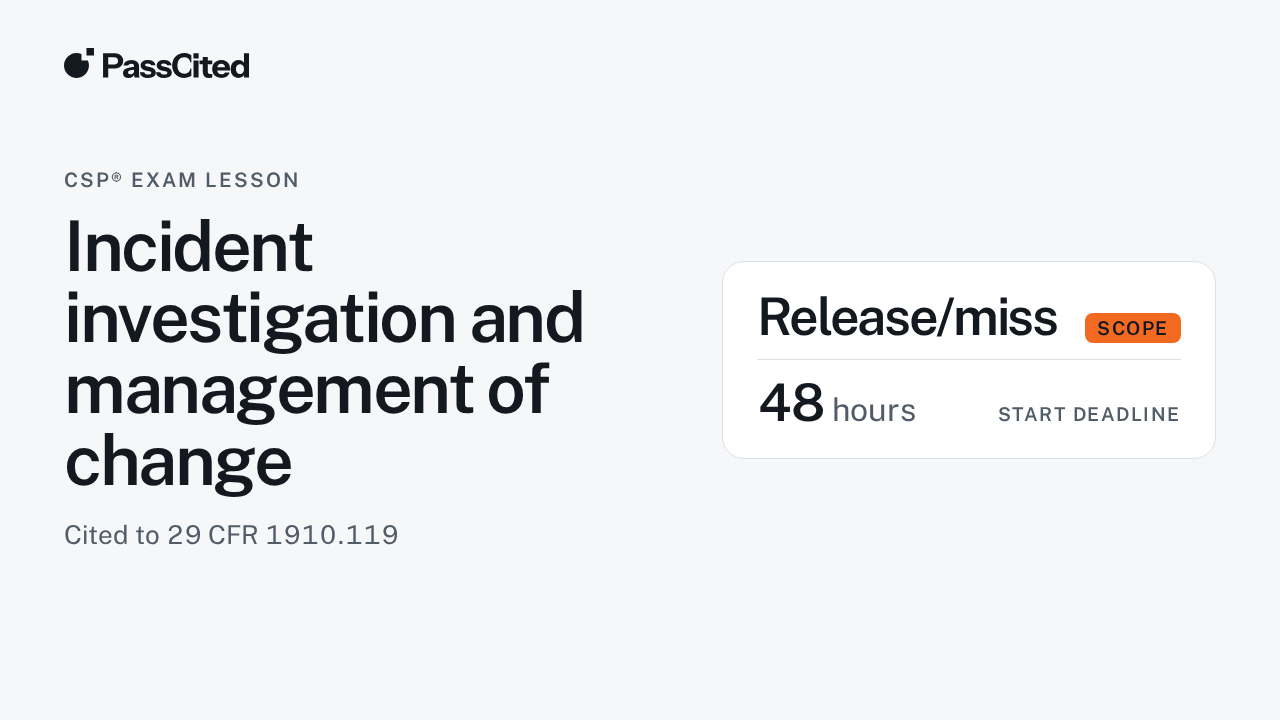 Incident investigation and management of changeCSP lesson, 6:31CSP exam review of OSHA PSM 1910.119: the 48-hour investigation start, team makeup, report contents, five-year retention, management of change rules, and compliance audits.
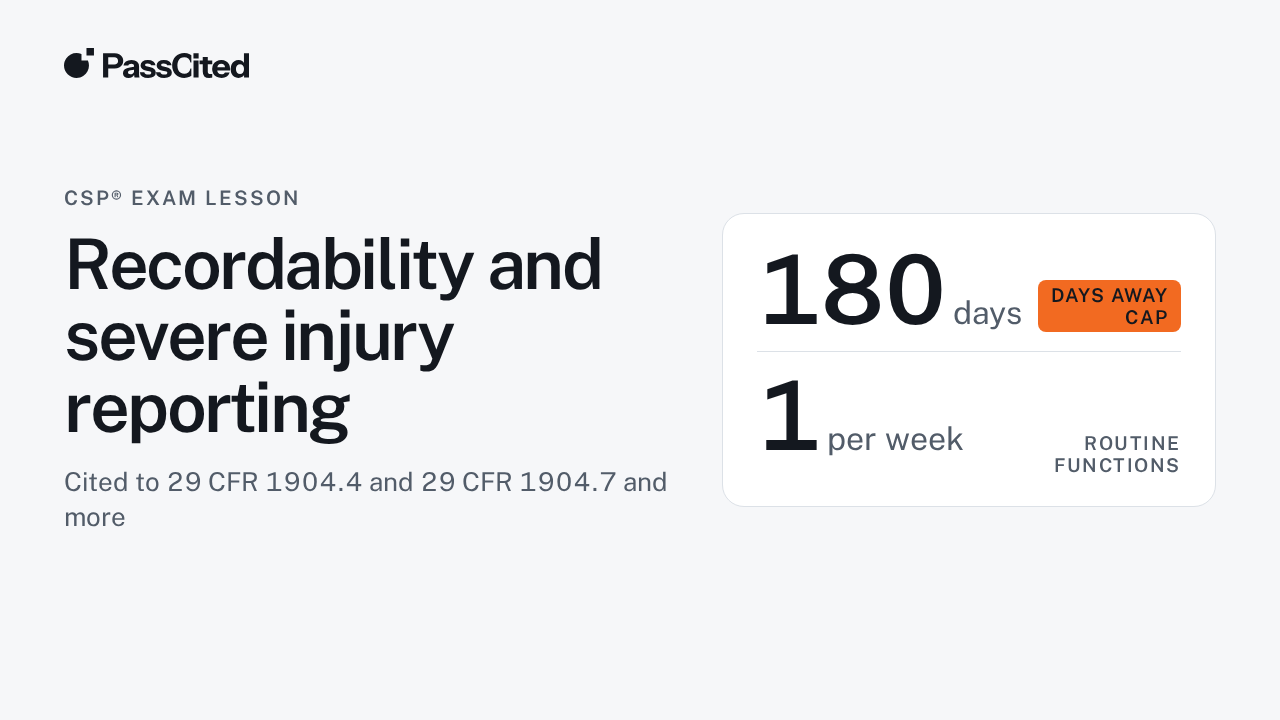 Recordability and severe injury reportingCSP lesson, 6:53CSP exam review of OSHA recordkeeping: the general recording criteria, first aid versus medical treatment, restricted work, the 8-hour and 24-hour reporting deadlines, and the incidence rate formula.
See where you stand on the CSP
25 questions, free, no card. You get a readiness score for each CSP domain.
ASP®, CSP® and CHST® are registered marks of BCSP. PassCited is not affiliated with or endorsed by BCSP.